
AGVs and robotics
Controlled as if by magic
AGVs, or driverless transport systems, have been used in automotive engineering since the 1980s. While this technology has established itself in transmission and engine construction, there are only a few applications in body construction today due to the initially unreliable and expensive technology, report the AGV experts at Tünkers.

However, the current demand for more flexibility with the objective of a "freely programmable" factory - software systems instead of hardware systems - now also makes AGVs interesting for the body shop. These AGV-driven factory layouts are a particular challenge, as it were, because classic conveyor belts and shuttle systems have to be substituted. Different formats can be transported with the help of driverless transport systems: Small parts are transported in boxes, stacking containers, conveyor belts or accumulation belts. Large parts such as side walls or floor assemblies can be transported as individual parts on carriers/skids or direct pick-up technology/clamping technology (substructure). Last but not least, small parts are also moved in standardized trays or Euro pallets.
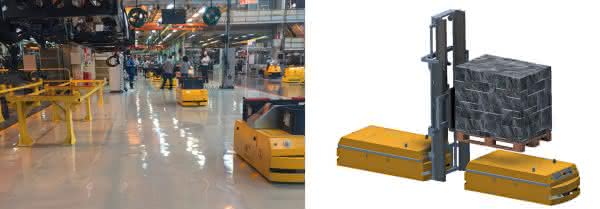
The mechanical engineering company Tünkers is currently offering various automation solutions in cooperation with the AGV specialist Sinova from Brazil. In addition to supply AGVs for transporting parts between inventory and production lines and transport AGVs for transporting parts through aisles and corridors despite the movement of people and other vehicles, Tünkers engineers are also installing process line AGVs for safe processing and assembly directly on the AGV. For this purpose, platforms are equipped with different clamping and gripping technology from the Tünkers modular system. In addition to the platforms for assembly lines, the Tünkers program also includes tugs, underride tugs, roller conveyors and stackers for coupling with the AGVs.
Optimize processes with accumulation conveyor AGVs
The freely navigable accumulating conveyor AGV is a successful Tünkers development that allows free design of the factory or cell layout. Each AGV is used as an additional component buffer and can be loaded by the worker, the robot or directly by a connected accumulating conveyor. The latter option saves time, as loading and unloading can be carried out in just one step. Even longer distances, non-linear conveying or conveying through several building complexes are no problem for the accumulating conveyor AGV. The applications are supplemented by the use of the pneumatic fine positioning system developed by Tünkers. The MCP 80 coupling element enables the unique fine positioning of +/- 0.1 mm.
Navigation options
The heart of an AGV is an industrial PC that manages the entire system logic. It is connected to the control units, controllers, sensors and actuators, which communicate via various communication protocols such as Ethernet, EtherCAT, RS232 and optionally CAN bus.
The AGV has a camera system located on the floor of the vehicle. This is used to identify the optical signals or contrasts required for orientation. An automatic error correction takes place via a control circuit, which is converted into movement signals of the AGV.
The systems can be navigated by induction, optics or laser. While induction navigation requires a structurally complex measure to embed the cable in the ground, the other two solutions do not require any structural adjustments. Optical navigation is carried out via a simple track guide applied to the floor, which is recognized by the AGV via a camera with LED lighting.
Opto-electronic laser scanners, on the other hand, are mounted on the AGV to enable the modern form of laser navigation via strategically placed reflective mirrors along the route. To implement the laser control, the surroundings are scanned with a vehicle and a 2D map of the environment is generated, which can be processed on the PC. The latest navigation option offered by Tünkers is control via ultra-wideband (UWB). UWB is a new type of wireless technology that is not bound to any frequency and is hardly susceptible to interference. It therefore opens up unused capacities in the electromagnetic spectrum. With UWB, data can be transmitted over an extremely broad frequency spectrum.
Safety always comes first
To ensure that humans and robots can work together safely, the AGV is equipped as standard with safety components for speed control, anti-collision control, monitoring of control times and emergency stop switches, and the AGV's surroundings are monitored by a laser system within a radius of up to seven meters. As soon as an obstacle is detected or an object enters the programmed safety zone, the laser system is triggered and the AGV is redirected or machine operation is stopped.
With the right design layout, the electronic-optical version achieves a safety category of SIL 3, 2 and PLD for object detection. In addition, the status of the AGV is continuously monitored and rapid identification of system failures is ensured. This reduces the risk of failure many times over compared to conventional systems.
Despite all the safety-supporting technology, the area around the AGVs must also meet certain requirements so that the vehicles can operate safely, correctly and without interruption. For example, the track must always be kept clean, free of objects, greasy and oily areas, liquids or contaminants that could impair contact between the AGV's drive wheels and the ground.


You might also be interested in
Standardized in design, flexible in use
Automated guided vehicles are increasingly in demand in production and logistics as they automate processes efficiently - but in addition to the vehicle, the right peripherals are also crucial for safe operation. A new solution consisting of a...
 read more...
Outdoor AGV networks production and logistics
An international company in the plastics industry is automating its intralogistics at its German site with a solution from ek robotics. A specially developed vehicle model from the Out Move series, an outdoor AGV, is being used.
read more...Transport systems for automated material flow
The Leo transporters from Bito make it easier for users to get started with the automation of material processes, which is possible from 20,000 euros. The system is a flexible all-in-one complete solution that is ready for immediate use and can be...
read more...Automated logistics for the university hospital
As part of the new construction of the University Hospital of Reims (CHU), France, the hospital has taken a number of steps to improve the needs of its patients and the working environment of its employees.
read more...K.Hartwall: Topping-out ceremony for the German site
The topping-out wreath was raised at the new building in the TIP Innovationspark Nordheide in Buchholz near Hamburg on February 27: The new K.Hartwall plant will comprise approx. 3,500 m² of hall space and around 2,000 m² of office and social areas.
read more...Noerpel Group tests driverless high lift trucks
The Noerpel Group has tested driverless pallet trucks in one of its two logistics facilities in Giengen. During a four-week trial, two autonomous systems were used to transport goods within the warehouse.
read more...Supply and disposal of printing machines by AGV
Numerous companies rely on AGVs in intralogistics to increase efficiency and meet challenges such as the shortage of skilled workers. One such company is GGP Media GmbH in Pößneck, Thuringia.
read more...Sophisticated automation: AGV and cobot combined
On behalf of Krefeld-based Saurer Technologies, the engineering team from Project Automation & Consulting developed a solution for production logistics that combines AGVs and cobots.
read more..."Herbie" robot in the Körber portfolio
Carrybots, a specialist in mobile robotics, is a new partner in the Körber supply chain ecosystem. The aim of this collaboration is to strengthen the position of both companies in intralogistics. Herbie" enables robot-based goods-to-person processes.
read more...