

World Robotics 2024
China overtakes Germany in the use of industrial robots
China has overtaken Germany in the use of robots in industry: China has moved up to third place in the world rankings with a robot density of 470 units per 10,000 employees. These are the findings of the World Robotics 2024 annual report published by the International Federation of Robotics (IFR).
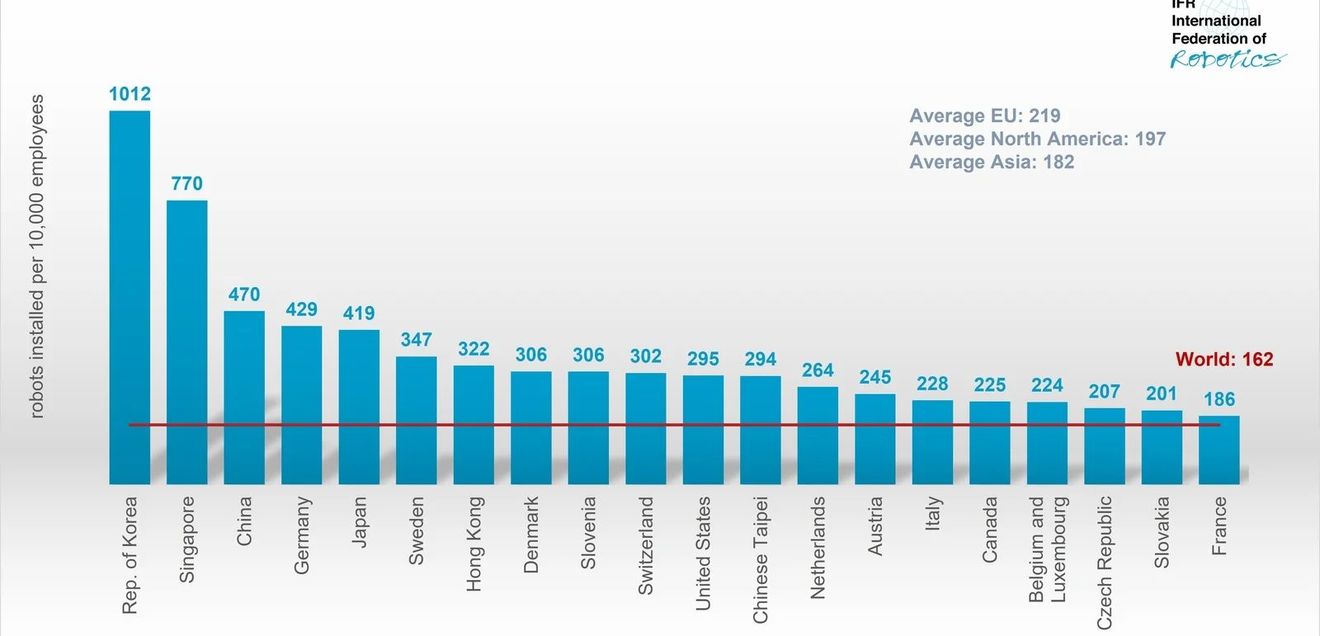
Although Germany installed a record number of 28,355 industrial robots in 2023, it is lagging well behind China in terms of medium-term momentum: the average annual installation rate (CAGR) between 2018 and 2023 was just 1%. China exceeded this result twelvefold in the same period.
"China has invested heavily in automation technology and ranks third in robot density in 2023 after South Korea and Singapore, ahead of Germany and Japan," says Takayuki Ito, President of the International Federation of Robotics. "This is particularly remarkable because China only reached the top 10 in the global ranking in 2019. The robot density figure is an important indicator for making the automation of the manufacturing industry internationally comparable by country."
The top countries
South Korea is the world leader in automation in the manufacturing industry with 1,012 robots per 10,000 employees. Robot density has increased by an average of 5% annually since 2018. With a world-leading electronics industry and a strong automotive sector, the Korean economy benefits from two major customer industries for industrial robots.
Singapore follows in second place with 770 robots per 10,000 employees. The electronics industry is by far the largest customer sector for industrial robots with a share of 75 to 90%. Singapore's robot density is very high due to the rather low number of employees in the manufacturing industry and the rapidly increasing operational stock.
China ranks third and has more than doubled the ratio of robots per 10,000 factory workers since 2019 (2019: 206; 2023: 470 units). The number of employees in the manufacturing industry is particularly high at around 37 million people.
Germany follows in fourth place with 429 robots per 10,000 employees. Robot density in Europe's largest economy has increased at an average annual growth rate of 5% since 2018.
Japan ranks fifth with 419 units. The robot density of the country with the largest manufacturing sector for industrial robots grew by an average of 7% per year (2018 - 2023). The robot density in the USA is 95 units. This puts the country in tenth place worldwide.
Robot density by region
In 2023, the average robot density worldwide rose to a new record of 162 units per 10,000 employees - more than twice as many as seven years previously (2016: 74 units).
The European Union has a robot density of 219 units per 10,000 employees. This corresponds to an increase of 5.2% compared to the previous year. Germany, Sweden, Denmark and Slovenia are among the top ten automated economies in the world.
The robot density in North America is 197 units per 10,000 employees - an increase of 4.2%. The United States is one of the ten countries with the highest robot density.
Asia has a robot density of 182 units per 10,000 employees in the manufacturing industry. This is an increase of 7.6%. The economies of South Korea, Singapore, China and Japan are among the ten most automated countries.


You might also be interested in
Yaskawa at the Automatica 2025
AI meets robotics
At this year's Automatica, everything at Yaskawa revolves around AI-based robotics solutions for the smart factory and beyond. As a trade fair highlight, the manufacturer is presenting its new Motoman Next product concept.
 read more...
Reliable robots, cobots and AGVs with embedded AI
Assuming an average machine hourly rate of 2,500 euros, the failure of an industrial robot is associated with high costs. For the first time, local AI makes it possible to reliably implement predictive maintenance from the gearbox to the gripper...
read more...China's industry undergoing AI transformation
China has launched its 15th five-year plan and is positioning robotics as a central component of its modern industrial system. The aim is to transfer artificial intelligence more strongly into physical applications and thus boost economic growth.
read more...Using AI-supported robots to combat the labor shortage in logistics
Logistics companies have already invested heavily in robotics and automation in response to increased demand. However, the shortage of labor threatens to slow down growth. According to the International Federation of Robotics, a new generation of...
read more..."Dancing with Robots"
With a live performance under the motto "Dancing with Robots", Trapo will be presenting intelligent automation and robotics solutions for the packaging industry at Interpack 2026.
read more...Movu Robotics at the Logimat 2026
Transformation to a 4-way pallet shuttle system
Movu Robotics, a member of the stow Group, will be demonstrating at Logimat how it is driving the large-scale transformation of automated storage and retrieval systems (ASRS) to 4-way pallet shuttle technology.
read more...Bosch Rexroth at the Logimat 2026
Humanoid robot on AMR platform
Mobile robotics is well established in intralogistics, now humanoid robotics is moving more into focus. At Logimat, Bosch Rexroth is presenting a mobile humanoid robot on an AMR platform for the first time.
read more...Exoskeleton: strength to put on
Automation specialist Comau is expanding its portfolio of wearable robots with a new exoskeleton. The wearable system reduces muscle strain by up to 50 percent and is aimed at a wide range of applications in industry and SMEs.
read more...The market for service robots
A recent report from IDTechEx analyzes the global market for service robots and examines key applications for delivery and logistics robots, cleaning and disinfection robots, social robots and more.
read more...