Crane systems
Sensitive cranes work at a depth of 38 meters
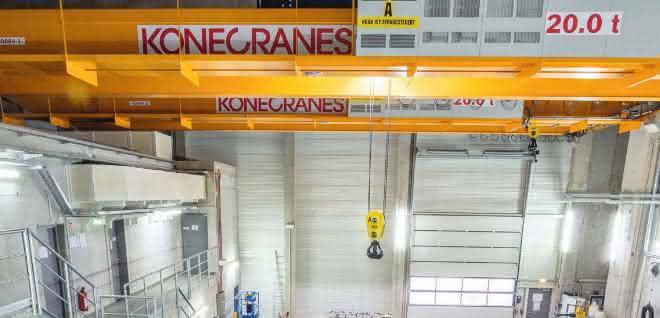
Konecranes supplies crane systems for the world's largest X-ray laser, the European XFEL in Hamburg, which generates extremely powerful X-ray laser beams up to 38 meters underground. This requires highly sensitive components - and precise cranes to bring them safely into position.
The European XFEL (X-Ray Free-Electron Laser) goes down to a depth of up to 38 meters: state-of-the-art technology generates X-ray laser beams that are used for various scientific experiments. Konecranes is comprehensively equipping the European XFEL with crane systems for a wide range of tasks - from double-girder bridge cranes to wall-mounted slewing jib cranes. In the newly opened European XFEL (X-Ray Free-Electron Laser) research center, a superconducting linear accelerator generates X-ray laser flashes. Up to 27,000 flashes per second at a wavelength of 0.05 to 4.7 nanometers - a unique repetition rate worldwide. The laser flashes are billions of times more powerful than the best conventional X-ray sources. This makes it possible to observe processes at an atomic level, such as the formation of a molecule or the reversal of magnetization. Since 2017, research has been underway at the end of the 3.4-kilometre tunnel that runs from Hamburg-Bahrenfeld to Schenefeld. A total of eight double-girder overhead cranes and a single-girder overhead crane from Konecranes are used to move sensitive equipment safely underground.
X-ray laser shoots at a depth of at least six meters
Depending on the nature of the landscape, the X-ray laser tunnel is between 38 meters and 6 meters deep. When the laser "shoots", X-rays are generated, well shielded underground. The openings in the shaft buildings, through which large components are inserted, are therefore sealed with heavy concrete slabs during operation. At the tunnel entrance in Hamburg-Bahrenfeld, two double-girder bridge cranes, each with a lifting capacity of 20 tons, are used for this purpose. At 20.8 meters, they span the entire entrance hall and can also lift sensitive and heavy equipment synchronously and transport it into the access shaft. Another single-girder overhead crane is specially designed to lift pumps from the accelerator tunnel for maintenance.
Smart features for safe and sensitive lifting
"The sensitivity of our cranes was particularly important for this project," explains Niclas Maassen from Konecranes in Hamburg. "Extremely slow and jerk-free travel was the main requirement." To enable the safe transportation of sensitive equipment, Konecranes uses frequency inverters. This allows the lifting speed of the large crane systems at the tunnel entrance to be infinitely adjusted from 0.5 to 9 m/min. The frequency inverter automatically monitors the lifting speed and thus ensures smooth operation. The trolley and crane travel speeds can also be infinitely adjusted - from 0.5 to 20 m/min and 10 to 40 m/min. The high-quality freight must not swing back and forth in the access shaft. "In addition to the inverters, load sway damping is also used. This smart feature automatically controls the acceleration and deceleration of the bridge and trolley," says Maassen. This prevents swaying in the long shaft. To enable the two double-girder bridge cranes at the front tunnel entrance to work together even in confined spaces, their drums for the long hoist cables are rotated so that they are parallel to the girder. "With such a large lifting height, you need equally long cables. By rotating the drums, we enable synchronous operation of the two large cranes even in a small space," says Niclas Maassen. In tandem operation, one crane operator steers both cranes simultaneously by radio remote control - the movements are automatically synchronized and no longer have to be coordinated by calling out.
Crane systems for every task around the X-ray laser
With a length of 3.4 kilometers, one access shaft is not enough. Four maintenance access points are therefore distributed at regular intervals along the tunnel. Concrete slabs also have to be lifted onto the shaft openings at these access points and high-quality components transported. For these tasks, Konecranes installed a total of four double-girder bridge cranes, each with two trolleys and a lifting capacity of two times 10 tons. They each have a span of 12 meters and a lifting height of up to 21 meters and are also equipped with frequency inverters and load-sway damping. In the experimental hall at the end of the tunnel system, a double-girder overhead crane with a span of 11 meters lifts equipment weighing up to 20 tons from the truck loading zone into the underground hall. In the vacuum laboratory above the hall, a double-girder overhead crane with a lifting capacity of 5 tons is used to transport particularly sensitive laboratory equipment - without jolting or swinging. "Our crane systems move a lot at the European XFEL, from large concrete slabs to expensive components," explains Niclas Maassen. "For smaller transport tasks, we have also equipped the European XFEL research center with wall-mounted slewing cranes and light cranes for loads from 500 kilograms to 2 tons." "The Konecranes team has already supported other large research centers and therefore knows our requirements inside out," says Süleyman Arslan, hall engineer at the European XFEL. "The cranes at the European XFEL have to work reliably and be easy to control. We attach great importance to long-term and sustainable performance."


You might also be interested in
Crane retrofit in Emmerich
In the inland port of Emmerich, Tsubaki Kabelschlepp has overhauled the cable routing of a container gantry crane belonging to Contargo Rhein-Waal-Lippe. A pre-assembled Totaltrax solution was used, which the experts for energy chain systems...
 read more...
For drumming and towing - cables that pull along
With the Reeltec and Festoontec product series, TKD Kabel offers a portfolio of robust cable solutions for cranes and hoists. The specialist for application-oriented cable solutions thus also supports the increasing digitalization and automation of...
read more...Crane retrofit in Emmerich
In the inland port of Emmerich, Tsubaki Kabelschlepp has overhauled the cable routing of a container gantry crane belonging to Contargo Rhein-Waal-Lippe. A pre-assembled Totaltrax solution was used, which the experts for energy chain systems...
read more..."Customer awareness of environmental issues is increasing"
What trends and developments are there in the industry when it comes to green logistics? Experts provide insights: Christian Heid is Managing Director, SWF Krantechnik.
read more...New standards in lifting technology and material handling
Crane technology manufacturer SWF is now embracing digitalization and networking with a vengeance. Intelligent control aids make work safer and easier.
read more...Next generation electric wire rope hoist
SWF Krantechnik, supplier of components for industrial cranes and hoists, presented its new product innovationsto a broad specialist audience for the first timeat LogiMAT.
read more...Premieres for wire rope hoist and chain hoist
Rope hoist, chain hoist, Demag KBK light crane system: Demag will be presenting new products in each of the three product areas at Logimat.
read more...Crane technology: Konecranes presents solutions for material handling
Konecranes will present its latest Industrial Service and Equipment products at Logimat. Konecranes has pioneered safer, more productive and more sustainable material handling equipment.
read more...Starting signal for the intralogistics trade fair
The annual event opened its doors to trade visitors at 9 a.m. today. By midday, it was clear that there was a high level of interest from visitors, which corresponds to the fully booked halls.
read more...