
Cranes
Crane systems: Concrete lifted with power
Rekers Betonwerk is active in the concrete and precast concrete industry. The company's own plant near Magdeburg manufactures precast concrete parts, precast concrete garages and angle supports. Crane solutions from ABUS, specially adapted to Rekers' requirements, enable reliable and safe transportation of the components in all weathers.
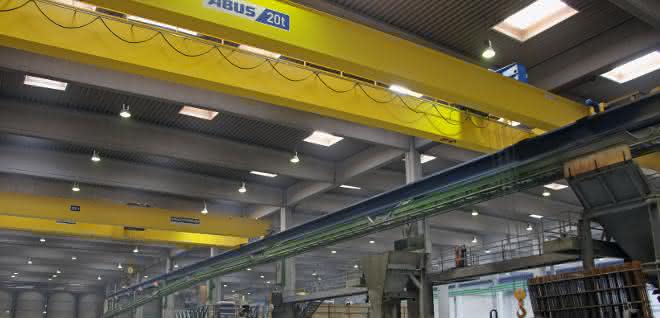
Precast concrete elements offer time and cost advantages for large-scale projects such as the construction of stadiums, logistics centers, department stores or parking garages. In addition, better quality can be achieved when manufacturing these construction elements in the concrete plant than on site at the construction site. In 2017, Rekers Betonwerk invested more than three million euros in the Ammensleben site, which has existed since 1993, including the construction of a new 4,500 square meter production hall. Three new ABUS double-girder overhead travelling cranes have also been in use at the plant since 2017 and 2018: a ZLK 20-tonne crane transports the still-liquid concrete to the garage forms within the production hall, among other things. As the statics of the hall construction reached their limits with the required load capacity, the ZLK 20-tonne was designed as an 8-wheel crane: Thanks to the double number of wheels compared to the standard design, the load is distributed more evenly on the crane runway and therefore on the hall supports.
Tandem operation for bulky components
Another adjustment to the material flow capacities was necessary in the outdoor area: Here, two ZLK 25-tonne cranes primarily transport foundation columns and bar-shaped components that were manufactured in the hall upstream. The two cranes can also work in tandem to transport particularly bulky and heavy precast concrete parts to the warehouse or prepare them for transportation. As the cranes have to transport their loads of up to 50 tons reliably even in snow and strong winds, Rekers Betonwerk had them equipped with a four-wheel drive. The traction achieved in this way enables the cranes to operate smoothly even in winter, and it was also possible to bypass an automatic shutdown system in the event of excessive wind pressure. The project planning and realization of the cranes was carried out by Bernhard Willmes ABUS Werksvertretung Essen/Münster.
From concrete to precast element
The heavy precast concrete parts are manufactured on stationary production tables at the Groß Ammensleben plant. The concrete is transported from the mixing plant to the tables in large concrete buckets using the ABUS ZLK with a span of 29.1 meters and poured into the formwork. In order to produce even large parts efficiently and with consistent quality, concrete buckets with the largest possible volume are used.
Forces well distributed
At the Groß Ammensleben plant, however, the statics of the hall's supporting structure limit the load-bearing capacity of the double-girder overhead traveling crane: The load of 20 tons is already at the limit of what the hall supports can take. ABUS works representative Bernhard Willmes called in a structural engineer to carry out a structural analysis of the hall construction. A crane solution adapted to the situation was then developed: The ZLK 20 tons was fitted with a total of eight wheels instead of the usual four-wheel chassis girder. The two main girders do not have a continuous trolley beam, but each main girder has its own trolley beam, which are connected by a coupling rod.
This means that the crane has eight wheels instead of four, which reduces the load on the crane runway per wheel and increases the crane's load capacity. The 8-wheel crane is not only structurally more favorable due to its lower forces per wheel, but also due to the distribution over a larger wheelbase overall. The crane is also equipped with the ABUliner frequency inverter control system for the hoist as well as for the crane and trolley travel. This allows the travel and lifting speeds to be continuously controlled and maintained. The ABUliner dampens oscillating movements of the concrete silo suspended from the hook, enabling the load to be positioned precisely above the production tables.
Transport in wind and weather
The finished concrete elements are then transported to the storage area or prepared for loading by two ZLK 25-ton cranes. Both ABUS cranes are positioned on a continuous crane runway with a span of 19.1 meters. The ZLK 25-tonne cranes are designed for tandem operation and can therefore transport particularly long or heavy components - weighing up to 50 tons - together. The two cranes used here have the optional ABUS equipment package for outdoor use: in addition to rain protection hoods for the crane travel motors, contactor boxes and trolleys, the special equipment also includes a safety catch at one end of the crane runway as wind protection. A paint system from the highest stress category also offers corrosion protection: it is made up of a 2-component epoxy resin-based primer and a subsequent 2-component PU-based paint, making it resistant to the weather for many years.
All-wheel drive for high traction
All four wheels of the two ZLK 25-tonne cranes are driven: Each wheel is equipped with its own motor including gearbox. This "all-wheel drive" enables high traction, even when there is snow on the crane rail or wind pushing against the large surface of the main girder. The crane's higher drive power also helps in windy conditions. This means that an automatic wind shutdown system can be bypassed and a high level of crane availability can be achieved.
The two cranes can continue to be operated with the four-wheel drive even if one engine should fail. In order to transport the heavy loads safely and place them precisely, the two ZLK 25-tonne cranes can also accelerate steplessly and maintain any selected speed during crane and trolley travel thanks to ABUliner frequency inverter control.
Simple and safe maintenance
All ABUS cranes are equipped with a 0.60 meter wide walkway along the crane main girder. This allows maintenance technicians to easily reach every component. While the running surface of the ZLK working inside is equipped with a tear plate floor, the floor of the two ZLK 25-tonne cranes consists of a grating so that the service specialists can work without the risk of slipping, even in rain or snow. A railing with knee rail and all-round baseboard provides additional safety.
About ABUS Kransysteme:
ABUS Kransysteme develops, manufactures and assembles in-house transport solutions with a load capacity of 80 kilograms up to 120 tons. Electric chain hoists that can lift up to four tons are used in the light payload range. These can be used as stand-alone chain hoists or in conjunction with slewing jib cranes, overhead monorail systems or small overhead traveling cranes. Electric wire rope hoists and single or double girder overhead traveling cranes are used in the larger load capacity ranges. Today, over 1,100 employees work in the four plants in Gummersbach and the surrounding area.


You might also be interested in
Crane retrofit in Emmerich
In the inland port of Emmerich, Tsubaki Kabelschlepp has overhauled the cable routing of a container gantry crane belonging to Contargo Rhein-Waal-Lippe. A pre-assembled Totaltrax solution was used, which the experts for energy chain systems...
 read more...
For drumming and towing - cables that pull along
With the Reeltec and Festoontec product series, TKD Kabel offers a portfolio of robust cable solutions for cranes and hoists. The specialist for application-oriented cable solutions thus also supports the increasing digitalization and automation of...
read more...Crane retrofit in Emmerich
In the inland port of Emmerich, Tsubaki Kabelschlepp has overhauled the cable routing of a container gantry crane belonging to Contargo Rhein-Waal-Lippe. A pre-assembled Totaltrax solution was used, which the experts for energy chain systems...
read more..."Customer awareness of environmental issues is increasing"
What trends and developments are there in the industry when it comes to green logistics? Experts provide insights: Christian Heid is Managing Director, SWF Krantechnik.
read more...New standards in lifting technology and material handling
Crane technology manufacturer SWF is now embracing digitalization and networking with a vengeance. Intelligent control aids make work safer and easier.
read more...Next generation electric wire rope hoist
SWF Krantechnik, supplier of components for industrial cranes and hoists, presented its new product innovationsto a broad specialist audience for the first timeat LogiMAT.
read more...Premieres for wire rope hoist and chain hoist
Rope hoist, chain hoist, Demag KBK light crane system: Demag will be presenting new products in each of the three product areas at Logimat.
read more...Crane technology: Konecranes presents solutions for material handling
Konecranes will present its latest Industrial Service and Equipment products at Logimat. Konecranes has pioneered safer, more productive and more sustainable material handling equipment.
read more...Starting signal for the intralogistics trade fair
The annual event opened its doors to trade visitors at 9 a.m. today. By midday, it was clear that there was a high level of interest from visitors, which corresponds to the fully booked halls.
read more...