

Conveyor technology & components
The vegetables arrive via easychain
A cooperative of vegetable growers in Ticino considers healthy and humane working conditions to be just as important to its core values as the sustainable production of its produce. For this reason, only conveyor technology that meets these guidelines is used in the Swiss distribution center: a particularly quiet and energy-saving easychain system from Denipro.
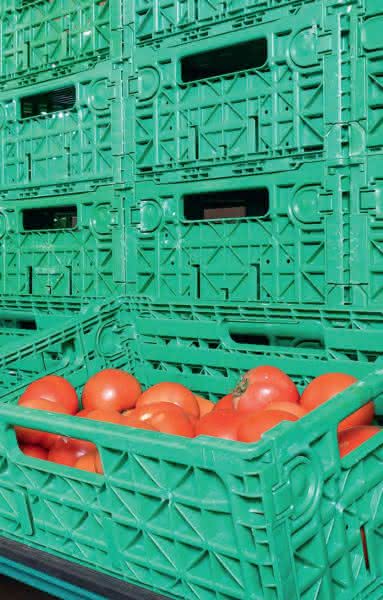
Passionate producers". This is the motto of the Federazione Ortofrutticola Ticinese (FOFT), a vegetable growers' association founded 80 years ago and based in Cadenazzo, Ticino. The products it markets bear the "TIOR" brand label. This stands for the regional origin ("TI" is the abbreviation for "Ticino") and for the high quality and cultivation methods ("OR" corresponds to "orto" or "vegetable garden"). For Paolo Bassetti, the managing director of the cooperative, there is a further association, namely that of "oro", meaning gold.
Vitamin-rich "jewels" perfectly packaged
Accordingly, he compares the tomato, zucchini, eggplant, cucumber and lettuce varieties produced by the FOFT farmers, which make up the lion's share of the TIOR range, to "precious pieces of jewelry" that are created with great craftsmanship in a jewelry shop. "At the end of the day, the Ticino vegetable garden is nothing else," remarks the FOFT boss with a twinkle in his eye during a tour of the company's distribution center in Cadenazzo. In the spacious hall, employees pack the - in Bassetti's diction - vitamin-rich "jewels" from the open-air and greenhouse cultures of the Magadino plain into green plastic folding boxes and prepare them for dispatch.
"As befits a company with a strong focus on sustainability, the conveyor technology we use is very energy-efficient"Paolo Bassetti Managing Director FOFT
"As befits a company with a strong focus on sustainability, the conveyor technology we use is very energy-efficient," Bassetti continues, pointing with pride to the easychain system with its 246-metre-long circular track and the spiral that swings up to a height of five meters, which the Swiss system provider Denipro implemented a few months ago as a turnkey project in a very short space of time. "Just imagine, our new material flow system only needs three electric motors for the entire route. This allows us to keep power consumption in the logistics area low."
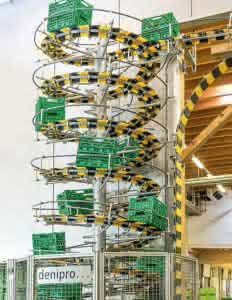
The positive energy balance mentioned by Bassetti is the result of the "rolling conveyor technology" (RFT) developed by Denipro, which is based on components with low resistance to movement. "This not only reduces friction, but also cuts energy consumption. And: with FOFT, three drives of 0.75 kW each are sufficient for the entire chain length," says Denipro CEO Daniel Fässer, explaining the key technology, which he says is one of the system provider's unique selling points.
The RFT concept enables a virtually maintenance-free system, even when very high transport capacities are required, as the plastic support plates of an easychain conveyor are supported by rollers that run very smoothly in two profile rails. Also of crucial importance: thanks to the RFT principle, its moving parts do not require any lubrication with special lubricants, greases or oils. In this respect, the easychain system is predestined for use in the food sector, for example to bridge the distance from first packaging to second packaging.
Conveying speed 0.4 m/sec
In Cadenazzo, the easychain system replaces the trolleys pulled by FOFT employees, which were previously used to transport the empty folding boxes to the goods handling points. It transports the 40 x 30 x 17 centimeter boxes returning from Migros, Coop and other wholesalers at a conveying speed of 0.4 meters per second without any further interfaces from the incoming goods area to the packaging line 136 meters away. The individual stages of this process: The empty boxes arrive folded on pallets at the incoming goods area. There, a forklift truck transfers them to a box erector. The machine picks a box from the stack, opens its side walls and pushes it upwards. It then picks up a second crate, places it on top of the first after opening it and passes the "double team" on to the easychain conveyor. After the transfer station, the conveyor transports the empty containers over the spiral from an ergonomic 70 centimetres to a height of five meters. At this height, it reaches the other end of the hall, where the folding crates are transported down to the two consecutive packing stations.
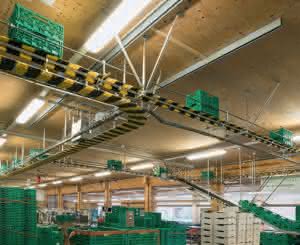
By using the third dimension, space on the floor of the hall is now free. The introduction of the easychain system also eliminated the risk of accidents associated with transporting empty containers on trolleys.
In recent years, the large food suppliers in Switzerland had continuously increased their order volumes at FOFT. For a long time, Bassetti and his colleagues on the Executive Board had been looking for an optimal logistics solution that would make work in the distribution center easier and give employees more leeway. "The health and well-being of our employees is a top priority for us," emphasizes the FOFT boss. "That's why it was very important to us that they get to grips with the changes and accept them."
A decisive criterion for this was the issue of noise emissions at the workplace. "We absolutely wanted the employees at the packing stations to be able to continue working without hearing protection," Bassetti continues. Once it was clear that the Denipro system would also overcome this hurdle thanks to the RFT principle and its very quiet-running rollers, the decision was made in favor of easychain. Bassetti has not regretted this decision to this day: "Our employees accepted the new technology very quickly. It works completely smoothly, even though it has been in permanent operation for several months now."
Hans Jürgen Jüngling


You might also be interested in
Cooperation agreed for the logistics circular economy
Booxit aims to make logistics processes more efficient and sustainable with intelligently networked reusable boxes. The start-up is receiving support from plastics specialists Haidlmair and Polytec.
 read more...
Boxes for logistics solutions
Con-Pearl is a manufacturer of environmentally friendly lightweight PP boards. The company has been using this material for years to produce logistics and transport packaging in pallet and half-pallet format, among other things. Con-Pearl now also...
read more...Sustainable and solid transportation
Efficient use of space during transportation and the reusability of packaging are crucial not only for economic but also for ecological reasons. They also protect products from damage during transportation and storage and thus make a significant...
read more...Containers for the future of intralogistics
Solo or in a shelving system
With a focus on sustainability and the circular economy of packaging, Bito-Lagertechnik is coming to Fachpack to present various models and types of returnable load carriers, boxes and transport packaging in different designs for sustainable...
read more...Fachpack: Folding containers made from bioplastics and marine plastics
Söhner Kunststofftechnik is focusing on sustainability and efficiency at Fachpack: the company is presenting sustainable packaging solutions such as large load carriers made of bioplastics and marine plastics and foldable stacking boxes made of...
read more...Unique boxes for unique products
The Walther Faltbox Group is taking a step towards sustainability: instead of recycling folding boxes with individual color gradients as usual, the company is now offering them as unique boxes in the Boxline store.
read more...Nestable reusable pallet made from recycled plastic
The transport and storage technology specialist Kiga from South Westphalia is presenting the Kiganesto plastic pallet at Logimat.
read more...Alternative to the mesh box: Craemer presents Kubo - the plastic box for heavy-duty applications
At this year's Logimat, the internationally active Craemer Group with its headquarters in Herzebrock-Clarholz, East Westphalia, will be exhibiting the new Kubo as well as the hygienic HB3, the extremely robust SB3, the CB1, CB3 and the large-volume...
read more...Containers and much more
As a full-service provider of customized storage and intralogistics solutions, Bito-Lagertechnik Bittmann is a partner for users in all industries and of all sizes, as well as for major international system integrators.
read more...