

Rotary stacking container
Vegetarian and well stacked
The Amidori Food Company is a successful start-up in the food industry. The young company produces Midori, a new category of vegetarian food. Efficient production processes are required to meet the increasing demand. Amidori optimized its internal logistics with a rotary stacking container system from Werit. The packaging solution is to be expanded further.
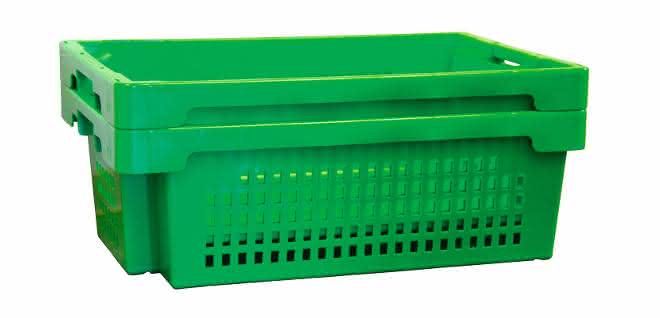
The plant protein people" is Amidori's self-description. With Midori, the company offers a product based purely on plant proteins that serves as a bite-resistant alternative to meat analog foods. The main raw materials are peas and other protein-rich plants of regional origin. This results in products with a fibrous consistency that can be fried or deep-fried as a meat substitute, for example for minced meat or in breaded form for chicken nuggets. Midori is delivered frozen. The raw materials and the finished Midori have to be transported within the production halls. Amidori wanted to make these intralogistics processes more efficient with new transport packaging. "We were looking for a container system that was suitable for foodstuffs, scored highly in terms of functionality and saved space," says Christian Wicht, Head of Production, Engineering & IT at Amidori, describing the requirements profile. Werit was able to offer a suitable packaging solution. The DSB-N series stackable containers meet high hygiene standards and satisfy the requirements of the International Food Standard and the British Retail Consortium. Proof of migration safety was also provided. The inner walls of the plastic packaging are easy to clean and are gentle on the contents. Amidori chose a product version measuring 600 x 400 x 200 mm with a volume of 32 liters, a closed base and perforated sides.
Up to 65 percent space saving
The empty stackable containers can be nested inside each other. In this way, the storage volume of the nested containers can be reduced by up to 65%. Amidori thus reduces the costs of transporting and storing empty containers. When full, the containers can be stacked. To do this, the crates are placed on top of each other exactly centered after a 180-degree turn at the inner edges. Another advantage is the simple manual handling. The ergonomic handles are safe and comfortable to grip and there is no annoying vacuum effect when unstacking.
Can also be used in deep-freeze storage
Werit manufactures the stackable containers from HDPE plastic. This makes the containers particularly robust and dimensionally stable in a wide temperature range between -40 and +70 degrees Celsius. Amidori therefore also uses the containers in deep-freeze storage, where inlay bags are also used to protect the food against environmental influences. Amidori has been using the DSB-N stackable containers at its two production sites in Stegaurach, Bavaria, and Wals-Siezenheim, Austria, since 2016. "Due to the positive experience, we want to increase the stock further," announces Christian Wicht. Werit will again supply the containers in special colors in accordance with Amidori's corporate identity.
About Werit
Werit, headquartered in Altenkirchen, Germany, was founded in 1949 and primarily produces plastic products. Werit employs more than 600 people at six production sites and four sales offices throughout Europe. The business segments aredivided into industrial packaging, building services and specialty products.
About Amidori
Amidori Food Company GmbH & Co KG is a food industry start-up founded in 2015 with over 100 employees. The head office with affiliated production site and test kitchen is located in Stegaurach near Bamberg. The company has another production site in Austria. The vegetarian food is sold via wholesalers, primarily in Germany and Scandinavia, as well as online and in selected Edeka and REWE supermarkets. Amidori also maintains a street food fleet to raise awareness and for market research purposes.


You might also be interested in
Werit launches new PHOTONconnect product range
Werit Kunststoffwerke actually specializes in industrial packaging, among other things. Now the company is tapping into a new market segment: with PHOTONconnect, Werit is opening up a new product area whose components are equipped with fiber optic...
 read more...
New container series and sharpened structure
New brand image, clear business unit structure and sustainable intralogistics solutions characterize Werit's trade fair appearance in Düsseldorf.
read more...Sustainable packaging and stacking
Werit looks back on 75 years of company history this year. The supplier of industrial packaging and plastic products is working on new solutions for containers and packaging systems as well as their collection and recycling in the responsible use of...
read more...Containers for safe processes and smart picking
With the special solution from Bekuplast, Rossmann is increasing process reliability and efficiency in its central warehouse in Landsberg and its e-commerce warehouse in Burgwedel.
read more...Circular load carriers for more sustainable supply chains
With the planned Industrial Accelerator Act, the European Union wants to accelerate the transformation of industry towards low-carbon production processes and resource-efficient supply chains. Logistics and transportation are also increasingly...
read more...Dragsbæk halves pallet area
By using automated pallet solutions from Palomat, Dragsbæk has halved the space required for pallets, optimized processes and sustainably improved working conditions.
read more...Efficiency on wheels
When Logimat, the leading international trade fair for intralogistics, opens its doors, fetra Fechtel Transportgeräte will be making a strong appearance at the fair. In Hall 3, Stand 3B61, the manufacturer will be presenting a broad portfolio of...
read more...Cosys ensures transparency in the reusable cycle
The EU packaging regulation PPWR will present companies with new requirements from August 2026. With digital container management and business intelligence, Cosys is helping to manage reusable processes transparently, efficiently and in compliance.
read more...Containers bring movement to Thalia logistics
Georg Utz, specialist for reusable plastic transport packaging, has realized a comprehensive logistics project together with the book retailer Thalia. Utz supplied 360,000 custom-made containers and 432,000 lids in three different colors for...
read more...