

AutoStore robot
Route planning increases robot efficiency and system throughput
Robot technology company AutoStore is offering a quick way to increase the efficiency and handling speed of existing AutoStore systems with the help of new software. Initial users are delighted with how easily they have been able to speed up their system and increase throughput.
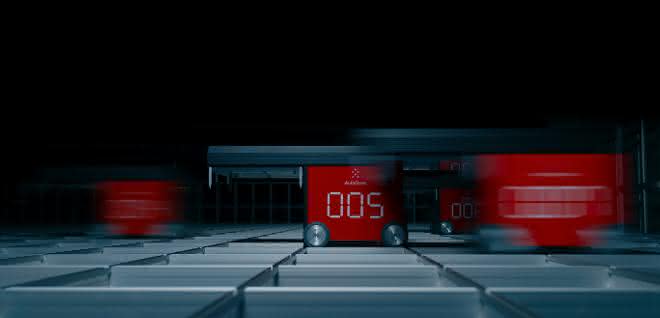
Consumer behavior in general, and the temporary closure of brick-and-mortar stores in particular, has accelerated the growth of online retail and is putting enormous pressure on supply chains. This growth will continue and increase further in the coming years. "Today, we are increasingly seeing demand for even more powerful systems that require higher throughputs in limited spaces," explains Peter Bimmermann, Business Development Manager D/A/CH & CEE and Managing Director of AutoStore System GmbH. With today's pressure to fulfill orders quickly, it is crucial for companies to have the right technology in the warehouse to be able to deliver even when unexpected events occur.
To speed up order processing with the automated Cube Storage System, AutoStore introduced new productivity software in fall 2020. With the new Router software architecture, users can significantly increase the efficiency of their AutoStore robots and thus the throughput of the overall system.
Route planning determines throughput performance
The standard AutoStore software architecture consists of two modules: the Driver as the communication center and for traffic control, and the Planner for task management. The Driver calculates the route for each robot in advance. Once such a route has been calculated, it remains unchanged. This becomes very complex as the number of robots increases and means that if crossings are unavoidable, one robot has to wait for the other. The Planner controls who can drive when.
The optionally available router, on the other hand, works according to the principle of dynamic route planning. The software uses sophisticated algorithms to continuously calculate the most efficient route for each robot for storage and retrieval within the grid in real time. Every second, the advanced software dynamically analyses and adapts to operational changes, speeding up the handling process and ensuring a continuously optimized order fulfilment process. In this way, the system is able to process and adapt to constantly changing events outside the grid, such as new orders, order cancellations or the performance of order fulfillment staff.
Up to 40 percent more power per robot
As a result, each robot achieves up to 40% more performance. This speeds up the processes in the AutoStore and also enables a higher robot density on the grid, as the routes are no longer pre-planned and blocked. This means that the number of robots can be doubled, which, together with the higher efficiency, enables an overall throughput that is up to four times higher.
Peter Bimmermann compares the software to a chess computer: "Like a chess computer, our router weighs up all the options in real time: what is the current traffic situation, how can the route be optimized and which robot is currently the best for a particular transport task? Compared to the Planner, we have 100 times more time to optimize the route. And therein lies the opportunity to really give every existing system a performance boost. This time our robots are not faster or better, they simply work more intelligently."
Up to four times higher total throughput
Traditionally, the performance of AutoStore systems can be increased or reduced relatively easily and quickly by using more robots, additional workstations or expanding the grid with more containers. AutoStore systems are therefore very powerful and scalable in themselves and can be flexibly adapted to the needs of the company. With the router, the AutoStore system can now be expanded even more flexibly and quickly - without changing the hardware. This makes the router particularly interesting for users who operate their system at its performance limits or who want to achieve high throughput in a limited space.
High-performance picking at the ports
Before the first tests with pilot customers, AutoStore tested the router in over 60,000 simulations in advance. Pilot projects were then run with customers on systems of different sizes - all with impressive results. For example, a system with 160 robots, 67,000 bins and 22 ports experienced waiting times at the workstations due to the high volume of traffic on the grid. With the router and its dynamic route planning, this time was reduced by 62% to around two seconds. In a smaller system with 50 robots, 41,400 bins and eleven ports, the waiting time was reduced by 33% and in a system with 84 robots, 72,500 bins and 35 ports by 40%. All users were delighted with the ease of use of the software and the increase in efficiency. "This underpins our promise to be the fastest order fulfillment system per square meter of warehouse space on the market. The software can be used by any AutoStore user and installing it takes less time than updating the operating system," emphasizes Peter Bimmermann, who is delighted with the positive customer response, even in new projects. The router now also allows larger applications to be installed, for example systems with 500,000 bins, 800 robots with a throughput of 20,000 bin/h and 83 ports with a performance of 300 bins/hour/port. However, smaller systems with 1,700 bins, 28 robots and 2 ports with a picking capacity of 450 bins/hour/port are also economically feasible. These are dimensions that were unattainable with the previous software and at a lower investment, as more robots were previously required for the same performance. This also reduces maintenance and service costs according to the formula: fewer robots = less maintenance/servicing.
Nominated: materialfluss product of the year 2021
The AutoStore Router has been nominated for Product of the Year 2021 in the warehouse and picking technology category in the materialfluss readers' poll. With the software for dynamic route planning, the robot performance of existing AutoStore systems can be increased by up to 40 percent. This reduces waiting times at the ports and increases the throughput of the overall system without any changes to the hardware. If required, operators can use the router to double the number of robots in the system and thus achieve up to four times higher overall throughput.


You might also be interested in
Dematic and Hai Robotics launch partnership for flexible AMR solutions
Dematic and Hai Robotics have recently agreed a Europe-wide partnership to work together as integration partners in the field of warehouse automation. Through this cooperation, the provider of automation solutions for supply chains and the...
 read more...
The market for service robots
A recent report from IDTechEx analyzes the global market for service robots and examines key applications for delivery and logistics robots, cleaning and disinfection robots, social robots and more.
read more...Application phase for Innovation Award 2026 begins
How can robotics help to make packaging more sustainable? Kuka is looking for creative and innovative ideas in the new round of the Innovation Award.
read more...Exoskeleton with AI power
Robotics company German Bionic presents its most advanced exoskeleton model to date, called 'Exia', which is fully controlled by augmented AI.
read more...Strategic partnership for the promotion of AI
Jungheinrich and Merantix have announced a strategic partnership. The aim of the cooperation is to promote applications based on artificial intelligence (AI) in the industry.
read more...New robotics organization founded
Omron has announced the establishment of a global robotics organization effective April 1, 2025. It will operate in parallel with Omron's automation business so that both areas can complement and support each other.
read more...No-code tool for programming robot user interfaces
ABB provides 'AppStudio', a software tool that allows users of all skill levels to quickly and easily create customized, graphical user interfaces for robots.
read more...SLAM navigation in real time
'Freestyle Localize', 'Trailer Find' and 'Scanner Switch' are three new features of Sigmatek's real-time location software forcontour-based navigation 'SlamLoc'.
read more...Robotic solution: Aiming high under your own steam
The Skypod system is now used in more than 100 order picking warehouses worldwide by companies in all kinds of industries. The autonomous Skypod robots are able to overcome height differences of up to 12 meters.
read more...