

It was time
Michael ten Hompel explains logistics to Transport Minister Scheuer
Prof. Michael ten Hompel, Managing Director of the Fraunhofer Institute for Material Flow and Logistics IML, presented a pioneering logistics concept at the launch of the Logistics 2030 innovation program of the Federal Ministry of Transport and Digital Infrastructure (BMVI) in Berlin on 4 September: It is designed to help Germany achieve market leadership in a platform economy.
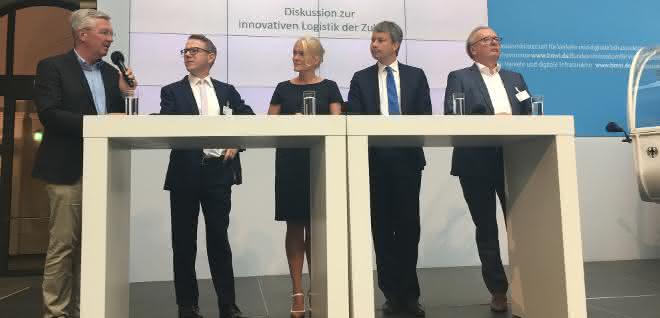
Digitalization and artificial intelligence will turn previous business models completely upside down. The interplay of platforms, artificial intelligence and interacting systems is creating a world in which data must be communicated across all borders. In order for German companies to be competitive in this emerging platform economy, the course must be set now - and logistics will become a key sector in this process. This was emphasized by ten Hompel on 4 September in Berlin. "The potential for the use of artificial intelligence in logistics is enormous and logistics will be the first industry in which AI processes will become established on a massive scale. Whoever controls the world's logistics chains controls the world's economy," said ten Hompel.
"In the private customer sector (B2C), the opportunity has been missed. Platforms such as Amazon, Uber or Alibaba have long since taken over macroeconomic business and logistics processes as monopolists. The logistics market leadership in the B2B platform sector is only just being decided. The winners will be digital platforms and AI algorithms, which will permeate the entire logistics sector and thus significant parts of the economy. A Silicon Valley of B2B competition is emerging, the Silicon Economy," ten Hompel continues. In a keynote speech at the presentation of the innovation program by Andreas Scheuer, Federal Minister of Transport and Digital Infrastructure, on 4 September at the BMVI in Berlin, ten Hompel presented what this Silicon Economy could look like in concrete terms and what steps are now necessary to implement it. This also included specific developments by the Fraunhofer IML, in which various key technologies have already been implemented.


You might also be interested in
Who will make it into the Logistics Hall of Fame 2026?
The Logistics Hall of Fame is entering a special election year: in 2026, several new members will be inducted by decision of the Council. Nominations are now open and the gala will return to Vienna in December.
 read more...
Gebhardt expands into France
The Gebhardt Intralogistics Group is expanding into France and opening its first location in Paris. This strengthens the company's presence in one of Europe's most important logistics markets.
read more...The market for service robots
A recent report from IDTechEx analyzes the global market for service robots and examines key applications for delivery and logistics robots, cleaning and disinfection robots, social robots and more.
read more...Expansion in Wesel successfully completed
Logistics complex for plastics and granulates expanded
Greiwing logistics for you has successfully completed its latest construction project in Wesel and opened a new warehouse. The existing logistics complex with silo tower and four integrated filling silos was expanded by a further 4,000 storage...
read more...Workstation system for shipping and logistics
With Sintro Packing, Karl is launching a workstation system that is designed to meet the specific requirements of shipping and logistics. It is characterized by modular adaptability and ergonomic efficiency.
read more...Bobcat presents expanded portfolio for material handling and logistics
Bobcat, one of the world's leading manufacturers of compact equipment, will unveil its new branding at LogiMAT 2024, showcasing its extensive range of material handling machines.
read more...In and (G)out
As the year draws to a close, Michael Schreckenberg, Professor of Physics of Transport and Traffic at the University of Duisburg-Essen, notes an astonishing trend in the year 2023, which is almost over - and not just in logistics, but also in the...
read more...Increased throughput thanks to greenfield-brownfield project
For 25 years, Witron has been the partner of choice for the Austrian food group Spar for the construction and expansion of its central warehouse in Wels. In the fourth construction phase, capacity, efficiency and performance increased dramatically....
read more...Poco expands its commitment thanks to Brüninghoff
Poco, the furniture discounter, has set up a large regional warehouse in the Lüneburg Heath with the help of Brüninghoff.
read more...