

Warehouse-/Picking technology
Material Flow Round Table: We are system jugglers
The unpredictability of online shoppers, high returns and low margins in e-commerce and the sense of investment - the round table discussion with representatives of logistics service providers almost did without the moderation of the Materialfluss editorial team. The contract logistics providers cheerfully threw the ball around and gave exciting insights into how they make themselves indispensable for their customers.
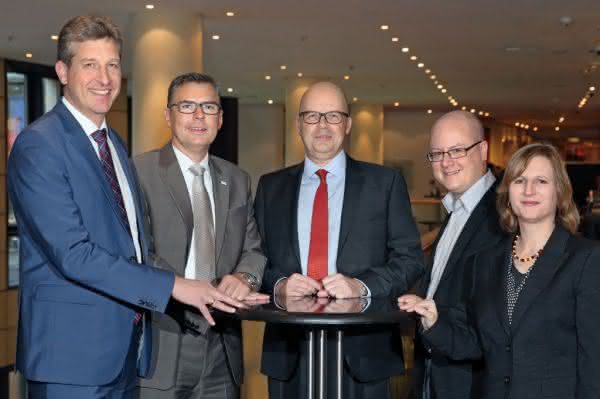
Now I have to make a plea for logistics - working in logistics is so exciting, you have to deal with technology, with IT, with people, with business administration - we have to bring young people into this industry and give them space," Thomas Krüger from BLG Logistics said in the middle of the discussion. It was unforeseeable that the round table with representatives from logistics service providers would result in a plea for the logistics sector. Or perhaps it was, considering the setting in which the round table took place - the German Logistics Congress. The participants took a break from congress networking on the morning of the first day of the DLK to discuss the challenges currently facing logistics service providers, and contract logistics providers in particular, in an informal setting. Editor-in-chief Martin Schrüfer and editor Susanne Frank met with Thomas Krüger, Managing Director of BLG Handelslogistik GmbH & Co KG, Stefan Porcher, Product Manager Contract Logistics at Hellmann Worldwide Logistics GmbH & Co KG and Matthias Schadler, Head of Business Development and Member of the Management Board at pfenning logistics GmbH at the Hotel Schweizerhof.
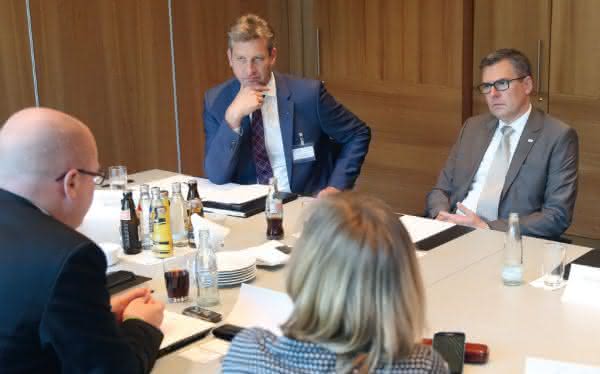
The unpredictability of e-commerce
The dominant topic at the start of the discussion round was the impact of e-commerce. The warehouse and conveyor technology manufacturers (see round table in Material Flow 6/2015) already agreed that intralogistics providers are being put to the test by the increase in online trade. Logistics service providers are also experiencing this on a daily basis. According to Krüger, the unpredictability of orders when the night worker comes back from his shift and goes online is a daily surprise. Matthias Schadler from pfenning logistics confirms this experience. The fact that consignments are becoming increasingly fragmented means a complete rethink in management and makes it necessary to restructure processes. What Schadler is particularly concerned about and sees as a major challenge is the handling of returns.
Krüger sees it the same way: "The customer who has ordered wants their credit note as soon as possible, and our customer wants the goods back as quickly as possible. And when you see what some returns look like, that's a challenge." To get a grip on the high volatility in e-commerce, Hellmann Worldwide Logistics set up an e-commerce subsidiary seven years ago to program solutions and will be offering its customers a pick-up service from the beginning of next year, says Porcher.
The round table participants are aware that the e-commerce business depends on a high percentage of goods being returned. "And returns must be handled as quickly as possible because the items no longer remain on the shelves in the same form for six months," explains Krüger. "The life cycle of products is getting shorter, production cycles are getting shorter, the rapid availability of goods and the fact that they can be returned easily are part of the sales and marketing process these days," says the Managing Director of BLG Logistics.
Logistics service providers are in demand for returns handling
So where are the solutions that logistics service providers are pursuing? Hellmann's Product Manager, Stefan Porcher, sees the crux of the matter in understanding the processes for these new business models: "In order to manage and understand multi-channel, people need to understand how to deal with this volatility. You need reference cases on how to deal with strong fluctuations and especially daily peaks."
Matthias Schadler, Head of Business Development at pfenning logistics, predicts that returns will continue to rise, even if there are attempts to reduce them. He sees the need to have a good IT system and to take care of the equipment in the warehouses. "Staff flexibility is also the be-all and end-all. We simply don't know exactly how high the returns will be. The item either sells very well or very badly; the buyer doesn't have a crystal ball, but relies on experience, so flexibility is extremely important."
Conveyor belts cannot overtake
But how exactly can this flexibility be organized? This question has been on BLG's mind and, with a project that was awarded the German Logistics Prize on the evening of the congress, it shows an example of what such a solution could look like. Krüger postulates that solutions must be found to replace conveyor belts. With a new pick-and-store system, BLG has developed a system for engelbert strauss in which robots bring the goods to the man. Krüger believes that this is just the first step. In the future, IT within a logistics system will have to manage orders intelligently and according to the situation. Swarm intelligence is a new dimension that also requires a complete rethink: "An organizational structure will have to change, it must become more of a team, only then can flexibility be realized."
Porcher admits that it is important to invest in conveyor technology and material flow components where it makes sense. However, he believes that manual processes are still justified in the main process - order picking - especially in the e-commerce sector. "This is because people can still react more flexibly to fluctuations and peaks."
Humans versus robots
Krüger counters that there is a resource problem, however, and that robots are certainly helping to ensure that people no longer have to walk for miles. He is certain that in five years' time, we will have material flow systems that are completely different to today and that the IT world will change in the direction of the cloud.
When it comes to the cloud, data security naturally comes into play. Schadler reports that the handling of data is a recurring topic of discussion with customers. The service providers are often more involved in the evaluations and processes than the customers themselves. As a representative of the service provider, he sees it as his duty to have the issue of data security under control, even if this means making major investments.
In addition to secure data, big data is of course also a topic that keeps service providers busy, as Stefan Porcher knows. In cooperation with the University of Osnabrück, Hellmann is investigating how business intelligence systems need to be structured in order to be equipped for big data. The aim is to find out how to deal with the mass of data in order to use it for reporting: "The topics of traceability and forecasting are becoming increasingly important for companies. And the more data is available, the better it is for our customers."
In the age of "cheap is cool": how do you cope with low margins in e-commerce?
Krüger admits that this is indeed very difficult. The requirement is that IT must be at the cutting edge, but innovations should also be made with small margins.
"That is feasible. All three of us sitting around this table can prove that," says Krüger. But in future, the client must also be aware that you can only be efficient if you also invest in new IT processes.
Porcher confirms that investments in IT pay off, but only after a certain period of six to seven years. "We have invested strategically in IT systems. As a result, we are competitive, generate income and are established in the market. When it comes to omni-channel, as a contract logistics provider you can't avoid investing and further developing the systems. Once you have overcome this initial hurdle and the systems are in place, you can build on them and generate new opportunities," explains the Hellmann product manager.
Schadler argues that it is in the client's interest to invest in IT systems. However, it makes him nervous when nobody really wants to pay for it. After all, the customer needs a system that enables them to be effective against their competitors and it is not acceptable for the service provider to bear all the costs.
Porcher sees another balancing act that the market expects from them. There are not only the large established companies, but also small start-ups, some of which have development behind them and others ahead of them. These companies also require solutions with which they can handle their business.
Krüger believes it is very important that the investments pay off over the term of the contract. He also sees a solution in developing systems that can be packed up again and used elsewhere.
Listening to the market and promoting young talent
Especially in IT, it is important to be "state-of-the-art". Outdated IT systems are a competitive disadvantage. Here too, companies rely on their service providers to be "up-to-date" in terms of IT, but also in terms of technical equipment overall. Hence the editors' question: "How do you keep up to date with the technology in the warehouse?"
Schadler reports that the company works together with specialists from the Fraunhofer Institute and consults them when it comes to complex tenders and discusses the project.
Porcher sees it as his primary task as a product manager to gather information in a wide variety of ways - Hellmann Worldwide cooperates with universities and consulting firms. He also believes it is important to look outwards and exchange ideas in an international environment: "For example, we talk to colleagues in the USA - they often come up with very innovative approaches."
Krüger agrees that exchange is important. But personnel development should not be neglected either. This is followed by the "lance-breaking" for a better image of the logistics professions mentioned at the beginning. You have to "show that it's sexy to work in logistics." The image is changing slowly, "but it has to change dramatically," says Krüger. He advocates giving digital natives enough space, because it is precisely these people who are needed as future system jugglers.
Welding, printing labels, assembling surgical instruments
Logistics service providers are increasingly taking on activities outside of pure warehousing, order picking and transportation services. They take on locksmith and welding work, BLG saws and washes aluminum profiles. Are these value-added services a growth area in contract logistics?
The answer to this question from the editorial team was a resounding yes. Due to the increasing number of variants, Krüger sees service providers increasingly taking on the role of the extended production workbench. "Production and logistics are growing closer together. Nowadays, operating manuals are printed out and enclosed with the car ordered. And if your favorite coffee, which is put together individually, is labeled 'Aunt Greta's favorite coffee', you don't need the specific expertise of the manufacturer. The service provider can do that too."
Schadler confirms the trend that service providers are increasingly becoming involved in production processes. "We weld profiles for bus manufacturers, for example. Not that we are welders by nature, but the customer motivates us to take on this work. This is a great opportunity for us to build up specialist knowledge and, of course, it makes us a little more indispensable," he admits.
Service providers are the extended workbench of manufacturers
The Head of Business Development at pfenning explains that the more such value-added services the service provider takes on, the more difficult it will be for the customer to switch.
Porcher confirms that it is precisely this individualization that distinguishes contract logistics. It is about responding to the individual needs of customers and not limiting oneself to the standard. He reports on an example in which Hellmann assembles surgical instruments just-in-sequence for the Charité hospital in Berlin, as is also known from the automotive industry. "The right surgical instruments are then ready for the next lower leg operation."
With 3D printing, you wait and see
For the contract logistics specialists at the round table, it is more the tangible, individual activities such as welding or labeling that they see as having potential. When it comes to 3D printing, the representatives of the contract logistics companies are united in their wait-and-see attitude. Schadler is the first to address the sticking point - the lack of a legal situation with regard to product liability. Krüger believes that 3D printing will focus on simple things such as give-aways. Porcher agrees that business opportunities are more likely to arise for things that can be personalized outside the mass market. However, the hurdles at the moment are still too high and the task of increasing the pressure to clarify the legal issues lies more with the manufacturers than the logisticians - this was the unanimous opinion around the table.
Our conclusion: The boom in e-commerce means that logistics service providers are in demand like never before. The statements make it clear that the demands are high and that it is becoming increasingly difficult to make investments in view of the low margins in e-commerce. On the other hand, contract logistics providers are succeeding in making themselves indispensable through specialization. The trend towards value-added services will continue and it is no longer inconceivable that logistics companies will soon also be building cars.
Susanne Frank


You might also be interested in
Dematic and Hai Robotics launch partnership for flexible AMR solutions
Dematic and Hai Robotics have recently agreed a Europe-wide partnership to work together as integration partners in the field of warehouse automation. Through this cooperation, the provider of automation solutions for supply chains and the...
 read more...
The market for service robots
A recent report from IDTechEx analyzes the global market for service robots and examines key applications for delivery and logistics robots, cleaning and disinfection robots, social robots and more.
read more...Application phase for Innovation Award 2026 begins
How can robotics help to make packaging more sustainable? Kuka is looking for creative and innovative ideas in the new round of the Innovation Award.
read more...Exoskeleton with AI power
Robotics company German Bionic presents its most advanced exoskeleton model to date, called 'Exia', which is fully controlled by augmented AI.
read more...Strategic partnership for the promotion of AI
Jungheinrich and Merantix have announced a strategic partnership. The aim of the cooperation is to promote applications based on artificial intelligence (AI) in the industry.
read more...New robotics organization founded
Omron has announced the establishment of a global robotics organization effective April 1, 2025. It will operate in parallel with Omron's automation business so that both areas can complement and support each other.
read more...No-code tool for programming robot user interfaces
ABB provides 'AppStudio', a software tool that allows users of all skill levels to quickly and easily create customized, graphical user interfaces for robots.
read more...SLAM navigation in real time
'Freestyle Localize', 'Trailer Find' and 'Scanner Switch' are three new features of Sigmatek's real-time location software forcontour-based navigation 'SlamLoc'.
read more...Robotic solution: Aiming high under your own steam
The Skypod system is now used in more than 100 order picking warehouses worldwide by companies in all kinds of industries. The autonomous Skypod robots are able to overcome height differences of up to 12 meters.
read more...