

Interview with LogiMAT CEO Michael Ruchty
"We leave shows to others"
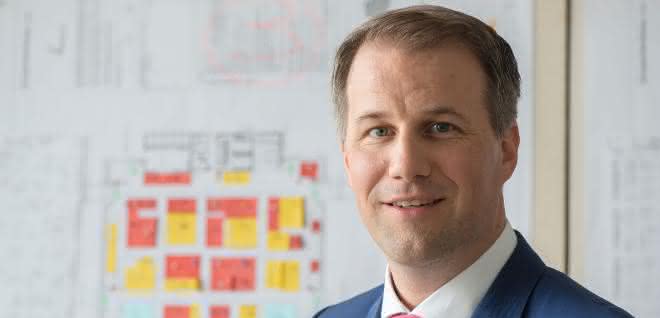
In February 2019, the intralogistics industry will have its next trade fair highlight in Stuttgart: over 1,600 exhibitors are expected at LogiMAT 2019. The 2019 edition is the first under the direction of Michael Ruchty, who took over the reins from "Mr. LogiMAT" Peter Kazander in March 2018. LT-manager spoke to Michael Ruchty, Project Manager at Euroexpo Messe- und Kongress-GmbH, about trade fair planning, looking at the big picture and his love of puzzles.
LT-manager: Mr. Ruchty, in view of the trade fair's successful years, is there actually an easier job than managing LogiMAT?
Michael Ruchty: Editor-in-chief at LT-manager (laughs)? Joking aside, it is of course a very pleasant job. But in view of the large number of exhibitors and the variety of requests and requirements, it's not quite as easy as it looks. But it's always fun.
LTM: Success awakens desire?
Ruchty: Definitely. We have many "repeat offenders", i.e. exhibitors who have been with us for a very long time and who ask for more space, more space and more space. Unfortunately, we often have to disappoint exhibitors who have been with us for 16 years, because we don't want to give up the diversity that has characterized Stuttgart from the very beginning. This is what makes LogiMAT what it is.
LTM: How big are the footsteps of "Mr. LogiMAT" Peter Kazander?
Ruchty: Peter Kazander's shoe size is 45, I'm 41 - so I still have plenty of room in that respect. Of course, Peter has left behind a huge legacy, but his door is always open to me. I've also been working alongside him for several years and have already been involved in many operational activities in the background.
LTM: Are there exhibitors who still call Peter Kazander when Mr. Ruchty has said "no"?
Ruchty: Yes, but I think that happens more out of habit over the past 16 years. Ultimately, we both want the same thing: The best result for our exhibitors and trade visitors.
LTM: What could you learn from Mr. Kazander?
Ruchty: Above all, how to deal with everyone involved, not just the exhibitors. I try to internalize Peter Kazander's spirit of partnership. That is one of the trade fair's major success factors. Always being on site, always being there, even if it's just a flower arrangement that's missing and that an exhibitor really wants immediately.
LTM: What stage of trade fair preparations are you currently in, in September?
Ruchty: We sent out the hall plans and placements in July and are currently in the process of implementing smaller and larger customer requests, mainly with regard to repositioning. We are also working hard on the supporting program.
LTM: When the early booking phase is over at the end of May, the big puzzle of hall occupancy begins?
Ruchty: Yes, when you're sitting there in front of it at the beginning, you always have the feeling, "This will never work". It's a huge puzzle...
LTM: Does that cover your puzzle needs or do you also like doing puzzles privately?
Ruchty: No, that will only come when my son is old enough for it ...
LTM:... then the number of pieces is also very manageable (laughs). On the other hand, you can't cut puzzle pieces to size like stand plans. And you really still plan the trade fair on paper?
Ruchty: Yes, we have true-to-scale plans here in which we put the stands. It's much easier to take into account all the different exhibitor requirements when you have the stands in your hands. At the end, the plan is then digitized and of course measured with a CAD program.
LTM: And then you send out the plans and turn off the phone for the time being?
Ruchty: Yes, for at least a week (laughs). Of course not, you can imagine that once the stand locations have been sent out, the phone doesn't stop ringing. With 1,200 stands, it's clear that not everyone is immediately satisfied. And those who are rarely call and praise us (smile). Our biggest challenge is that the trade fair is almost full when the plans are sent out and the room for maneuver is correspondingly small.
LTM: Is the Stuttgart location set, and if so, for how long?
Ruchty: There are no plans to leave Stuttgart. The contracts have been concluded beyond 2019. And, what makes us very happy: we have heard of plans to build another hall.
LTM: My next question would have been about Plan B, i.e. what to do if the trade fair continues to grow ...
Ruchty: Then our boundless creativity will be called upon every year anew. The new Hall 11 will still be a few years away.
LTM: So you don't have to move to the roof or into tents?
Ruchty: We have Hall 2 and the gallery in Hall 1 available for the first time in 2019 and the response has been excellent. In other words, there will also be more space in 2019.
LTM: The tent idea persists ...
Ruchty: A tent could be erected, but the logistics situation on site doesn't allow it. The tent can't be set up until Monday evening and is extremely expensive. What's more, with a tent it's like so often in life - everyone wants it, but nobody wants to go inside. And it would get very chilly on the roof (laughs).
LTM: So the timing of the trade fair is also fixed?
Ruchty: Yes, LogiMAT will remain in the spring.
LTM: What do you think LogiMAT can do better than the trade fair in Hanover?
Ruchty: In one word: customer service. Exhibitors often tell us that with "us", all it takes is a phone call if you have a problem and a solution is found straight away. I don't want to say any more about the differences, it can't be our job to give Deutsche Messe AG tips on how to run a trade fair.
LTM: Are there any plans to expand the content of the trade fair or is that out of the question given the cramped exhibition grounds?
Ruchty: No, but we can adapt. We look very closely at the directions in which the markets are developing. We have ideas ourselves, but we pay close attention to the exhibitors' input.
LTM: How do you weigh up new exhibitors from new sectors against the "old-timers"? Ten new or ten old?
Ruchty: Not at all. We look after our loyal, long-standing exhibitors and of course we pay attention to "refreshing" them. We are currently expecting around 250 new or returning companies for LogiMAT 2019, i.e. companies that have not exhibited in Stuttgart in the past three years. Of course, the halls always look the same at first glance, but there are always changes. Many companies also give us feedback that their customers have learned over the years where their stand is located and therefore no longer want to change. In this respect, it is sometimes good not to experience any surprises as a visitor.
LTM: I experience surprises at the trade fair year after year, but that's more down to my poor sense of direction than your trade fair planning (laughs).
Ruchty: You can definitely get lost, in 2019 we're talking about 120,000 square meters in total ... We're working on keeping the visitor aisles as straight as possible, even for you (smiles).
LTM: How does and will the trade fair maintain its independence now that the trade fair organizer belongs to a large publishing house?
Ruchty: Euroexpo as the trade fair organizer was founded in 1996 as an independent GmbH and has been its organizer since 2003 after the trade fair changed its name. There are no links to the rest of the publisher's portfolio. The same applies to our media partners as to our exhibitors. Everyone is treated equally and fairly. That is a promise.
LTM: Mr. Ruchty, you have been "doing" trade fairs since 2007. What do you see as the most significant change or development since then?
Ruchty: Digitalization. Ten years ago, we printed and sent out the manuals for exhibitors. Fortunately, this can now be done digitally. At the trade fair itself, both the quantity and the quality of the exhibition stands have improved. If you look at how much detail most stands are planned, that used to be different. Ten years ago: Gray wall and maybe a poster on it, done. I'm always impressed by how much more effort companies put into presenting themselves at trade fairs. However, due to the limited options for stand sizes, LogiMAT is still not a show trade fair but a working trade fair. That's a good thing, we leave the "show-making" to other trade fairs.
LTM: What has changed among the visitors?
Ruchty: They come to the trade fair much better prepared and act in a very targeted manner. You can no longer just go to Stuttgart and see the trade fair in one day. You need three days to see everything. On average, visitors spend 1.5 days at the trade fair according to our FKM-approved evaluations.
LTM: What other tools can trade fair organizers develop to give visitors more benefits during their visit to the exhibition grounds?
Ruchty: That's not an easy question. First and foremost: communication. Thanks to our many media partners, we try to achieve unique advance coverage in the trade magazines. We have also expanded the app for the trade fair this year, but we want to keep the trade fair human and not impose everything digitally or virtually on the visitor. The trade fair is a marketplace for people.
LTM: What efforts are being made to get the traffic situation to and from the trade fair under control?
Ruchty: As part of the expansion of the exhibition grounds, two new parking garages are being built, which are even scheduled to be completed before Hall 11. We are very pleased about this, because parking is one of the main problems at the trade fair. Yes, it was true, before the start of LogiMAT 2018 all hell broke loose on the first day, but it cleared up from ten or half past ten. We are in constant contact with the Traffic and Safety department at Messe Stuttgart, which is doing a great job. With a trade fair of this size, the odd traffic problem is unavoidable.
LTM: What is the most important quality a trade fair manager needs - apart from an affinity for puzzles, as I was able to learn ...?
Ruchty: Heart and soul and a super committed team. And a green thumb, because the LogiMAT plant must continue to be nurtured in order to offer exhibitors and trade visitors this high quality from year to year
LTM: What is your favorite part of being an exhibition director, and which do you like less?
Ruchty: I experience the difficult moments in front of the hall plans, when I think to myself, "How is it all going to fit in and together". That often causes headaches. The best moment is the day when the trade fair opens and you can see that everything is running smoothly. Then, in the worst case, the only headache is the beer on the exhibitor evening.
LTM: Mr. Ruchty, thank you very much for talking to us.
Marvin Meyke and Martin Schrüfer spoke to Michael Ruchty. Incidentally, "Mr. LogiMAT", the hero of the 2/11 issue of LT-manager and Michael Ruchty's predecessor as trade fair boss, is still around: according to reports, Peter Kazander's thoughts are now focused on LogiMAT China (15-17 April 2019, Shanghai).
Michael Ruchty has been with Euroexpo Messe- und Kongress-GmbH in Munich since May 2011. Initially working as a trade fair consultant and from 2016 in project management, he has been responsible for LogiMAT - International Trade Fair for Intralogistics Solutions and Process Management in Stuttgart since March. The forwarding agent began his professional career in 2004 at a sporting goods manufacturer, where he worked in customer service, sales and product marketing. In 2007, Ruchty moved to an international trade fair organizer headquartered in Brussels. As DACH Project Manager at the Munich office, he was responsible for the expansion and strategic development of trade fairs in the logistics and maintenance sector before continuing his trade fair career at Euroexpo in 2011.


You might also be interested in
Peter Kazander on his way to retirement
A farewell in installments
Euroexpo, the Munich-based organizer of the intralogistics trade fair LogiMAT in Stuttgart, is gratefully saying goodbye: After 20 years, Managing Director Peter Kazander took the first step towards retirement on 30 June 2023.
 read more...
Hannover Messe: CeMAT becomes Logistics
Often postponed, now finally communicated: At the Hannover Messe, Deutsche Messe AG also announced how it envisions the future of the CeMAT sub-brand: integrated.
read more...Editorial materialfluss 03/2019
The limits to growth
What the Club of Rome think tank propagated just 50 years ago (and which, incidentally, is still quoted in many CEO presentations by German intralogistics companies), namely the limits to growth, concerned the global economy.
read more...But there was ONE highlight at LogiMAT
Intra Logistik writes what she thinks - this time about her personal impressions of LogiMAT in Stuttgart.
read more...Editorial materialfluss 01-02/2019
On the summit
Passionate hikers know the feeling: when you finally reach the summit, you take a break and let your gaze wander over the vast landscape. And then it's downhill. Inevitably! Whether this image can also be applied to the upcoming intralogistics trade...
read more...Vanderlande Industries: For short lead times
E-commerce has changed consumer expectations. They demand speed, accuracy and flexibility throughout the ordering and delivery process. Vanderlande understands the complexity that comes with a successful...
read more...Conveyor technology & components
Habasit: Extra wide for the material flow
In Stuttgart, Habasit will be focusing its trade fair presence on wide timing belts from the HabaSync product family. With a width of up to 600 millimetres, they are currently the widest timing belts available on the market and are suitable for a...
read more...14-16.03.2017: 15th LogiMAT
Event motto: tba Organizer: EuroExpo Date: 14-16.03.2017 Place: Stuttgart Location: Messe Entrance fee: tba LT-manager has been an annual media partner of LogiMAT since 2010. More...
read more...Ricola modernizes intralogistics with Stöcklin
Ricola relies on Stöcklin for the retrofit of its high-bay warehouse at the Laufen site.
read more...