

Software
Software makes intralogistics valuable
Omnichannel business should now be part of everyday life for many companies that previously relied on direct sales or their dealer network. This is because end users use the procurement channels that seem easiest and cheapest to them at the moment. The choice of the right warehouse management system plays a central role in this.
If you ignore the web store in favor of other sales channels, for example, you are ignoring customer needs. Digital and traditional communication and sales channels will run in parallel in the future, but must be closely networked with each other, otherwise efficiency will fall by the wayside. This applies above all to intralogistics, for which it makes a considerable difference whether a manufacturer of industrial products supplies its dealer with a call-off order or whether the end user is waiting for an urgently needed part after clicking the mouse. Orders are received via the Internet, via MRP orders from branches or from sales staff via the ERP system. Customer service and returns handling are also increasingly taking place online. This is not only the case for the Amazons and Zalandos of this world, but also for medium-sized mechanical engineering companies. What opens up new channels for sales and is particularly user-friendly and convenient for the customer, poses a major logistical challenge. Manufacturers, dealers and service providers have to be extremely flexible, respond to customer requests in real time, deliver on time and earn money even with order size 1. To ensure that all processes run smoothly and error-free from receipt of the order to delivery, software is crucial in addition to high-performance storage and sorting technology.
Core functions of a WMS
Goods receipt:Internal warehouse processes:
- Notification
- Receipt
- Deconsolidation
- Quality inspection
- Putaway
- Stock confirmation
- Returns management
Goods issue:
- Stock transfer
- replenishment
- Transfer posting
- stocktaking
- Control station
- Order management
- Order picking
- consolidation
- packing
- dispatch
- Delivery confirmation
Scalable in functionality, size and performance
In order to process all orders efficiently, it is advisable to use a warehouse management system (WMS) that is scalable in terms of size, performance and, above all, functionality - and that communicates with common ERP systems and supplementary systems such as customs or transport management via standard interfaces. This not only manages warehouses and stocks, but also controls intralogistics processes. It organizes, prioritizes and processes orders that are received via the various sales channels. The WMS coordinates incoming goods, putaway, storage position, retrieval, picking, packing, outgoing goods and dispatch. Whether small warehouses with low throughput, distribution centers with several hundred thousand order lines per day, complex logistics centers with different storage zones and high performance, automated warehouses or manually or forklift-operated systems: with a modern WMS, the required resources, storage and picking types can be activated at the click of a mouse. The WMS adapts to a company's growth, changing needs and new article structures. It also controls shuttles, stacker cranes, conveyor technology, sorters and other mechanical components and is able to take over the management and visualization of complex material flow systems.
Wide range of customization options
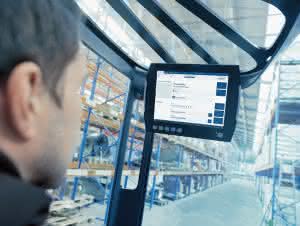
Some software providers offer additional functions such as batch and serial number management, energy and client management as well as taking into account the date of manufacture and best-before date. Such WMS can be used across all industries. The expansion modules of a warehouse management system also include software packages that support different picking principles, among other things.
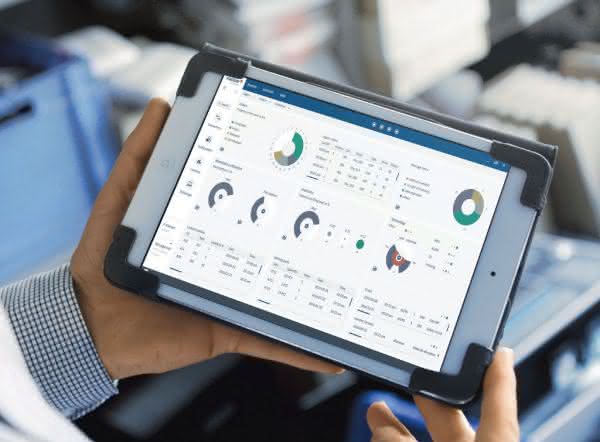
Although a warehouse management system controls complex tasks in a company, it must be simple and intuitive for managers to use, even via smartphone or tablet. Every employee should be able to use the software without a great deal of training. A self-explanatory, graphical user interface is therefore essential. With the help of various dialogs, the control room employee has a precise overview of all progress in order processing.
WMS optimizes entire supply chain management
The advantages of a modern warehouse management system lie in the rapid processing of warehouse inquiries and the recording of warehouse stock in real time. Such a WMS increases process reliability and enables optimal use of all warehouse resources. This reduces storage costs and increases the company's profitability at the same time.
Markus Müllerschön


You might also be interested in
Arvato implements shuttle system for H&M in Poland
H&M will be able to handle its logistics in Central and Eastern Europe faster and more agile in future: Arvato has expanded its e-commerce distribution center in Stryków, Poland, and installed an automated shuttle warehouse with a capacity of up...
 read more...
Automation using shuttle technology and SAP
GC Corporation develops, produces and distributes dental products. In order to make the European subsidiary, GC Europe, fit for the future to meet increasing logistical requirements, the company expanded its storage and picking capacities at the...
read more...Intralogistics for steel wholesalers
Lemvigh-Müller relies on Knapp
Lemvigh-Müller is making its largest investment in logistics to date and centralizing two warehouses in Odense and Kolding, both in Denmark, into one distribution center in Kolding. This will ensure that Lemvigh-Müller can handle larger volumes of...
read more...New shuttle warehouse for BSH Hausgeräte in Dillingen
The ground-breaking ceremony for a shuttle warehouse for household appliance specialist BSH Hausgeräte recently took place in Dillingen, Bavaria. TGW Logistics will build a highly automated small parts warehouse there by spring 2027.
read more...Combined storage solution with transshipment and pallet warehouse
With the newly founded Faurecia Clarion Electronics (Fengcheng), Faurecia aims to become a global leader in electronics technology for vehicle cockpits. When it comes to intralogistics, the company relies on a combined warehouse solution from...
read more...Storage and order picking technology
SSI Schaefer automates for the market leader in ready-to-eat salads
Fresh Servant maximizes its performance through automation at its logistics center in Edsevö, Finland. The company relies on a complete system from SSI Schaefer, consisting of an SSI Cuby shuttle warehouse, pick-by-light picking and the WAMAS...
read more...30 million spare parts shipped annually
The manufacturer and supplier of automotive spare parts DRiV has put a new automated distribution center for Europe into operation. An automation solution from Knapp forms the heart of the system.
read more...Production and assembly flexibly supplied
Automotive supplier Magna manufactures exterior mirrors at its Assamstadt site in Germany. Magna relies on an automation solution from Knapp to cope with the changes in logistics and to be able to operate flexibly with a high level of vertical...
read more...Novaltia builds new distribution center with Knapp
The Spanish pharmaceutical wholesaler Novaltia is once again relying on a complete solution from Knapp: In the new distribution center at its headquarters in Zaragoza, logistics processes are to be streamlined and sequences made more precise by...
read more...