

Politics promotes the digital future
7.7 million euros for European Blockchain Institute at Fraunhofer IML
At the European Blockchain Institute in NRW (EURO-CHAIN), the Fraunhofer Institute for Material Flow and Logistics IML will work with companies and other research institutions to advance blockchain technology in the future. NRW Minister of Economic Affairs and Digital Affairs Prof. Dr. Andreas Pinkwart recently handed over the 7.7 million euro funding decision to the directors of the Fraunhofer IML.
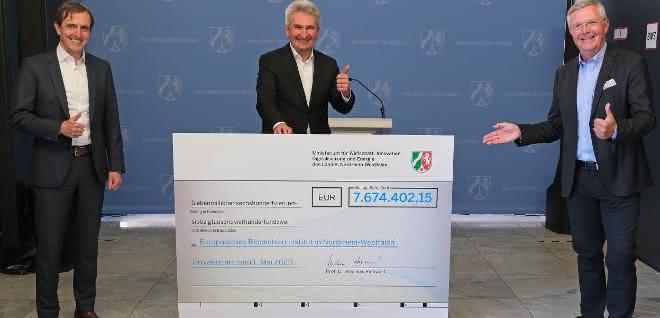
"The project to establish the Blockchain Institute will create a unique European institute at Fraunhofer IML that will drive forward digitalization in science and practice. As a key technology, blockchain has the potential to make data exchange tamper-proof and to automate and autonomize a large number of processes in the value chain in the future," says Prof. Michael Henke, Director of Fraunhofer IML, describing the importance of the technology. As transparent and decentralized registers for transactions, blockchains play a key role in the digitalization of the economy. They make the sensible use of numerous other technologies possible in the first place.
The research at the European Blockchain Institute thus complements the work of the Dortmund scientists and ties in directly with the existing research infrastructure at the science location: "Blockchain technology will only unfold its full impact in the coming years and this will happen in logistics. In combination with digital platforms, artificial intelligence and the Internet of Things, a new and self-organizing 'Silicon Economy' is emerging. We are delighted to have brought the European Blockchain Institute to the heart of European logistics - because that is where it belongs," explains Prof. Michael ten Hompel, Managing Director of Fraunhofer IML.
Over the next five years, the scientists will be working on open source solutions in the form of software, hardware and business models relating to blockchains. They will develop these for and with companies of all sizes. In logistics and supply chain management in particular, many different, economically independent partners work closely together, but do not necessarily trust each other. The focus of research is therefore on open and holistic solutions that can be used by all players on the market. The aim is to connect entire logistics chains digitally from end to end.
"We are facing a new stage in the digitalization of the economy. Technologies such as blockchain, the Internet of Things and artificial intelligence are fundamentally changing the way we do business and opening up completely new opportunities for companies. The European Blockchain Institute will decisively advance the logistics sector in North Rhine-Westphalia in particular and make an important contribution beyond the borders of our state," emphasizes NRW Minister of Economic Affairs and Digital Affairs Pinkwart.
The EURO-CHAIN project consortium consists of the Dortmund Fraunhofer Institutes IML and ISST as well as the Chair of Corporate Logistics and the Chair of Materials Handling and Warehousing at the Technical University of Dortmund. 25 employees are to be employed at the institute in the future. Following the project period, it is to be established as a sustainable and permanent institution.
You can find out more about funding here: https://www.wirtschaft.nrw/pressemitteilung/landesregierung-foerdert-europaeisches-blockchain-institut-mit-77-millionen-euro


You might also be interested in
AEB and Fraunhofer IML cooperate
End-to-end digital customs clearance with blockchain
The software provider AEB SE and the Fraunhofer Institute for Material Flow and Logistics IML are working together on a blockchain-based customs solution.
 read more...
On course for the future
The first Hellmann Innovation Day took place in Osnabrück on March 28. New technologies from various manufacturers and cooperation partners were presented as part of an exhibition.
read more...2 Perspective : Blockchain - And now everything is suddenly completely different?
"2 Perspectives" is a new section: Here, we comment on overarching topics that concern the industry and logistics. This time with: Andrea Gillhuber, editor-in-chief of the industry magazine SCOPE.
read more...Blockchain pilot project for container logistics launched
The Port of Rotterdam Authority is launching a blockchain-based pilot project with two other partners. The aim is to integrate physical, administrative and financial flows into the supply chain in a completely paperless manner.
read more...Future Logistics Congress - 43rd Dortmund...
Simplifying logistics with AI
More than 350 participants will come together in Dortmund on September 9 and 10, 2025 for the 43rd Future Logistics Congress. This year, everything revolves around artificial intelligence (AI), resilience and sustainability. Speakers from science...
read more...Starting signal for open source: SKALA provides first components
The Fraunhofer Institute for Material Flow and Logistics IML has published open source components for logistics for the first time as part of the SKALA innovation project.
read more...New version of Röhlig Realtime
Röhlig Logistics presents the enhanced version of "Röhlig Realtime". The company is supplementing its digital service portfolio with a central platform that ensures greater transparency and networking throughout supply chain management.
read more...Strategic route planning reorganized
Strategic route planning is one of the key success factors for retail companies. It structures routes and areas, reduces costs, ensures optimal use of resources and increases customer satisfaction.
read more...German Innovation Award for IGZ
Autonomous AI control station for logistics centers wins award
The autonomous AI control center "Smart Logistics Cockpit" from IGZ was awarded the German Innovation Award 2026 in gold. The solution automates central control station activities in logistics centers and is designed to significantly increase...
read more...