

Warehouse planning
Yale simulates and visualizes warehouse scenarios
Visualization and simulation tools for scenario planning make it easier to cope with unexpected changes. "Logistics is constantly changing," says Ron Farr, Director Warehouse Sales EMEA at Yale Lift Truck Technologies.
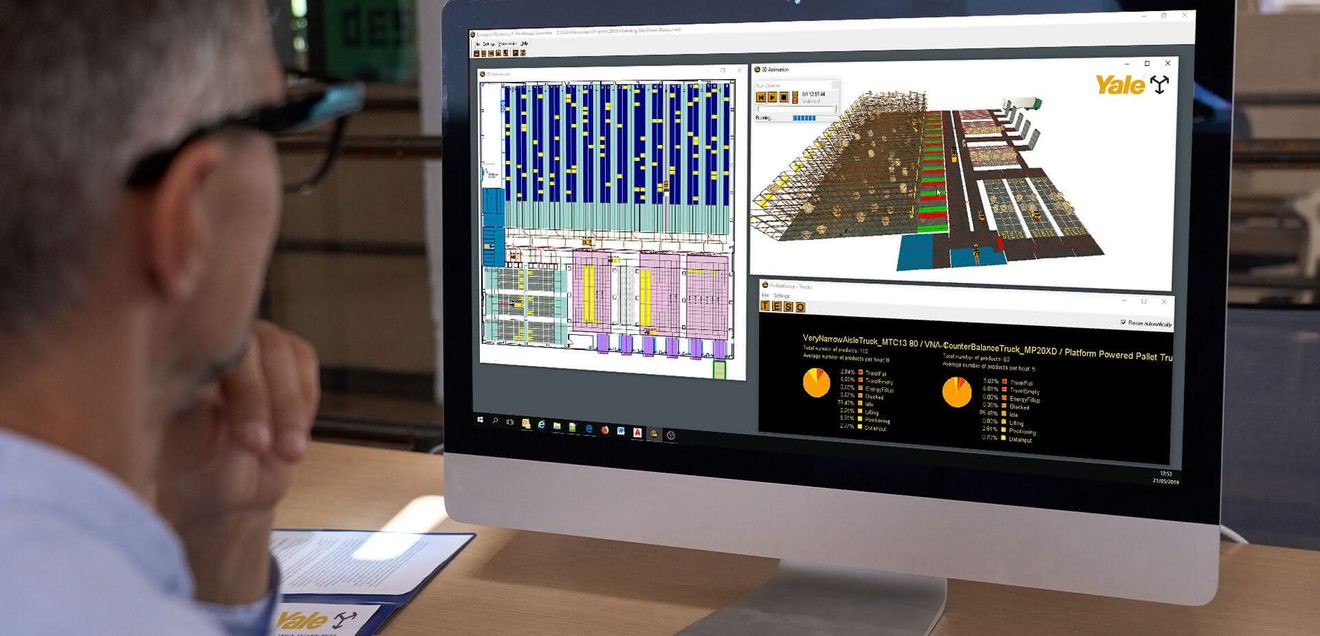
"Companies don't just have to decide on a fleet that works in the current situation. They also need to consider how the equipment can be adapted in the future." With a global network of independent dealers, the forklift truck manufacturer supports customers locally with data-based simulation and visualization solutions. It uses the Yale Warehouse Simulator, a software program that can develop various warehouse layouts based on real situations.
Complex mathematical calculations provide statistics on fleet performance and efficiency based on different scenarios. The tool allows companies to experiment in two and three dimensions with different layouts, configurations of forklifts and time sequences, including data analysis. This can support the planning of scenarios and prepare companies in the best possible way for unknown changes in the warehouse. The simulation model is based on the real world.
The details range from forklift trucks with different tasks and fixed maintenance intervals, to storage areas where the supply of goods is stagnant, varying quantities of pallets, congestion on transport routes and the number of trucks used to optimize the flow of goods and productivity. Together with its dealers, Yale can therefore recommend the optimum combination of industrial trucks for the respective warehouse requirements.


You might also be interested in
Software for intralogistics
TUP Warehouse Management Solutions is coming to Logimat with its warehouse management solutions. Artificial intelligence will also be a topic at the stand.
 read more...
Software and identification systems
Into the Dark: The camp of the future
Automated and digital processes in dark warehouses increase productivity and optimize resources.
read more...Fraunhofer-IML validates SSI Schäfer Software Wamas
The Fraunhofer Institute for Material Flow and Logistics has successfully validated SSI Schaefer's Wamas WMS (Warehouse Management System) software.
read more...Raiffeisen Agil digitizes with Opheo
Raiffeisen Agil Leese eG, based in Lower Saxony, will be using the Opheo transport control center to manage its fleet of 25 trucks and 31 wheel loaders, mobile shredders and screening machines from the second quarter of 2024.
read more...Digital warehouse management for SMEs
A few years ago, all processes in the various warehouses of the medium-sized company Sanitär-Heinze were still paper-based, but today they are completely digitalized.
read more...Klinkhammer's new WMS generation pleases the user
Intralogistics system integrator Klinkhammer is presenting the new graphical user interface and interaction logic of its warehouse management software Klinkware 11 for the first time at Logimat.
read more...Software in logistics and transportation
Successful changeover
Klinkhammer expanded the automated small parts warehouse and order picking at toy manufacturer Simba Dickie in Sonneberg. In the course of this, the system integrator relied on its partner SWAN to introduce the SAP Extended Warehouse Management...
read more...Multi-level shuttles ensure speed at Göpfert
Göpfert relies on multi-level shuttles from Klinkhammer and intelligent software. The result: an intelligent material flow concept with optimized arrangement of the conveyor technology. The machine manufacturer is thus increasing its performance in...
read more...Logistics processes intuitively under control
Symbiolog has set up a logistics center in Burgbernheim that offers services for manufacturers in the sanitary, heating and air conditioning (SHAC) industry with modern storage and picking technology. The viadat 9 software enables the efficient...
read more...