

AI-supported solutions
Generative AI in the automation environment
The mechanical engineering and automation industry is undergoing profound change. This transformation is being driven by more volatile global trade, geopolitical crises and increasing market pressure, which demands greater agility, technological security and cost efficiency.

New technologies such as cloud solutions and AI systems are having a disruptive impact on the market. In order to be competitive, AI-supported solutions are needed to deliver added value faster and in higher quality and to automate repetitive tasks.
The cooperation project between Siemens, Microsoft and Thyssenkrupp Automation Engineering on the use of generative AI in the automation environment aims to tackle the current challenges in PLC programming. The aim of the project is faster, more efficient and qualitatively improved PLC code generation and further processing as well as its qualitative validation. This represents a major step towards reducing existing project risks and project costs. "This means nothing less than a democratization of the technology and a further step in the spread of technology," says Marcel Pfeiffer, Head of Digital Factory Solutions at Thyssenkrupp Automation Engineering.
The application combines operational technology with information technology. In doing so, Thyssenkrupp Automation Engineering utilizes its extensive experience in demanding, fast-moving customer projects with complex requirements and tight schedules. This expertise is combined with Siemens' automation portfolio and Microsoft's comprehensive GenAI expertise in the areas of software solutions, AI services and cloud applications.
AI assistant supports people
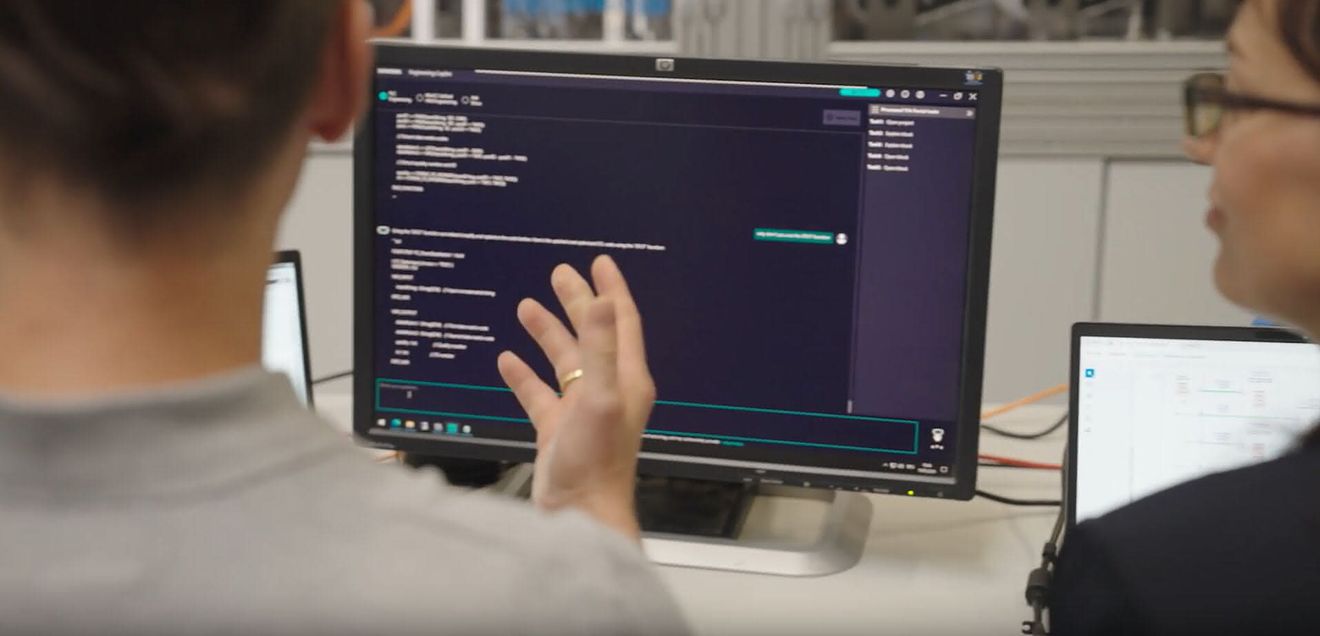
The Engineering Copilot from Siemens is a generative AI-based assistant that supports people in their work and can take over repetitive tasks. The Engineering Copilot is directly connected to the Siemens TIA Portal development environment and offers the following functionalities: automated generation of HMI screens, automated PLC code generation and a chat function to resolve queries about the TIA Portal quickly and efficiently.
The Industrial Copilot is based on the powerful Azure OpenAI Services from Microsoft and uses proven data sources for input. A combination of process sequence description, cycle time diagram, geometric description of the system (CAD file), circuit diagram (CAE file) and customer PLC specifications is used. A particular advantage of the project is that the copilot is already used in the early development phases. Instead of testing the code sequences on the real system, this is initially carried out using a digital twin. The seamless transition to the physical object then takes place in later development phases. As a result, the Industrial Copilot remains active throughout the entire development process and ensures both faster development and higher quality results. The result is data output in the form of HMI screens, PLC code and its validation. "In the specific case of technology transfer and its further development, a production system for battery cells was selected, as is used by numerous European car manufacturers. Here, the Engineering Copilot was able to exploit its full potential throughout the entire development and finalization process," says Carsten Krauß, Head of Controls, Business Line Battery at Thyssenkrupp Automation Engineering.
The advantages of the Engineering Copilot and its integration into the product development process are manifold. The first is risk minimization. Previous processes in PLC code generation become more predictable and personnel resource bottlenecks can be better compensated for. Thanks to the support of generative AI and user guidance provided by the GenAI-based Siemens Industrial Copilot, newcomers can become experts in no time at all. Since it allows input in natural language, interacting with the Siemens Industrial Copilot is as easy as having a technical discussion with a colleague. Beginners will therefore be able to quickly generate, optimize and debug complex automation codes on instruction. In addition, repetitive tasks can be delegated to the co-pilot, resulting in a reduced workload and shorter development times. Simple and user-guided creation enables rapid system visualization. Thanks to the low-threshold access, a high level of user acceptance is also achieved. The ability to plan PLC code creation more precisely makes it much easier to reduce project risks and tap into growth potential.
Improve the quality of the PLC code
One factor that should not be underestimated is the standardization and quality improvement of PLC code as the basis for a harmonized code reference database. This assistance system represents a low-threshold offer that enables companies across all industries to achieve their goals in the area of PLC code creation and validation in a more predictable, faster, more cost-effective and higher-quality manner. "To summarize, the Engineering Copilot TIA Essential with groundbreaking AI technology addresses the primary challenges in the field of PLC programming and this cooperation project offers Thyssenkrupp Automation Engineering a clear global competitive advantage in terms of efficiency and quality," says Marcel Pfeiffer. The technology will be presented by Thyssenkrupp together with Siemens and Microsoft at the Siemens booth during SPS in Nuremberg.
SPS, Hall 11, Stand 100


You might also be interested in
Kion gets off to a strong start in 2026
Significant increase in incoming orders
The intralogistics company Kion Group records a significant increase in order intake in the first quarter of 2026 and increases profitability and cash flow despite geopolitical uncertainties.
 read more...
System integration meets intelligent robotics
Trapo becomes Omron Solution Partner
Trapo is a new Omron Solution Partner. Through this partnership, Trapo is adding mobile robotics (AMR) and intelligent automation technologies to its portfolio.
read more..."Synapticon Intelligence" business unit...
AI is becoming a critical competence for success
Synapticon, provider of solutions for integrated motion, announced the launch of Synapticon Intelligence as an internal project in the spring. Now the company is taking the next step and establishing Synapticon Intelligence as an independent...
read more...Flexible automation and seamless integration
More and more automation technologies are finding their way into intralogistics. Various conveyor systems, storage, transport and picking robots promise efficiency and improved ergonomics.
read more...Efficient warehouse logistics thanks to fully automated conveyor line
Six storage areas on three levels, two vertical conveyors and a converted, 140-meter-long truck loading ramp - these are the cornerstones of the new pallet conveyor system at Raiffeisen Kraftfutterwerke (RKW) in Kehl.
read more...Autonomous mobile robot solution
Optimized logistics in electric motor sales
Together with Ølgod Elektro, Brd. Klee has implemented an autonomous mobile robot solution from Omron to streamline order processing and optimize logistics processes.
read more...Efficient material flow at Phoenix Contact
Modules as required
One of Prismat's largest EWM projects has been in live operation at Phoenix Contact since the end of 2023. Since then, the company has benefited from a highly efficient material flow in its distribution center thanks to the standards-compliant...
read more...Robotics optimizes life cycle assessment
The Autostore automatic storage and retrieval system enables high storage density and flexibility.
read more...Still presents integrated automation solution
In its iGo automation solution, intralogistics specialist Still aims to combine the entire range of automated solutions.
read more...