

Power supply/motors/drives
Intelligent supply of autonomous vehicles with electrical energy
There is hardly an industry at the moment in which there is no talk of autonomous vehicles. Whether drones in parcel delivery, shuttle systems in intralogistics or driverless transport systems in the automotive industry - the requirements for flexibility, networking and collaboration are high in the context of Industry 4.0. The key question here is: how do autonomous vehicles reliably get the electrical energy they need?

In principle, batteries are one way of supplying autonomous vehicles with energy. However, they are relatively expensive and heavy. They also have to be charged or replaced manually. An attractive alternative could be an automatic charging process in defined areas by automatically contacting the vehicle with a charging contact.
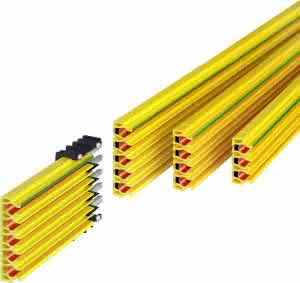
Conductix-Wampfler charging contacts have proven themselves in practice many times over for the automatic recharging of electric vehicles. Charging can also take place at waiting positions in the process sequence. This means that downtimes can be used sensibly. In most cases, direct charging is made possible by a stationary charger with which the vehicle automatically makes contact in a predefined area. This reduces the weight of the vehicle and thus saves energy. A direct voltage of 24 or 48 volts is transmitted. However, signals or data (e.g. CAN bus) can also be exchanged between the vehicle and the charging station via optional pilot contacts.
Modular design enables flexibility
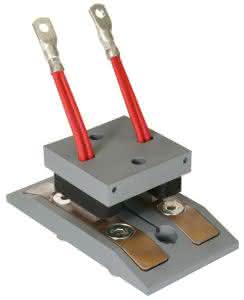
The modular design of current collectors and the base plate of the solutions developed by Conductix-Wampfler makes it possible to cover different charging currents from 20 to 600 amperes as well as mechanical tolerances at low cost. This means that even supercaps or larger lithium-ion batteries with higher charging currents can be charged reliably and safely. The extremely compact installation space is in line with the trend that the autonomous vehicles or service robots to be supplied are becoming ever smaller, faster and lighter.
As reliable contacting and a long service life are of fundamental importance to the operator of a system, the Conductix-Wampfler charging contacts have a metal ramp. This ensures that the current collector does not come into contact with the plastic insulation when driving up the side. This reduces abrasion and wear. It also prevents plastic particles from impairing current and signal transmission - especially at low voltages.
Conductor rail and charger for satellites in pallet warehouse
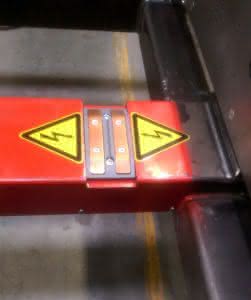
Conductix-Wampfler's loading contacts are used in robot-based pallet storage systems with high storage densities, for example in the beverage industry. The pallet shuttles are supplied via the MultiLine 0831 conductor rail from Conductix-Wampfler. The pallets are picked up by satellites and can therefore be stored several deep - with a high throughput at the same time. The satellite is always recharged via a 20 A charging contact from Conductix-Wampfler when it has docked on the shuttle - its "mother ship", so to speak - regardless of whether it is loaded with a pallet or on an empty run.
Simon Dülffer
About Conductix-Wampfler
With its own companies and a number of partner companies, the Delachaux Group is represented in many industrialized countries. Conductix-Wampfler's core competence lies in the development, production, consulting and installation of solutions that provide answers to all questions relating to energy and data transmission for mobile consumers. Its customers include crane construction companies, manufacturers of personnel transportation systems, suppliers of storage and conveyor technology, the automotive industry and mechanical engineering companies. The company unites all the technologies commonly used today for energy and data transmission, such as festoon systems, conductor rails, energy guiding chains, spring cable reels, motorized cable reels, slip ring assemblies and non-contact energy supply systems, under one roof.


You might also be interested in
Arvato implements shuttle system for H&M in Poland
H&M will be able to handle its logistics in Central and Eastern Europe faster and more agile in future: Arvato has expanded its e-commerce distribution center in Stryków, Poland, and installed an automated shuttle warehouse with a capacity of up...
 read more...
Automation using shuttle technology and SAP
GC Corporation develops, produces and distributes dental products. In order to make the European subsidiary, GC Europe, fit for the future to meet increasing logistical requirements, the company expanded its storage and picking capacities at the...
read more...Intralogistics for steel wholesalers
Lemvigh-Müller relies on Knapp
Lemvigh-Müller is making its largest investment in logistics to date and centralizing two warehouses in Odense and Kolding, both in Denmark, into one distribution center in Kolding. This will ensure that Lemvigh-Müller can handle larger volumes of...
read more...New shuttle warehouse for BSH Hausgeräte in Dillingen
The ground-breaking ceremony for a shuttle warehouse for household appliance specialist BSH Hausgeräte recently took place in Dillingen, Bavaria. TGW Logistics will build a highly automated small parts warehouse there by spring 2027.
read more...Combined storage solution with transshipment and pallet warehouse
With the newly founded Faurecia Clarion Electronics (Fengcheng), Faurecia aims to become a global leader in electronics technology for vehicle cockpits. When it comes to intralogistics, the company relies on a combined warehouse solution from...
read more...Storage and order picking technology
SSI Schaefer automates for the market leader in ready-to-eat salads
Fresh Servant maximizes its performance through automation at its logistics center in Edsevö, Finland. The company relies on a complete system from SSI Schaefer, consisting of an SSI Cuby shuttle warehouse, pick-by-light picking and the WAMAS...
read more...30 million spare parts shipped annually
The manufacturer and supplier of automotive spare parts DRiV has put a new automated distribution center for Europe into operation. An automation solution from Knapp forms the heart of the system.
read more...Production and assembly flexibly supplied
Automotive supplier Magna manufactures exterior mirrors at its Assamstadt site in Germany. Magna relies on an automation solution from Knapp to cope with the changes in logistics and to be able to operate flexibly with a high level of vertical...
read more...Novaltia builds new distribution center with Knapp
The Spanish pharmaceutical wholesaler Novaltia is once again relying on a complete solution from Knapp: In the new distribution center at its headquarters in Zaragoza, logistics processes are to be streamlined and sequences made more precise by...
read more...