

New committee for the professor
Ministry of Transport appoints Petra Schäfer as logistics advisor
Petra K. Schäfer, Professor of Transport Planning at Frankfurt University of Applied Sciences (Frankfurt UAS), has been appointed as a logistics consultant by the Federal Ministry of Transport and Digital Infrastructure (BMVI). The professor at the Department of Architecture, Civil Engineering and Geomatics is thus one of 15 advisors who are to advise the BMVI on the Logistics 2030 innovation program, which was launched in September 2019. The commission includes high-ranking representatives from companies, research and science, as well as representation from the federal states. The first meeting is scheduled to take place on March 24, 2020 at the BMVI in Berlin.
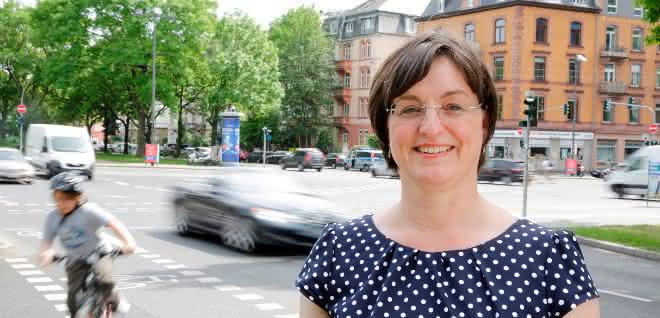
"I am delighted to have been selected as one of only 15 consultants in Germany," says Prof. Dr.-Ing. "I am also looking forward to the challenge facing our team of consultants: To further strengthen and expand Germany's leading global position as a logistics location." Prof. Schäfer is Managing Director of the interdisciplinary ReLUT - Research Lab for Urban Transport. Here, she and her colleagues conduct research in the field of commercial transport and data analysis, develop solutions for the last mile of the logistics chain and analyze and evaluate new mobility solutions such as electromobility and autonomous driving. She can therefore contribute her expertise to the advisory commission.
The declared aim of the Logistics 2030 innovation program is to further strengthen and expand Germany's leading global position as a logistics location. To this end, visions for the logistics sector in 2030 were developed in a comprehensive process for ten strategic fields of action under the leadership of Steffen Bilger, Parliamentary State Secretary at the BMVI. Building on this, concrete measures for innovation, modernization and digitalization were developed to make the freight transport and logistics sector fit for the future. For example, the aim is to enable more transportation and more mobility with less traffic. The areas of action include, for example, digital infrastructures, data processing and platform solutions. One measure in this field is the creation of a future-proof and flexibly expandable data exchange infrastructure, via which innovative new information offerings in the field of mobility and logistics can be easily supplied with the available data offerings. The measures also include the use of artificial intelligence.


You might also be interested in
Who will make it into the Logistics Hall of Fame 2026?
The Logistics Hall of Fame is entering a special election year: in 2026, several new members will be inducted by decision of the Council. Nominations are now open and the gala will return to Vienna in December.
 read more...
Gebhardt expands into France
The Gebhardt Intralogistics Group is expanding into France and opening its first location in Paris. This strengthens the company's presence in one of Europe's most important logistics markets.
read more...The market for service robots
A recent report from IDTechEx analyzes the global market for service robots and examines key applications for delivery and logistics robots, cleaning and disinfection robots, social robots and more.
read more...Expansion in Wesel successfully completed
Logistics complex for plastics and granulates expanded
Greiwing logistics for you has successfully completed its latest construction project in Wesel and opened a new warehouse. The existing logistics complex with silo tower and four integrated filling silos was expanded by a further 4,000 storage...
read more...Workstation system for shipping and logistics
With Sintro Packing, Karl is launching a workstation system that is designed to meet the specific requirements of shipping and logistics. It is characterized by modular adaptability and ergonomic efficiency.
read more...Bobcat presents expanded portfolio for material handling and logistics
Bobcat, one of the world's leading manufacturers of compact equipment, will unveil its new branding at LogiMAT 2024, showcasing its extensive range of material handling machines.
read more...In and (G)out
As the year draws to a close, Michael Schreckenberg, Professor of Physics of Transport and Traffic at the University of Duisburg-Essen, notes an astonishing trend in the year 2023, which is almost over - and not just in logistics, but also in the...
read more...Increased throughput thanks to greenfield-brownfield project
For 25 years, Witron has been the partner of choice for the Austrian food group Spar for the construction and expansion of its central warehouse in Wels. In the fourth construction phase, capacity, efficiency and performance increased dramatically....
read more...Poco expands its commitment thanks to Brüninghoff
Poco, the furniture discounter, has set up a large regional warehouse in the Lüneburg Heath with the help of Brüninghoff.
read more...