

Changed processes
Smart through the warehouse - with autonomous transport systems
If you had told the merchants who founded Bremer Lagerhaus-Gesellschaft in 1877 that more than a century and a half later, self-propelled robots would be whizzing through their warehouses, they would probably have thought you were crazy.
The founding of Bremer Lagerhaus-Gesellschaft took place during the period of German industrialization, when Germany was transforming into a modern industrial nation. During this time, economic and social structures changed fundamentally, and with them the working conditions of logisticians. The founding fathers of Bremer Lagerhaus-Gesellschaft had to react to the changes of their time and make profitable use of technological innovations for the company. And they succeeded. Over 140 years later, the idea of concentrating warehouses on the waterfront and operating goods handling centrally together has become a global logistics company. Today, BLG Logistics has over 100 locations around the world. The group of companies provides around 18,500 jobs and has made a name for itself throughout Europe with its three divisions of Automobile, Contract and Container.
Changing processes through digitalization
Today more than ever, BLG Logistics is required to offer intelligent and customer-specific solutions. This is because digitalization is massively changing logistics and its processes. How can a global logistics company prepare for this? BLG has repeatedly asked itself this question in recent years and has come to the conclusion: The many new topics, technologies and projects need a smart process. BLG Logistics systematically organizes innovations and new technologies that are or could become interesting for the company. Three types have proven their worth: operational projects, research projects and 100-day projects. In the operational projects, impulses and suggestions from day-to-day business and cooperation with customers are implemented. In this way, processes are continuously improved. Research projects focus on long-term commitment. Young technologies in particular generally still require a great deal of development. BLG Logistics conducts research with competent partners on these projects with a time horizon of between three and five years. The third part of the innovation activities is quite different: The 100-day projects. In just 100 days, BLG tests market-ready technologies and implements new solutions directly in day-to-day business.
Machine and human on the side
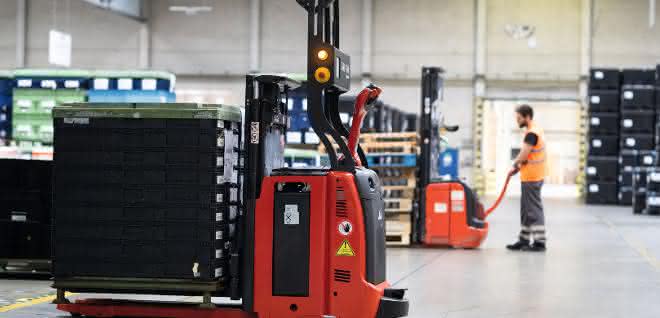
In the latest 100-day project, the logistics company is testing the use of driverless transport systems. The focus of the interpretation of Industry 4.0 is on optimal cooperation between people and logistics objects. Machines are already making work easier at many points in the value chain. They take over physically strenuous or monotonous tasks and thus relieve the strain on employees. The logistics company is also hoping to achieve this added value with its latest test project. Autonomous transport systems have been in use at the logistics center in Bremen for several weeks.
The aim is to test the autonomous pallet trucks in a real environment with people. What happens, for example, when man and machine meet on the floor? The project team set up two different test environments for this purpose. The autonomous pallet truck is supposed to pick up load carriers and unload them at a specified location. Once the driverless transport system has been trained and programmed by the employees, it no longer needs to be operated and moves independently between the previously defined locations. It orients itself with the help of sensors and a previously learned map of the surroundings and therefore does not need any additional marking lines in the warehouse. The autonomous pallet truck also works as part of a team: it can share the map it has learned with other robotic colleagues via a WLAN connection.
Two levels for safety
The transport system has a programmed two-stage safety system to ensure that work in confined spaces runs smoothly, even with colleagues made of flesh and blood. In the first stage, the system slows down and in the second, a braking process is initiated as soon as an obstacle is detected by the sensors. The colleagues were also able to gain the following insight: Precise positioning of the load carriers and routes with as few bends as possible increase the efficiency of the entire system. The autonomous transport systems can be used to automate a whole range of tasks. These include, for example, the transportation of small load carriers or the storage and retrieval of products. The intelligent robot systems can react quickly to constantly changing production conditions or just-in-time provision of goods.
Once the test phase has been completed, BLG Logistics will examine how the project could be transferred to continuous operation and is already in the process of testing the next exciting technology for its possible applications.
Intra says: Clean!
The speed with which BLG Logistics is marching into the future is astonishing: not all logistics service providers are dealing with clever ideas such as 100-day projects, not to mention targeted research. The future will show whether BLG Logistics is interpreting Industry 4.0 correctly. What we can already see today looks very much like it!


You might also be interested in
Dematic and Hai Robotics launch partnership for flexible AMR solutions
Dematic and Hai Robotics have recently agreed a Europe-wide partnership to work together as integration partners in the field of warehouse automation. Through this cooperation, the provider of automation solutions for supply chains and the...
 read more...
The market for service robots
A recent report from IDTechEx analyzes the global market for service robots and examines key applications for delivery and logistics robots, cleaning and disinfection robots, social robots and more.
read more...Application phase for Innovation Award 2026 begins
How can robotics help to make packaging more sustainable? Kuka is looking for creative and innovative ideas in the new round of the Innovation Award.
read more...Exoskeleton with AI power
Robotics company German Bionic presents its most advanced exoskeleton model to date, called 'Exia', which is fully controlled by augmented AI.
read more...Strategic partnership for the promotion of AI
Jungheinrich and Merantix have announced a strategic partnership. The aim of the cooperation is to promote applications based on artificial intelligence (AI) in the industry.
read more...New robotics organization founded
Omron has announced the establishment of a global robotics organization effective April 1, 2025. It will operate in parallel with Omron's automation business so that both areas can complement and support each other.
read more...No-code tool for programming robot user interfaces
ABB provides 'AppStudio', a software tool that allows users of all skill levels to quickly and easily create customized, graphical user interfaces for robots.
read more...SLAM navigation in real time
'Freestyle Localize', 'Trailer Find' and 'Scanner Switch' are three new features of Sigmatek's real-time location software forcontour-based navigation 'SlamLoc'.
read more...Robotic solution: Aiming high under your own steam
The Skypod system is now used in more than 100 order picking warehouses worldwide by companies in all kinds of industries. The autonomous Skypod robots are able to overcome height differences of up to 12 meters.
read more...