

Interview with TST boss
"I've always had my own ideas"
Frank Schmidt not only has an interesting family history, but also the entrepreneurial gene: in this exclusive interview, he explains how he turned a one-man business into a large, medium-sized logistics service provider and what values are important to him.
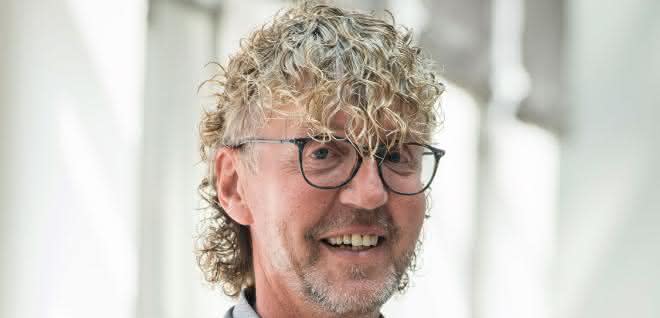
materialfluss: How did you come up with the name Trans Service Team? Normally we tend to talk about Spedition Meier or Meier Logistik ...
Frank Schmidt: I grew up with my parents' business, my father was just a haulier. I had always scratched at the door and always had my own ideas, but my older brothers were set as the management, so I didn't get away with it. That led me to start my own business in 1990. I wanted to drive around in my own truck, enjoy time and peace and quiet. That worked until 1994, but I had no ambitions to grow until then. Then the opportunity arose to take on a big job. And so I sat on the couch - which still exists today - and came up with a name for the company - Trans Service Team: Transporting with Service in a Team, the name was found, quite simply.
mfl: In an interview, you are quoted as saying, "You'll be looking around" when you talked about your detachment from your parents' business. What is behind this?
Schmidt: When you grow up in a large family and are one of the youngest of six children, you have a certain need for recognition. People used to place bets on how long I would be able to maintain my independence - that spurred me on.
mfl: Did you ever reconcile?
Schmidt: We did. My father even managed to put his hand on my shoulder once and say that he was proud of me. That wasn't easy for him. He will be 88 years old this year and now lives right next door to me. I support my parents, although they put big obstacles in my way at the beginning. From their point of view, I was the "black sheep", but I was unstoppable.
mfl: Over the years, you have integrated numerous family members, including your siblings, into the company. How did this come about?
Schmidt: I think I am one of the driving forces behind TST, a driver of innovation. Around 1995, I realized that it could be difficult in the transport sector, we were too dependent on pure transport, so we had to become more independent. That's why we focused on logistics. However, pushing pallets from left to right was not enough for me. So I delved deeper into the material flow and looked at the processes of my first customer. My suggestions were listened to and went down like a bomb. I was allowed to analyze all the plants and adapt the processes. We needed proper warehouses for the step into production-related logistics. And so, in 1996, TST invested the first three million marks in a forwarding facility. This continued in 1998 and we then bought a really large logistics facility because we had the corresponding orders. In 2000, my father had to give up his business because he had concentrated too much on general cargo transportation. I then took over the company and secured all the jobs. The foundations for expansion were laid.
mfl: Do you agree that pure transportation is something that everyone can do now and is still "music" in the services?
Schmidt: That is still true. Back in 1996, we immersed ourselves so deeply in our customers' processes that we were able to influence and optimize the material flow in a production facility. Today, everyone is talking about Industry 4.0 and perfect solutions. They don't exist. There are only intelligent logistics solutions that work in combination with robots and people. When it comes to the human-machine interface, I am confident that we are certainly one of the biggest innovators among logistics service providers. We are known and highly valued by our customers for our very innovative solutions and ideas.
mfl: Are the sophisticated logistics and material flow concepts that you develop for customers more lucrative? Why do you go to the trouble of building up so much expertise in this area?
Schmidt: Yes, you see, we have an equity ratio of 60 percent and, with a few exceptions, we finance ourselves completely, so we are independent of banks. There is no 100 percent solution in logistics, but you can only earn some money with intelligent solutions. Everything around us is logistics, but it's all about getting it right. We used to share the benefits of an improved material flow with customers. Today, we are so fully booked that we only have limited resources available for complex requests in the near future. We need to hire 800 employees over the next two years, but of course it will take time for us to get them all on board.
mfl: 3,000 employees, 300 million turnover, family pacified - what now?
Schmidt: I'm starting with the company, that comes first. I would like to place the company on even more different pillars and develop TST into a brand. We want to expand the service portfolio, but only at reasonable margins. We won't do it for one or two percent. What do you gain from growth if there is nothing left over at the bottom line?
mfl: Thank you very much for the interview.
From truck driver to company boss
Within three decades, Frank Schmidt has built up a logistics company that is now one of the leading service providers for industrial and manufacturing logistics in Germany. It is a story of courageous paths: instead of joining his father's haulage company, Schmidt founded his own company in 1990, aged just 23, and borrowed 180,000 marks from the bank to buy his first vehicle. Just three years later, he moved into his first logistics center and became a service provider for one of Germany's leading cosmetics and detergent manufacturers. When his father's freight forwarding company closed in 2001, he took over the company and hired all the employees and his siblings. With 38 family members now working for Trans Service Team, the Worms-based logistics specialist is a genuine family business. Today, the 52-year-old and his wife Melanie run a company that operates 73 warehouse and logistics locations worldwide with more than one million square meters of storage space.


You might also be interested in
Dematic and Hai Robotics launch partnership for flexible AMR solutions
Dematic and Hai Robotics have recently agreed a Europe-wide partnership to work together as integration partners in the field of warehouse automation. Through this cooperation, the provider of automation solutions for supply chains and the...
 read more...
The market for service robots
A recent report from IDTechEx analyzes the global market for service robots and examines key applications for delivery and logistics robots, cleaning and disinfection robots, social robots and more.
read more...Application phase for Innovation Award 2026 begins
How can robotics help to make packaging more sustainable? Kuka is looking for creative and innovative ideas in the new round of the Innovation Award.
read more...Exoskeleton with AI power
Robotics company German Bionic presents its most advanced exoskeleton model to date, called 'Exia', which is fully controlled by augmented AI.
read more...Strategic partnership for the promotion of AI
Jungheinrich and Merantix have announced a strategic partnership. The aim of the cooperation is to promote applications based on artificial intelligence (AI) in the industry.
read more...New robotics organization founded
Omron has announced the establishment of a global robotics organization effective April 1, 2025. It will operate in parallel with Omron's automation business so that both areas can complement and support each other.
read more...No-code tool for programming robot user interfaces
ABB provides 'AppStudio', a software tool that allows users of all skill levels to quickly and easily create customized, graphical user interfaces for robots.
read more...SLAM navigation in real time
'Freestyle Localize', 'Trailer Find' and 'Scanner Switch' are three new features of Sigmatek's real-time location software forcontour-based navigation 'SlamLoc'.
read more...Robotic solution: Aiming high under your own steam
The Skypod system is now used in more than 100 order picking warehouses worldwide by companies in all kinds of industries. The autonomous Skypod robots are able to overcome height differences of up to 12 meters.
read more...