

Logistics service providers
Food logistics of superlatives
In Aargau, Switzerland, the country's largest bakery has been built and a logistics center that sets new standards. The project is a milestone in the implementation of Coop's logistics strategy. The major distributor's vision is for the company to be largely CO2-neutral by 2023. The planning partner for the complex construction project was IE Food Engineering, part of the IE Group.
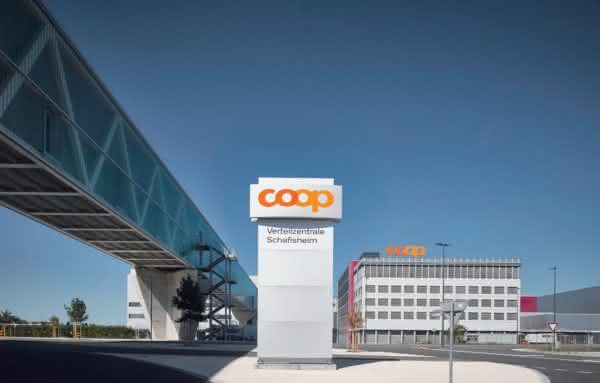
Coop produces 60,000 tons of bread and baked goods at its new logistics site in Schafisheim. The wholesaler supplies 350 stores with food from there. Schafisheim is also the starting point for the national distribution of frozen products. In short: a logistical tour de force is performed here every day. "We have big plans," was the declaration of intent of Leo Ebneter, Head of Logistics at Coop, when the planning of a new logistics center was initiated around seven years ago. Today it is clear what dimensions he had in mind at the time: after three years of construction, a building complex has been created that sets new standards in food logistics.
The mammoth project is a milestone in the implementation of Coop's 2015+ logistics and bakery strategy. This in turn is part of the major distributor's CO2 vision, which envisages the entire company being largely CO2-neutral by 2023. This includes the gradual shift of transportation from road to rail. Coop already transports around two thirds of its goods by rail.
Concentration of three business divisions at one location
In the new building complex in Schafisheim, Coop has set up three divisions at a location with optimal transport and distribution links directly on Switzerland's economic axis. Firstly, the largest bakery in Switzerland and one of the most modern in Europe has been created here: Around 600 employees work in three shifts on traditional wood-fired ovens and high-performance systems with a high degree of automation. During the night, they bake fresh breads, cakes and tarts. During the day, they produce dough pieces - i.e. pre-made products from raw dough - which are frozen on site in the deep-freeze warehouse, distributed to the branches and baked there.
"What the new Gotthard Base Tunnel is for Switzerland, Schafisheim is for Coop logistics."Joos Sutter Chairman of the Executive Board, Coop
The second area that Coop has located in Schafisheim is the national distribution center for frozen foods of all kinds with fully automated warehouse management and order picking. From here, Coop supermarkets and Coop Pronto stores throughout Switzerland are supplied with frozen pizzas and frozen vegetables. As a third function, Coop has set up a regional distribution center for the entire Coop range. Deliveries are made to around 360 sales outlets in the greater Zurich area and in north-western and central Switzerland. The logistics site also has an empties center where returns from the stores are collected and sent for further processing.
Construction project corresponds to the volume of 200 single-family homes
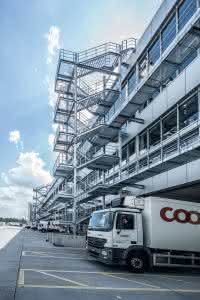
The planning and realization of such an ambitious and complex large-scale project requires partners who not only have planning, logistical and construction expertise, but are also familiar with the specific framework conditions and requirements of the food industry. With a total investment of 600 million Swiss francs, a gross floor area of 240,000 square meters and a construction volume equivalent to around 200 detached houses, the qualifications of the planning partner are uncompromising. Coop decided to work with IE Food Engineering, part of the IE Group, which has proven its expertise in factory construction in the food sector in numerous projects.
Cooperation between experts from different disciplines
Despite many years of experience, the construction of the new Coop logistics center was a major challenge for the planning company simply due to its enormous dimensions and logistical complexity. The basic prerequisite for the success of the project was cooperative planning under the leadership and participation of specialists from the client and the engineers and architects from IE Food. The TGW Logistic Group, which specializes in internal logistics solutions, was also brought on board as an important partner. In total, around 200 specialists from a wide range of disciplines were involved in the project organization.
Construction project profile
Client: Coop-Genossenschaft Planning and realization: IE Food Engineering (IE Group Zurich and Munich) Project scope 5 new buildings: - Distribution center - National deep-freeze warehouse - Empties center - Industrial bakery and confectionery Number of project team members: 80 to 120 Gross floor area: 240.000 m2 Construction volume: 1.5 million m3 Foundation: 282 bored piles extending up to 23 meters underground Planning time: 5 years Construction time: 3 years Investment volume: CHF 600 million Energy production biomass power plant: approx. 14 gigawatt hours/year Electricity production solar power plant: 250,000 kilowatts/year
Focus on efficiency and sustainability
The Coop logistics center is an example of overcoming complex challenges in factory construction:
- Building structure developed from the function The planning approach "from the inside out" was also used in Schafisheim. At the end of the bakery's production lines, the deep-freeze center is located at the same height. The baked goods are transported directly to the deep-freeze warehouse and then to the distribution center via a passageway.
- Linking the intralogistics with the external logistics concept The timetables for the delivery and collection of the trucks, calculated down to the minute, set the pace for the internal logistics systems. In Schafisheim, the conveying processes, warehouse management, order picking and provision of goods have been automated as far as possible. State-of-the-art storage systems, shuttle vehicles, robotic and buffer systems are used.
- Building technology with ecological added value 70 percent of the ovens in the industrial bakery are heated with energy from the company's own biomass heating center. The main source of energy is organic grain waste from the Swissmill grain mill in Zurich. With sustainable energy generation, Coop reduces CO2 emissions by around 10,000 tons per year. The process heat from the bakery and the biomass power plant is also used in Schafisheim.
Thomas Hanhart


You might also be interested in
Arvato implements shuttle system for H&M in Poland
H&M will be able to handle its logistics in Central and Eastern Europe faster and more agile in future: Arvato has expanded its e-commerce distribution center in Stryków, Poland, and installed an automated shuttle warehouse with a capacity of up...
 read more...
Automation using shuttle technology and SAP
GC Corporation develops, produces and distributes dental products. In order to make the European subsidiary, GC Europe, fit for the future to meet increasing logistical requirements, the company expanded its storage and picking capacities at the...
read more...Intralogistics for steel wholesalers
Lemvigh-Müller relies on Knapp
Lemvigh-Müller is making its largest investment in logistics to date and centralizing two warehouses in Odense and Kolding, both in Denmark, into one distribution center in Kolding. This will ensure that Lemvigh-Müller can handle larger volumes of...
read more...New shuttle warehouse for BSH Hausgeräte in Dillingen
The ground-breaking ceremony for a shuttle warehouse for household appliance specialist BSH Hausgeräte recently took place in Dillingen, Bavaria. TGW Logistics will build a highly automated small parts warehouse there by spring 2027.
read more...Combined storage solution with transshipment and pallet warehouse
With the newly founded Faurecia Clarion Electronics (Fengcheng), Faurecia aims to become a global leader in electronics technology for vehicle cockpits. When it comes to intralogistics, the company relies on a combined warehouse solution from...
read more...Storage and order picking technology
SSI Schaefer automates for the market leader in ready-to-eat salads
Fresh Servant maximizes its performance through automation at its logistics center in Edsevö, Finland. The company relies on a complete system from SSI Schaefer, consisting of an SSI Cuby shuttle warehouse, pick-by-light picking and the WAMAS...
read more...30 million spare parts shipped annually
The manufacturer and supplier of automotive spare parts DRiV has put a new automated distribution center for Europe into operation. An automation solution from Knapp forms the heart of the system.
read more...Production and assembly flexibly supplied
Automotive supplier Magna manufactures exterior mirrors at its Assamstadt site in Germany. Magna relies on an automation solution from Knapp to cope with the changes in logistics and to be able to operate flexibly with a high level of vertical...
read more...Novaltia builds new distribution center with Knapp
The Spanish pharmaceutical wholesaler Novaltia is once again relying on a complete solution from Knapp: In the new distribution center at its headquarters in Zaragoza, logistics processes are to be streamlined and sequences made more precise by...
read more...