

Lifting tables
Professionally lifted
Lift tables are rather unspectacular intralogistics systems. But only at first glance: This is because the specific environments in which they are used require a wide variety of technologies and designs as well as often customized solutions.

Customized loading" - this was the customer order from the Volkswagen plant in Poznan: a lift table solution was required. The requirements for lift tables have been constantly evolving, especially in special applications. It is no longer just a question of length, width, height and load capacity; availability, speed, accuracy, functionality and other special features must also be taken into account. The challenge for the lift table project implemented by manufacturer Laweco was to create a ground-level installation with a loading platform only 90 millimetres high. The lifting scissors are mounted next to the load platform so that the trolleys can be driven onto the lift table with little pushing force. An electro-hydraulically operated, 1.2 metre long loading bridge significantly minimizes the effort required to drive onto the platform.
Lifting table for loading at ground level
After loading the scissor lift, the loading plate is raised using the control knob and at the same time forms the fall protection in accordance with the European standard DIN EN 1570 applicable to lift tables. There is no need to spend time closing doors or inserting railings. A loading plate also bridges the transition to the truck. The raised areas of the scissor packs can be used as a traffic route, secured by railings. The ground-level installation has not only ergonomic but also practical reasons. The lift table does not require a pit in the floor and can be repositioned. Such a lifting device can also be retrofitted inside buildings without having to cut open storey ceilings.
Flexibly adapted to the application requirements
Transport trolleys, trolleys, platform trolleys, shelf and rack trolleys - almost every company has trolleys of this type for the temporary storage of goods, materials and products. The workstations at which these trolleys are loaded and unloaded must be designed as ergonomically as possible, especially to avoid bending or stooping down, which is harmful to the back. To do this, the transport trolley must be lifted accordingly, for which a scissor lift table is ideal.
So what does a lift table need to look like to fulfill this task optimally? Since its beginnings, Flexlift Hubgeräte GmbH has been manufacturing flat-form lifting tables from the "FM" series, which can also be built very narrow. For example, the standard version of the lift table in this series with a load capacity of 500 kilograms is only 500 millimetres wide, while the one for 1,000 kilograms is 600 mm wide. As Flexlift reports, "many of our customers therefore use these lift tables to lift their transport trolleys": the trolley is simply driven over the lowered lift table, which then moves up and lifts the trolley by its underbody. This works "quite well in most cases, but on closer inspection it is not ideal".
Ergonomics, safety and precision
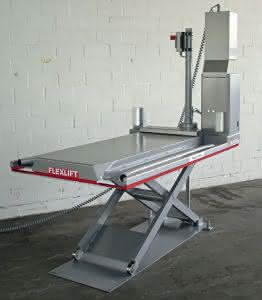
For a better and safer solution, Flexlift developed the FMA series, which is based on the aforementioned narrow lift tables from the "FM" series. These tables also have additional "runners" on both long sides, onto which the transport trolley is moved when the lift table is lowered. This is possible because it is only necessary to drive onto the 4 to 5 millimeter sheet thickness of the skids. There is a recess in both runners that is suitable for two of the wheels. As soon as the wheels move into this recess, the trolley has reached its position. When the lift table is now raised, the wheels of the trolley dip slightly into the recesses, which automatically prevents the trolley from rolling off the lift table. As there are countless variants of transport trolleys on the market, "the design of an "FMA" lift table must always be adapted to the trolley used by the customer", reports Flexlift.
Versatile lifting and traversing units
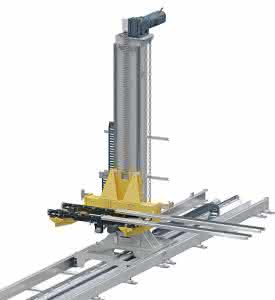
Winkel GmbH, Illingen, offers general contractors in logistics and intralogistics a wide range of machines and systems, including lifting and traversing units. Whether lifting, palletizing or order picking - the tasks in intralogistics are diverse. In order to handle dissimilar products as efficiently as possible, different transport solutions are required, which must be adapted to the requirements of the products and the local conditions. Winkel therefore offers general contractors a wide range of equipment that is precisely tailored to their specific needs. The portfolio includes, for example, lifting and traversing units that move the goods vertically and horizontally. They are ideal for multi-shift operation and can be integrated into existing conveyor systems.
The modular devices offer lifting capacities between 0.5 and ten tons. The lifting systems are equipped with interception devices and modern safety technology. The load is picked up using forks, telescopic forks or special gripper systems. Horizontally, the units are driven electromechanically. Winkel offers lifting devices in one, two or four-column versions - with or without counterweight. Reinhard Irrgang
www.flexlift.dewww.laweco.de www.winkel.de


You might also be interested in
The smartphone as an emergency signaling device
A smartphone with the appropriate software can serve as a digital personal emergency signal system. This means it is available anywhere and at any time and is inexpensive to purchase.
 read more...
Efaflex presents new machine safety gate
The Efa-SRT MS Performance allows up to one million load changes per year.
read more...Safe interaction
During automated material transfer between the robot cell and the automated guided vehicle system, people must not be allowed to enter the danger zone unnoticed. An innovative solution from Leuze safeguards the transfer stations with the aid of...
read more...Conveying and lifting technology
Light curtains for safe conveyor lines
Efficiency and safety in material flow are becoming increasingly important in industry. The combined use of safety light curtains and automation light grids, which are based on similar technology, provides answers to these two requirements, which...
read more...Customized safety during loading and unloading
With its modular safety and loading technology system of the same name, Expresso, the manufacturer implements individual complete solutions for goods handling.
read more...Safety for automated intralogistics
Companies must ensure that their employees can also work accident-free inside the warehouse. Euchner is presenting its new CKS2 key system for this purpose.
read more...Safety when reversing
The Sens+ camera-based assistance system from Toyota protects forklift truck operators from collisions with objects and people.
read more...Autonomy is not a panacea
Autonomous mobile robot (AMR) or driverless transport system (AGV) - if you want to automate your intralogistics transport processes, you seem to be faced with a choice between two different technologies.
read more...Optimized automation concept for storage and retrieval machines
The Heilbronn-based sports retailer Intersport Deutschland has expanded its central warehouse together with Körber Supply Chain in recent years.
read more...