

Conveyor and lifting technology
Always at the right energy level thanks to DSE
System elements such as storage and retrieval machines, shuttles and distribution trolleys are among the most important key players in intralogistics. Their energy requirements are correspondingly high and the implementation and maintenance of the energy infrastructure is correspondingly complex. Dambach Smart Energy Management - DSE for short - ensures that peak currents from the grid are reduced, thereby enabling significant energy savings.
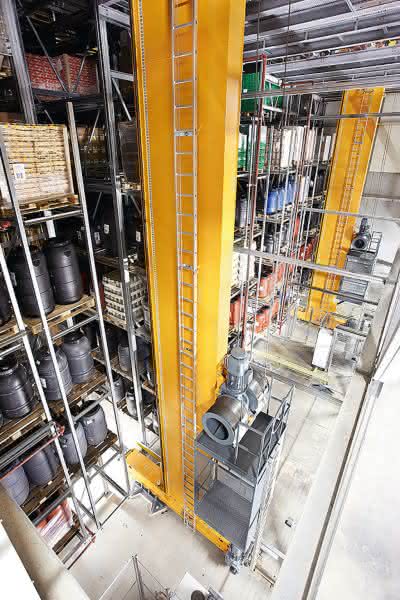
Dambach focuses on sustainability and resource conservation in the further development of its products. The basis for this is generally a closely interlinked interaction between control technology and mechanics. "For more than five years, Dambach has been working on the use of storage technologies in conjunction with a wide range of applications in warehouse technology," says Dirk Lorenz, Head of Control and Modernization at Dambach Lagersysteme. "Only through detailed knowledge of all the mechanical properties of a machine can optimum control concepts be developed. Conversely, findings and trends from control technology can influence the mechanical design of a machine". Typical representatives of this approach are the Dambach Compact Shuttle (DCS) as a device and the Dambach Smart Energy Management (DSE) as a device on a machine.
Power caps supply shuttles with energy
Equipped with robust 400 V drive technology, the DCS is designed for transporting a wide range of pallet formats and offers a high level of system reliability, even with old or damaged load carriers. The Power Cap energy storage units replace cables or batteries and thus supply the shuttles with energy for autonomous operation at channel depths of up to 40 meters. Dambach uses three storage sizes depending on the channel depth, so that Power Caps are also available for 15 and 22 meter depths.
"Our energy and resource management systems are available to anyone interested and can be purchased directly from us."Dirk Lorenz, Dambach Lagersysteme
Dynamic reloading in a few seconds
As Dirk Lorenz emphasizes, the maximum loading time of the shuttles is only 12 seconds: "We load dynamically during operation and therefore only for long enough for the shuttle to carry out the next movement safely. Normally, this only takes around six seconds. This technology enables us to operate 24 hours a day without interruption in deep-freeze applications, for example". In general, the DCS are suitable for use in the extremely wide temperature range from -30 °C to +40 °C. To date, 100 shuttles with Power Cap technology are already in use worldwide.
DSE increases grid independence even during peak demand
Dambach offers its SRMs in the Mono, 18 m and EKT series with innovative DSE energy management. DSE stands for Dambach Smart Energy Management. Lorenz: "In this version, the SRMs are fully electric hybrids: Only 15 to 20 percent of the power currently required is taken from the conventional supply network, with the much larger remainder coming from the high-performance energy storage system integrated into the SRM. The DSE significantly improves the efficiency of an automated storage system. The storage and retrieval machines are therefore significantly more efficient, without any loss of performance.
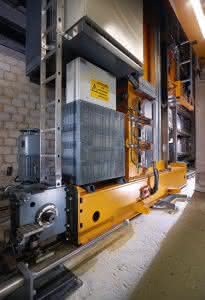
First installation of DSE
The DSE is currently proving itself successfully in the world's first installation in a high-bay warehouse at Boehringer Ingelheim. Four stacker cranes, each 32 meters high, are equipped with the system. The performance values achieved with DSE are impressive: the stacker cranes travel at speeds of up to 3.5 m/s, lift at 1 m/s and achieve a travel acceleration of 1.2 m/s². This is achieved with a very positive energy balance, as the peak power required from the mains is reduced to a fifth.
The performance of the storage and retrieval machines can be increased by using the existing mains supply. The additional energy required for this is taken from the power caps, which are charged by recovering energy when the stacker cranes are braked and the load is lowered. The recovered energy is then used for the drives in addition to the energy from the mains.
One third less energy consumption
DSE is particularly suitable for applications at locations with a weak energy infrastructure or grids that are only designed for low power peaks and are susceptible to faults and where energy saving through grid recovery is not possible.
By intelligently recharging the energy storage units partly from the grid and partly from energy recovery, the peak current drawn from the grid is reduced by a factor of five. The recovered energy is reused locally. Overall, energy consumption is reduced by a third.
Thinking about the future
According to Lorenz, the DSE makes sense for use in highly developed industrialized countries: "At the latest when the large nuclear power plants are finally shut down due to the energy transition, our grids will be more sensitive, and then there could be demands that no longer tolerate pulse loads such as those produced by RBG. He emphasizes: "We have created systems that can work autonomously and are not dependent on superimposed systems. Companies can noticeably and sustainably improve their energy balance with this type of energy supply."
Reinhard Irrgang


You might also be interested in
Arvato implements shuttle system for H&M in Poland
H&M will be able to handle its logistics in Central and Eastern Europe faster and more agile in future: Arvato has expanded its e-commerce distribution center in Stryków, Poland, and installed an automated shuttle warehouse with a capacity of up...
 read more...
Automation using shuttle technology and SAP
GC Corporation develops, produces and distributes dental products. In order to make the European subsidiary, GC Europe, fit for the future to meet increasing logistical requirements, the company expanded its storage and picking capacities at the...
read more...Intralogistics for steel wholesalers
Lemvigh-Müller relies on Knapp
Lemvigh-Müller is making its largest investment in logistics to date and centralizing two warehouses in Odense and Kolding, both in Denmark, into one distribution center in Kolding. This will ensure that Lemvigh-Müller can handle larger volumes of...
read more...New shuttle warehouse for BSH Hausgeräte in Dillingen
The ground-breaking ceremony for a shuttle warehouse for household appliance specialist BSH Hausgeräte recently took place in Dillingen, Bavaria. TGW Logistics will build a highly automated small parts warehouse there by spring 2027.
read more...Combined storage solution with transshipment and pallet warehouse
With the newly founded Faurecia Clarion Electronics (Fengcheng), Faurecia aims to become a global leader in electronics technology for vehicle cockpits. When it comes to intralogistics, the company relies on a combined warehouse solution from...
read more...Storage and order picking technology
SSI Schaefer automates for the market leader in ready-to-eat salads
Fresh Servant maximizes its performance through automation at its logistics center in Edsevö, Finland. The company relies on a complete system from SSI Schaefer, consisting of an SSI Cuby shuttle warehouse, pick-by-light picking and the WAMAS...
read more...30 million spare parts shipped annually
The manufacturer and supplier of automotive spare parts DRiV has put a new automated distribution center for Europe into operation. An automation solution from Knapp forms the heart of the system.
read more...Production and assembly flexibly supplied
Automotive supplier Magna manufactures exterior mirrors at its Assamstadt site in Germany. Magna relies on an automation solution from Knapp to cope with the changes in logistics and to be able to operate flexibly with a high level of vertical...
read more...Novaltia builds new distribution center with Knapp
The Spanish pharmaceutical wholesaler Novaltia is once again relying on a complete solution from Knapp: In the new distribution center at its headquarters in Zaragoza, logistics processes are to be streamlined and sequences made more precise by...
read more...