

Workstations
Self-determined work in order picking processes
The DSC Essen branch of DHL Solution Fashion has been processing textiles for various clothing companies and their stores for many years. Workplace system specialist Hüdig + Rocholz developed an efficient and future-oriented workplace together with the company and other partners.
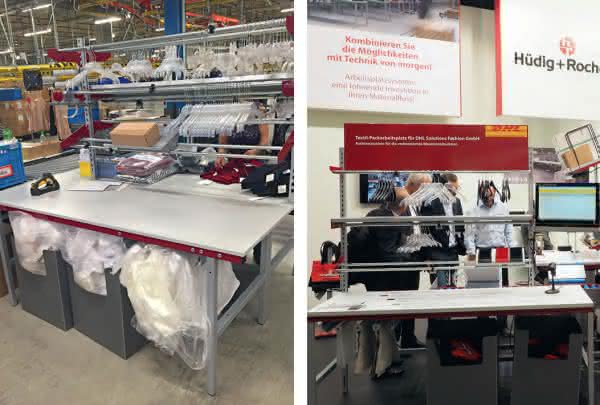
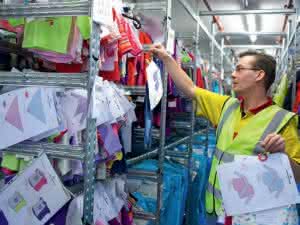
The processing of these items is largely determined by the wishes of various stores and their departments and also depends on the condition of the items provided by external suppliers. In addition to activities such as ironing goods, sorting flat goods or removing individual packaging, goods can also be secured on request. Depending on the recipient location and the quality of the delivery, a dozen individual activities can quickly become necessary for one item, which the employees carry out on a product-related basis.
Previously, the instructions for the work steps were provided in paper form at the workplace. Due to the large number of exceptional cases, different branches and departments, the instructions were summarized in a catalog at the workplace. The head of department explains that "observing all possible combinations presents us with daily challenges and means longer training times, especially for new employees". Theoretically, 106 combinations of individual activities are possible for a product in a branch for a department of the recipient.
This also presents managers and employees with particular challenges. While department managers invest a lot of time in maintaining catalog data, manually calculating evaluations and actively supporting new employees during the training process, trained employees must constantly re-read the individual process flow of the goods to be processed and record these quantitatively by writing them down.
Under the leadership of DHL Solutions Fashion, a research project was set up in collaboration with Hüdig + Rocholz GmbH & Co. KG as a specialized manufacturer of workplace systems and Sensrec GmbH with the aim of setting up an efficient and future-oriented workplace. The University of Duisburg-Essen, Chair of Production Engineering, provided scientific support for the project.
Hardly any process knowledge required
The system was developed within eight months. An independent assistance system for employees at the workstations was designed in such a way that transaction data is automatically imported from DHL's own ERP system. In future, employees will hardly need any process knowledge, as they will automatically receive the correct instructions for the respective processing step simply by scanning barcodes, with additional image material if required. The workstation is simply equipped with a touch-enabled computer system and a hand scanner.
System maintenance is designed to be so intuitive that foremen and department managers set up one-off work processes, which the system then assigns and evaluates independently. The IT system for Workplace 4.0 is self-learning. Holger Dander, Managing Director of Sensrec and responsible for IT development, explains: "We import almost 10,000 data records every day that are due to be processed in the coming days. The employee is not aware of any of this and only needs a hand scanner to display the processing steps that are important to them on the monitor."
Reduce secondary times within the picking process
The work tables were optimized by Hüdig + Rocholz as part of the development process, particularly with regard to ergonomic aspects. Sufficient work surfaces, sorted material provision options (e.g. for hangers or labels) and waste separation facilities were taken into account and help to significantly reduce secondary times during order picking. This is achieved primarily through the adaptability of the System Flex work table used. "Every employee has the option of adapting the workstation to themselves and the process in just a few simple steps. This also increases acceptance," adds Ralph Roth, Managing Director of Hüdig + Rocholz.
In addition to reducing secondary times during order picking, the digitalization of the process also allows key figures to be generated for the first time. Administrators receive information on current daily events, the utilization of workstations and the process of individual articles through monitoring. The system therefore helps to identify workload peaks at an early stage, to carry out optimum personnel planning and to improve the entire supply chain.
www.dhl.dewww.huedig-rocholz.de


You might also be interested in
Antares Vision Group at the Interpack 2026
Ecosystem for quality and traceability
At Interpack 2026 in Düsseldorf, the Antares Vision Group will be presenting solutions for greater transparency, security and compliance along global supply chains.
 read more...
Arvato further expands customs logistics in Turkey
With a new type A customs warehouse in Istanbul-Tuzla and additional capacity, Arvato is strengthening its cross-border logistics expertise and positioning Turkey as a strategic hub between Europe and Asia.
read more...Brand presence in a new design
In Nuremberg, the Bluhm Weber Group will be presenting marking systems with labels, ink and lasers for the packaging industry. The company will also be presenting its new visual concept for the first time and underlining its innovative character...
read more...Roadshow: Bluhm Weber Group at all about automation
The Bluhm Weber Group will be exhibiting with a mobile showroom at all about automation in Straubing: From 26 to 27 June 2024, the coding and marking specialist will be showcasing the latest technology with labels, ink and lasers specifically for...
read more...Optimize logistical processes
At Logimat, Bluhm Systeme will be demonstrating the optimization potential of industrial marking for logistics processes. The new look of the digital trade fair stand also visually underlines the message that Bluhm is focusing on pioneering elements.
read more...Intelligent depalletizing robot in the warehouse
The supply chain and e-commerce service provider Arvato has had an intelligent robot-controlled depalletizer developed that further accelerates processes and the flow of goods in the warehouse.
read more...Linerless printing - for added sustainability
Linerless, self-adhesive labels are ecological and efficient - and are available from Mediaform in top quality in many versions. The new Bixolon XL5-40CT, a desktop model whose siliconized print roller guarantees clean label printing, is available...
read more...TSC Printronix Auto ID introduces new direct thermal printer
TSC Printronix Auto ID has launched a new mobile direct thermal printer - adding another basic and premium model to its Alpha series in the 3-inch segment.
read more...REA Elektronik at the Fachpack
Labeling and testing, but high quality!
REA Elektronik supports the packaging industry with solutions for high-quality marking and reliable code verification.
read more...