

From materialfluss SPEKTRUM 2020
Fresh food stored smart
Food retailers are increasingly relying on modern automation technology for warehouse technology and order picking. The delivery wholesaler Frischdienst Walther has automated its trio of warehouses for frozen, fresh and dry goods with the general contractor Klinkhammer. Compared to the automated small parts warehouse, a KlinkCAT shuttle warehouse provides around 30 percent more output despite requiring half the space.
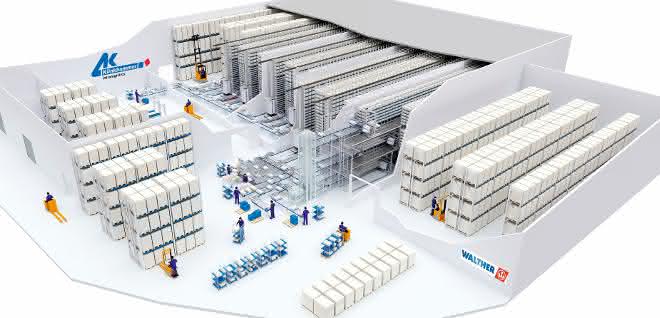
In Franconia, restaurateurs and hoteliers rely on the family-run delivery wholesaler Frischdienst Walther, which is managed by the fourth generation of Friedrich Walther, for a regular supply of goods. With 8,500 items, the company offers an extensive range of fresh and frozen products as well as foodstuffs. From bratwurst and Franconian dumplings to freshly caught fish, from new products to local delicacies, regional restaurants and hotels will find everything they need as culinary hosts. In order to be able to keep the promise "Ordered by 6 p.m. today, everything delivered fresh and complete tomorrow" in the future, the company is automating its dry warehouse with Klinkhammer, increasing the efficiency of chilled products with a multi-level shuttle warehouse and doubling the size of its automated deep-freeze warehouse. With the help of the electronic route planning system and its own fleet of vehicles with two-chamber refrigeration systems, delivery deadlines and cold chains are reliably adhered to. The special feature of the system is that the technology covers and combines three different temperature ranges and three different flows of goods.
Integration of three climate zones
The 2-aisle automated deep-freeze warehouse with an ambient temperature of -22°C, which was completed in 2016, was extended by two aisles to provide a total of 19,680 tray storage locations. The new deep-freeze conveyor technology and an additional picking station are connected to the existing system in such a way that the distances are as short as possible and the loss of cold as well as the heat and moisture input are kept to a minimum. The retrieval is sequenced, i.e. in the order in which the frozen items are to be picked and packed for each order. An automatic fresh goods warehouse with a temperature range of 2°C to 6°C is equipped as a high-performance shuttle warehouse with three KlinCAT multilevel shuttles and also serves as an order consolidation buffer. B, C and D articles are stored in the non-air-conditioned, 2-aisle, automatic dry goods warehouse. Employees pick fast-moving A items directly from the manual pallet warehouse onto roll containers using pick-by-voice and merge them with the goods from the automated warehouse at the goods issue point. As the products remain in the temperature-controlled area from this point onwards, uninterrupted temperature-controlled warehousing is guaranteed. The workstations are equipped with an all-round roller table, which enables ergonomic handling of the trays. They have multi-order work tables for the order containers.
Flexibility in pack sizes with tray technology
Due to the wide variety of packaging designs, trays are used as loading aids in all three warehouse areas. The separation of products from pallets onto trays enables flexible and simple handling of orders with small batch sizes and mixed assortments. The goods-to-person system is used to provide the items in all three temperature zones for picking at the respective workstations.
"We chose Klinkhammer because we can already look back on a very good, trusting cooperation in the first automation project," emphasizes Friedrich Walther, Managing Director of GV-Frischdienst Walther GmbH. "The high storage density of the automated warehouses saves storage space, which in turn significantly reduces the need for air conditioning, i.e. refrigeration technology, and thus enables significantly reduced electricity consumption for this. Another decisive advantage is the precision, speed and route optimization in the goods storage and picking processes."
Efficiency in the multi-level shuttle warehouse
Delivering to customers in less than 24 hours requires a high degree of flexibility and speed in order processing. The temperature-controlled fresh goods warehouse is therefore equipped with three KlinCAT multilevel shuttles, one above the other, each of which reaches six container levels. The shuttle warehouse offers a significantly higher throughput rate than the automatic dry goods warehouse equipped with conventional storage and retrieval machines. Compared to the automated small parts warehouse, the shuttle warehouse provides 30 percent more capacity despite requiring half the space. This solution helps to speed up the internal material flow, especially for fast-moving fresh goods such as fresh dairy products, cheese specialties and fresh meat.
Pre-picking accelerates the flow of goods
The shuttle warehouse also serves as an order consolidation buffer. Pre-picking is used to temporarily store orders for dispatch so that they can be combined with goods from other storage areas at a later date. This speeds up order processing and decouples the processes. The pre-picked order trays are stored in the lower levels of the KlinCAT. This ensures that the trays are kept together and that the goods are retrieved as quickly as possible. To avoid costly sprinkling or inerting, all automated storage systems are designed for the maximum height of the top storage level of 7.60 metres.
It all depends on the software
Storage strategies that are stored in the warehouse management system have a major influence on the efficiency of the overall system. The Klinkhammer warehouse management software integrates all automated warehouses. It is connected to the existing host system. Special sequencing algorithms enable the order and item sequence to be adhered to precisely, taking into account product groups, batches and best-before dates. The actual net weights per piece can also be recorded for goods by weight, such as legs of venison with different individual weights. For this purpose, barcodes on the goods with net weights are scanned and totaled. The Klinkhammer material flow computer controls the transportation of the trays and the storage location management. The KlinkVision visualization system brings transparency to the warehouse and enables fast remote maintenance.


You might also be interested in
Winner material flow PRODUCTS OF THE YEAR 2023
Conductix-Wampfler: ChargeLine 0865
Two-pole conductor rail segments for efficient opportunity charging of shuttles, suitable for thousands of cycles per day.
 read more...
Hermann Grewer celebrates his 80th birthday
Hermann Grewer, Honorary Chairman of the North Rhine-Westphalia Transport and Logistics Association (VVWL) and Honorary President of the German Road Haulage, Logistics and Disposal Association (BGL), celebrated his 80th birthday on June 6.
read more...Well chilled for sure
V-Zug Kühltechnik AG, developer and manufacturer of refrigeration appliances and part of the successful V-Zug Group, has set up a new production facility for refrigerators of all heights and dimensions at its Swiss site in Sulgen.
read more...Advantageous automation of small parts warehouses
The RSX1 shuttle system will be at the center of Rocketsolution's presence at this year's Logimat trade fair.
read more...Reduced energy requirements in the high-bay warehouse
One of Germany's leading premium car manufacturers is already focusing on energy efficiency in the production of its new SUV model with electric drive. The storage and retrieval machines in a high-bay warehouse at the production site have been...
read more...Low lift pallet truck for light duty applications
Clark has launched a new low lift pallet truck with the model designation LWio15 for light transport tasks. The truck has a load capacity of 1500 kg and is suitable for short distances in goods distribution, production or warehousing.
read more...Internationalization as an opportunity
E-commerce is in a state of flux. Changes in purchasing behavior and procurement problems are keeping e-commerce retailers busy. Logistics plays a decisive role in the overall online shopping experience.
read more...Fulfillment Center for Frisco.pl
Polish eGrocery specialist and TGW deepen partnership
TGW is building a highly automated fulfillment center for Frisco.pl in the Polish capital Warsaw. This is the second project in a row that the two companies have implemented together.
read more...Which world will it be in 2023?
Michael Schreckenberg teaches at the University of Duisburg-Essen as Professor of Physics of Transport and Traffic. Once a year, he addresses the readers of materialfluss, formerly LT-manager, with a critical and humorous expert article on transport...
read more...