
Interview: Steffen Bersch, SSI Schäfer
"The issue of sustainability is always intrinsic"
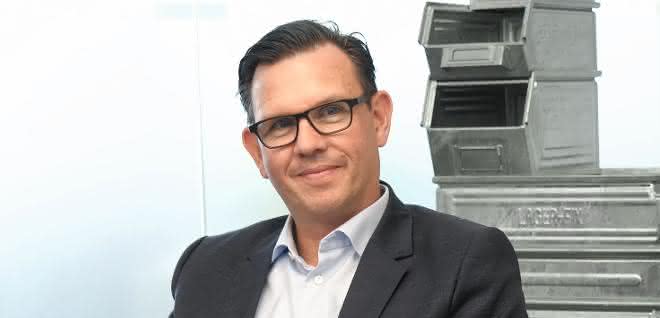
On March 1, Steffen Bersch took the helm at intralogistics specialist SSI Schaefer. In an exclusive interview with editor-in-chief Martin Schrüfer in materialfluss, the CEO talks about the company's inclusion in the "50 Sustainability & Climate Leaders" initiative, sustainability within the company and his first seven months at the helm of SSI Schaefer.
materialfluss: Mr. Bersch, the announcement that SSI Schaefer has joined the "50 Sustainability & Climate Leaders" initiative was accompanied by a commitment to sustainable intralogistics. What was the trigger?
Steffen Bersch: As a biotechnologist by training, I fundamentally believe that we are seeing very clear signs of climate change. In my opinion, this climate change has something to do with the partially uncontrolled use of resources. As we have a responsibility for future generations and their lives, we need to focus on the issues of climate and the sustainable use of resources. I believe that the coronavirus period has made us realize even more clearly that it is time to act. The topic of sustainability has also been on the agenda in many customer meetings in recent months.
mfl: What is it essentially about?
Bersch: We combine economically efficient and sustainable logistics solutions with a focus on energy consumption and CO2 emissions and reducing costs throughout the supply chain - while maintaining healthy working conditions. As a company with 10,000 employees, we also have a responsibility ourselves. The initiative we have joined is based on the sustainability goals of the United Nations. A company that is committed to these goals should find a platform on which this can be presented. This is how we became one of the "50 Sustainability & Climate Leaders".
mfl: With the announcement, the company let it be known that it wanted to raise its "voice for sustainable, economical and future-proof intralogistics". Do you have the feeling that sustainability is becoming less important?
Bersch: No, I don't have that feeling. Above all, we want to promote the change towards sustainable and economical intralogistics and stimulate discussions within companies. I am not only active as CEO of SSI Schaefer, but also as an advisor in other companies, some of them in the packaging industry. The topic is always intrinsic. Questions such as how to replace conventional packaging with sustainable packaging are driving the industry and retailers. Consequently, this means that we as an intralogistics company also have to deal with this and offer solutions.
mfl: What was the reaction to the announcement?
Bersch: The feedback was very good, both from customers and from the media. I now hope that we will be able to further advance SSI Schaefer's efficient solutions with technological topics such as energy recovery, software for energy efficiency, predictive maintenance, recyclable materials or sustainable building technology and ergonomic working conditions.
mfl: Is sustainability suitable as a unique selling point in intralogistics? Is that what SSI Schaefer wants it to be?
Bersch: I don't believe that sustainability is a unique selling point, but that you have to have it in your basic portfolio and master it. It's always about finding the optimum solution for the customer, for which we need innovative products. Then we need a wide range of services so that we can offer everything from a single source. In other words: as economically productive and as sustainable as possible, so that we keep the unit costs for transporting goods in the internal process as low as possible. The issue of sustainability is important, but not a unique selling point.
mfl: Where do you want to improve your own sustainability in your private life?
Bersch: I see the topic as a kind of marathon and don't change things ad hoc. Through initiatives such as the "Fridays For Future" movement, I see that the next generation has high expectations of our generation, which is currently active in business. We have to realize these. I question my lifestyle, but I'm not dogmatic about it. There's no point in cycling every distance now, which is obvious to me as a Münster resident anyway, or talking about the solar system that I already have installed. I discuss these issues and try to implement them in our lives, but I don't do it dogmatically.
mfl: Mr. Bersch, we are conducting this interview on October 1 - you took the helm on March 1 - how would you sum up the first seven months?
Bersch: SSI Schaefer is an incredibly great company with high technological standards and an equally incredible customer focus. I got to know many open and committed employees, unfortunately many of them only on screen. I had a very pleasant start. As far as the corona pandemic is concerned, it was of course a very bumpy start, as elements of crisis management were quickly added.
mfl: So you were right in the middle of it ...
Bersch: Yes, but it was also helpful for me, as many issues such as health and safety measures in the company and securing the cash flow were properly addressed again in the process. I believe that the entire management team, the employees, the shareholders and, last but not least, our customers did a good job.
mfl: What was the most valuable piece of advice that your predecessor, interim CEO Dr. Helmut Limberg, gave you?
Bersch: He said: "You have a great company here, leave a lasting impression." Mr. Limberg has done great groundwork since October 2019, so I had a good foundation.
mfl: At the time, the shareholders and the advisory board expressed the hope that the company's management would once again be sustainably staffed ...
Bersch: Yes, and the impression I leave behind should of course be positive in this sense (laughs).
mfl: How did you perceive the intralogistics sector, which was new to you?
Bersch: Process technology, where I come from, and intralogistics have always had a good perception and the potential to develop well. The topics in both areas are comparable, which made the change easier for me. What I mean by this is that our customers are striving for more productive, automated solutions. This applies to both sectors. In intralogistics, you are closer to the customer. If these solutions don't work, you have more direct feedback than in process technology. Process technology was higher in terms of regulation, but on the other hand the performance expectations in intralogistics are higher.
mfl: What issues did you put first on the agenda for yourself and the company in your new job?
Bersch: We see SSI Schaefer as a company that has been growing strongly for several decades. The company is very well positioned. Together with the change in management, the process was initiated to modernize the company's internal structures and make them more efficient in order to stabilize and improve performance for customers. SSI Schaefer has innovative products, is broadly positioned and incredibly experienced. This now needs to be developed further.
mfl: Is consolidation the right word?
Bersch: Consolidation is a word that sounds negative.
mfl: What about "focusing on the inner values" instead?
Bersch: When companies or entire industries grow very strongly, they always reach a point where they need to leverage synergies. However, our markets are generally developing very positively, partly due to coronavirus, so we have to tackle two issues at the same time: Growth and internal synergies.
mfl: We found out a few days ago that there will no longer be the usual LogiMAT, giving us a good opportunity to set off some product fireworks. When will there be new products from your company again?
Bersch: We are in the process of realigning ourselves in this area too and will be presenting new topics shortly. Together with our partner DS Automotion in particular, we are currently working on some very attractive new solutions in the AGV sector. In the field of robotics and order processing and generation, we are looking at the use of artificial intelligence. There is also the topic of micro-fulfillment centers, which we are also addressing. So there are many technologically relevant topics that we are currently developing further and will announce next year.
mfl: Thank you for the interview.


You might also be interested in
Outdoor AGV networks production and logistics
An international company in the plastics industry is automating its intralogistics at its German site with a solution from ek robotics. A specially developed vehicle model from the Out Move series, an outdoor AGV, is being used.
 read more...
Transport systems for automated material flow
The Leo transporters from Bito make it easier for users to get started with the automation of material processes, which is possible from 20,000 euros. The system is a flexible all-in-one complete solution that is ready for immediate use and can be...
read more...Automated logistics for the university hospital
As part of the new construction of the University Hospital of Reims (CHU), France, the hospital has taken a number of steps to improve the needs of its patients and the working environment of its employees.
read more...K.Hartwall: Topping-out ceremony for the German site
The topping-out wreath was raised at the new building in the TIP Innovationspark Nordheide in Buchholz near Hamburg on February 27: The new K.Hartwall plant will comprise approx. 3,500 m² of hall space and around 2,000 m² of office and social areas.
read more...Noerpel Group tests driverless high lift trucks
The Noerpel Group has tested driverless pallet trucks in one of its two logistics facilities in Giengen. During a four-week trial, two autonomous systems were used to transport goods within the warehouse.
read more...Supply and disposal of printing machines by AGV
Numerous companies rely on AGVs in intralogistics to increase efficiency and meet challenges such as the shortage of skilled workers. One such company is GGP Media GmbH in Pößneck, Thuringia.
read more...Sophisticated automation: AGV and cobot combined
On behalf of Krefeld-based Saurer Technologies, the engineering team from Project Automation & Consulting developed a solution for production logistics that combines AGVs and cobots.
read more..."Herbie" robot in the Körber portfolio
Carrybots, a specialist in mobile robotics, is a new partner in the Körber supply chain ecosystem. The aim of this collaboration is to strengthen the position of both companies in intralogistics. Herbie" enables robot-based goods-to-person processes.
read more...Demand-oriented load carrier transport
Efficient logistics with AGVs
Environmental awareness and the careful use of resources are becoming increasingly important. With advanced solutions, plant operators can significantly improve the ecological footprint of logistics processes.
read more...