

Storage- and racking systems
Two new bearings increase efficiency
Blechwarenfabrik Limburg GmbH, one of the leading manufacturers of tinplate packaging for chemical-technical products such as paints, varnishes and glazes, has built a new 63,000 m2 plant in Limburg. Mecalux supplied two automated warehouses with a total capacity of around 20,000 pallets and the EasyWMS software for this plant.
Founded in Germany in 1872, Blechwarenfabrik Limburg is one of the first manufacturers of tinplate packaging for the chemical-technical industry in Europe. The company has around 300 employees and has production facilities in Germany, Russia and Poland.
The head office in Limburg is located in the city center and has grown there for 118 years. The relocation of the headquarters to an industrial estate in Limburg is intended to significantly increase the company's efficiency.
The new headquarters is strategically located at a traffic junction on the B49 and A3. Mecalux's technical department, in collaboration with the sheet metal factory's logistics team, meticulously analyzed the needs, possibilities and critical conditions to design and build an automated warehouse for the raw material inside the production hall and a double-depth automated self-supporting warehouse for the finished products. Pallets are transported between the two warehouses using automated guided vehicles (AGVs).
Importance of automation for logistics processes
The raw material for the sheet metal factory is delivered on pallets. These pallets are then stored in the automated warehouse in the production hall. The so-called panel warehouse is 10 m high and around 100 m long and consists of two aisles with single-depth racks on both sides. A total of 2,500 pallets measuring 800 x 1,200 mm and 1,000 x 1,200 mm can be stored in the panel warehouse.
There is a stacker crane in each aisle, which moves the goods between the locations in the racks and the entry and exit conveyor belts at both ends. The stacker cranes are equipped with a safety device to prevent the material from slipping during transportation.
When the raw material leaves the automated warehouse, it is transferred to special pallets with four different dimensions. The pallets are then transported to the shelves using driverless transport systems or taken directly to the production area. The sheet metal goods factory dispenses with conventional forklifts and relies on complete automation.
The results
- Reduction in logistics costs: raw material warehouse, production area and end product warehouse are located in the same facility (saving on rental costs for external warehouses and travel costs for transporting goods)
- Maximum performance: The automation of logistics processes enables a constant flow of movement, higher productivity and perfect control of goods.
- Tailor-made solution: The automated warehouses and automated guided vehicles (AGVs) handle pallets of different dimensions.
- Efficient management: The processes in both warehouses are organized and coordinated by EasyWMS from Mecalux and the Galileo control software.
The pallets with the finished products coming from the production area are instead transported by the AGVs to the automated self-supporting warehouse. The AGVs transfer the pallets with the finished products to conveyor belts, which then transport the finished products to the automated warehouse. Before the finished products are stored, they pass through a checkpoint that checks the dimensions, weight and condition of the pallet.
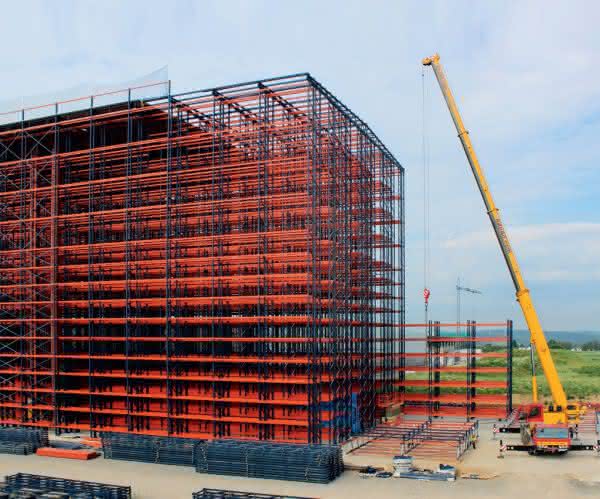
The self-supporting warehouse has a capacity of 18,000 pallets, a length of 96 m, a width of 30 m and a height of 30 m and consists of four aisles with double-depth racking on both sides. The two-mast stacker cranes consist of double-depth telescopic forks and are able to access the front and rear storage positions on all levels.
The self-supporting warehouses are buildings consisting of racks that support their own weight, the weight of the walls, the ceiling and the goods. When designing the warehouses, various factors affecting the structure were taken into account, such as wind strength, seismic activity in the area and local regulations.
Finally, the pallets organized by the warehouse management system are transported to the shipping area. There is a pre-loading area where the pallets are sorted according to the order or transport route in order to speed up loading onto the truck.
EasyWMS in use
EasyWMS is a warehouse management software (WMS) that coordinates and controls all internal processes in both warehouses. This system organizes the receipt of goods, assigns pallets to a location according to their rotation, removes pallets leaving the warehouse and prepares orders and shipments. In addition, the Galileo control module ensures the operation of all devices in this logistics center on the move and ensures compliance with regulations.
www.mecalux.dewww.blechwaren-limburg.de


You might also be interested in
Outdoor AGV networks production and logistics
An international company in the plastics industry is automating its intralogistics at its German site with a solution from ek robotics. A specially developed vehicle model from the Out Move series, an outdoor AGV, is being used.
 read more...
Transport systems for automated material flow
The Leo transporters from Bito make it easier for users to get started with the automation of material processes, which is possible from 20,000 euros. The system is a flexible all-in-one complete solution that is ready for immediate use and can be...
read more...Automated logistics for the university hospital
As part of the new construction of the University Hospital of Reims (CHU), France, the hospital has taken a number of steps to improve the needs of its patients and the working environment of its employees.
read more...K.Hartwall: Topping-out ceremony for the German site
The topping-out wreath was raised at the new building in the TIP Innovationspark Nordheide in Buchholz near Hamburg on February 27: The new K.Hartwall plant will comprise approx. 3,500 m² of hall space and around 2,000 m² of office and social areas.
read more...Noerpel Group tests driverless high lift trucks
The Noerpel Group has tested driverless pallet trucks in one of its two logistics facilities in Giengen. During a four-week trial, two autonomous systems were used to transport goods within the warehouse.
read more...Supply and disposal of printing machines by AGV
Numerous companies rely on AGVs in intralogistics to increase efficiency and meet challenges such as the shortage of skilled workers. One such company is GGP Media GmbH in Pößneck, Thuringia.
read more...Sophisticated automation: AGV and cobot combined
On behalf of Krefeld-based Saurer Technologies, the engineering team from Project Automation & Consulting developed a solution for production logistics that combines AGVs and cobots.
read more..."Herbie" robot in the Körber portfolio
Carrybots, a specialist in mobile robotics, is a new partner in the Körber supply chain ecosystem. The aim of this collaboration is to strengthen the position of both companies in intralogistics. Herbie" enables robot-based goods-to-person processes.
read more...Demand-oriented load carrier transport
Efficient logistics with AGVs
Environmental awareness and the careful use of resources are becoming increasingly important. With advanced solutions, plant operators can significantly improve the ecological footprint of logistics processes.
read more...