

New fresh food warehouse for ASKO
Intelligent dynamics for the promise of freshness
Three material flows, three outgoing goods, three load carriers and three different customer target groups - ASKO's new fresh food warehouse in Norway was not so much a quantitative challenge for Witron's technical systems, but rather the logic and dynamics in the processes, the integration of the technology and the planning were decisive for the successful start-up.
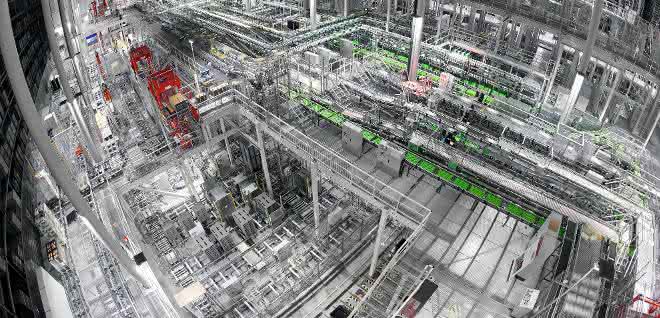
Restaurant guests rarely notice the white, inconspicuous fridge with the wine-red ASKO lettering on the side of the hotel buffet. For Holger Weiß from Witron, it is practically a mantra. It reminded the man from the Upper Palatinate of his task every morning and every evening during project implementation: the fresh food warehouse of the Norwegian food retailer ASKO must be up and running by the start of 2018, otherwise the fridge will be empty. The warehouse project in Vestby, around 40 kilometers from the Oslo metropolitan region, was his debut as a project manager at Witron and he could hardly have chosen a more complex construction project. The new 24,000 m2 ASKO fresh food warehouse not only fills refrigerators in restaurants and hotels (14,000 customers), which only order a few units, but more often and at the last minute, but also supplies over 2,600 stores and twelve regional warehouses throughout Norway - from Oslo in the south to Tromsø in the Arctic Circle, a distance of 1,800 km. With such distances, the truck cannot be half-empty. Around 80% of the goods picked go to the regional warehouses, while the other 20% - in almost equal parts - goes to stores and hotels. "In addition, we have to combine dry goods from the neighboring central dry goods warehouse with the picked goods from the fresh goods warehouse in a new consolidation unit - a warehouse within a warehouse, so to speak," explains Weiß.
Intelligent processes networked throughout
Arild Åsmul is aware of the challenges facing his logistics. "We didn't just ask for a technology expert for the project or look for technical systems, but we looked for a company that understood our process, our dynamics, could map it and develop or adapt technical solutions for it," explains the Logistics Director. And both ASKO and Witron had to rethink originally planned processes in the ongoing project in order to harmonize processes and technology - flexibility was required from both partners. "Intelligence was required to prevent congestion on the conveyor technology," reports Åsmul and laughs. "We ramped up the logistics center in three stages, which also illustrates the complexity of this project to some extent. With our sophisticated standard modules, we have integrated an overall concept that handles day-to-day business robustly and is also flexibly designed for future requirements," explains Weiß and Åsmul nods in agreement.
The OPM system initially went live in January 2017, followed by the DPS / OCB and MPS systems in March 2017. The processes of both systems were then merged in May 2017. The consolidation unit was then completed in June 2017. Since then, a Witron OnSite team of 47 employees - spread over three shifts - has ensured high system availability seven days a week. They are problem solvers and process optimizers. Both the customer and the service provider have had some entertaining days. The partners' challenge: today, the technology has to control three different flows of goods - from incoming goods to outgoing goods. Each flow of goods is dependent on the order and the customer's definition. However, this also means that the flows of goods are not separate from each other, but are interdependent. This means that intelligent networking is required: the goods arrive at the incoming goods department, are stored in the fully automated high-bay warehouse and then initially take three different routes through the logistics center - perhaps the yogurt first.
Reindeer meat manually, yogurt automatically
He travels on the conveyor system to the Order Picking Machinery (OPM), a fully automated system for case picking - at ASKO, this is a system for sausage or dairy products. The majority of the total volume is picked here. At the heart of the system is the COM (Case Order Machine) loading device, which is used by many grocers and retailers worldwide. With a system performance of over 500 picks per hour, it is possible to pick retail units onto load carriers in a gentle and store-friendly manner. 14 COMs are in operation at ASKO - they pick more than 7,000 retail units per hour. The integration of four more COMs is already being implemented. This is an expansion option that was already included in the concept at the start of planning. The implementation has become necessary earlier than originally planned due to ASKO's positive business development - characterized, among other things, by innovative logistics processes and the resulting competitive advantages.
The second route for the individual packaged steaks is via the Dynamic Picking System (DPS) and the Order Consolidation Buffer (OCB). Here, too, expansions are already in the pipeline, which will be put into operation during ongoing operations by the end of 2019. In the DPS, the highly dynamic and semi-automated picking of small parts is supported by a pick-by-light system. ASKO also stores large slow-moving containers in the DPS. The DPS works according to the goods-to-man / man-to-goods principle. Depending on the order structure, the articles are permanently or as required in the picking front, which means that this is always optimized. ASKO uses containers with three different container heights.
From the DPS area, there are again dependencies on OPM - and therefore also on the subsequent MPS unit. What is still missing in terms of products and processes? Reindeer meat from northern Scandinavia, which cannot be picked automatically. The meat is picked manually using the Module Picking System (MPS) from Witron. The solution is a goods-to-man system supported by pick-by-light. The Witron material flow computer controls all the necessary pallet movements from the high-bay warehouse and signals the removal quantities to the employees via pick-by-light displays. The dynamic pick front is generated on an order-related basis by cross transfer carts. The ergonomic positioning of the order pallet or order grid box on the pick front itself is carried out centrally between the individual storage pallets. "In addition to reindeer meat, we also store huge wheels of Camembert, for example," says Åsmul. If a hotelier orders fresh goods such as yogurt from the automated OPM area and also reindeer meat, the reindeer meat is manually added to the yogurt packed on pallets or roll containers in the MPS.
Dry and fresh goods come together
"We make it a bit more difficult for our Witron colleagues. In addition to the three material flows, we also have to handle three load carriers - half pallets, Euro pallets and roll containers," reports Åsmul, laughing.
laughs. "And the picked dry goods also have to be consolidated," adds Weiß with a grin. If a hotel customer orders fresh goods and dry goods from the neighboring logistics center, the retail units are brought together at ergonomic workstations in a semi-automated consolidation zone in the new fresh goods warehouse - all three material flows can then be involved. This process is also controlled via the Witron warehouse management system. The picked fresh goods travel via connecting pallet lifters (the logistics center was built on a slope - including blasting of the ground) back to a new goods receiving area and are then packed manually with the dry goods to form an order on a load carrier and then leave the "warehouse within a warehouse" with the company's own fleet of ASKO trucks. Example: In addition to the yogurt and reindeer meat, the hotelier also orders two containers of Coca-Cola to fill his white refrigerator. If the fresh food orders go directly to one of the twelve ASKO regional warehouses, the packed load carriers leave the fresh food warehouse via the outgoing goods department. However, if the regional warehouses also order dry goods, the fresh and dry goods meet in a cross-docking unit to be delivered from there. Here too, the Witron warehouse management system takes control.
The new fresh food storage project took three processes, three material flows, three load carriers, three outgoing goods, three different distribution channels and three years - from the first mechanical installations to the complete acceptance in spring 2018 - a logistical masterpiece, the ASKO employees attest to Witron. "And we are constantly optimizing the processes together to be able to meet our customers' every wish," reports Åsmul. "In addition to the installation and adjustments to the conveyor technology, we had to map the dependencies in the orders in the software and control the material flow so that, for example, the dry goods don't have to wait too long or hoteliers receive their orders on time. Unfortunately, simply running the system faster doesn't work; intelligence and flexibility are crucial," Weiß looks back. "We have a buffer for the regional warehouses, but not for orders to restaurants or hotels," adds Åsmul. The white refrigerator at the side of the buffet drives them both.
Witron has published a great multimedia special on the project:
newsgames.pageflow.io/Witron#175048


You might also be interested in
Circular load carriers for more sustainable supply chains
With the planned Industrial Accelerator Act, the European Union wants to accelerate the transformation of industry towards low-carbon production processes and resource-efficient supply chains. Logistics and transportation are also increasingly...
 read more...
Integration of a robotics solution
Lyreco modernizes logistics center in France
Lyreco is pressing ahead with the automation of its central site in Villaines-la-Juhel with an investment volume of over 25 million euros.
read more...Dragsbæk halves pallet area
By using automated pallet solutions from Palomat, Dragsbæk has halved the space required for pallets, optimized processes and sustainably improved working conditions.
read more...Pixels instead of paper
With the solutions from Logistikbude, Bekuplast, manufacturer of plastic containers, keeps an eye on its load carriers, saves costs and can work more efficiently with forwarding partners.
read more...Flexibility in saving space
Purus Plastics has developed a new retail range. The company operates a processing plant for plastics; recycling creates new products from secondary raw materials, including pallets.
read more...Solutions for the food industry
At Werit, the focus is on customer-specific solutions, sustainable recycling and pooling systems and products made from recyclate. The stand concept is divided into four areas: Products and innovations in the food sector, customer solutions,...
read more...Pallets with QR code
At the Epal Germany stand, visitors can gain an insight into the reusable system propagated by Epal, the life cycle of an Epal pallet and the newly developed QR pallet.
read more...The path of the Euro pallet into the IoT
With the introduction of the EPAL Euro Pallet QR in 2024, the European Pallet Association (EPAL) aims to set a new standard for the classic Euro pallet, which has been used successfully for over 60 years, and pave the way for ecologically...
read more...Retail range: flexibility to save space
Purus Plastics has developed a new retail range that is designed to attract the interest of retailers in particular. The company operates a modern plastics processing plant in Arzberg, Bavaria; new products are created from secondary raw materials...
read more...