

Cover interview LT-manager 03-04/2019
"We don't have to hide from any company"
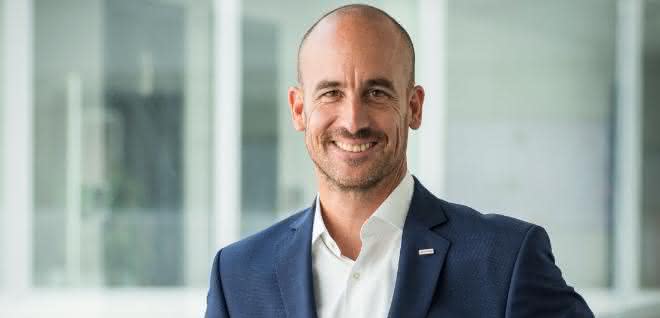
Over the past few years, intralogistics specialist Swisslog has transformed itself into a modern company under the umbrella of KUKA and has developed both in terms of turnover and technology - particularly in the areas of software and robotics. In an interview with LT-manager, Dr. Christian Baur, COO Swisslog Group & CEO Swisslog Logistics Automation, explains the vision for his company and provides insights into his management style.
LT-manager: Let's start with the Swisslog company. May I ask what the mood is like?
Christian Baur: We are very satisfied. Swisslog has been part of KUKA for almost five years and has developed very sustainably during this time. Not only in terms of business volume, which has almost doubled since then, but above all in terms of solutions and technologies tailored to the megatrends. This development naturally motivates our employees, who can realize their potential with us. The topic of robotics in particular is arousing great interest among our employees. The first part of the journey has been mastered - we are on course.
LT-manager: What makes KUKA happier? The new fields or the volume of business?
Baur: It's difficult to differentiate because sustainable growth is not possible without new technologies. However, I am happy about the overall development and how we are currently positioned in the market. However, I am primarily concerned with the long-term development of our company. This is what I am most concerned about. Firstly, although the global economy is still growing, I think that a company must be positioned in such a way that it can cope with a downturn in one of the regions without major repercussions. Secondly, logistics is in a state of upheaval. E-commerce has been the driver that has changed our consumer behavior the most in recent years. Logistics must take this into account and master the digital processes from supplier to customer.
LTM : What was your vision back then?
Baur: Logistics was rather rigid back then, today it's about offering flexible systems. Our vision four years ago was therefore to make the company a leader in the areas of data, i.e. software and robotics. However, as the barriers to market entry have fallen, you now have not only traditional companies as competitors, but also many start-ups and companies from other sectors, as the availability of computing power as well as easy-to-use and cost-effective automation products - such as robots - offers opportunities. This represents a major challenge and means that the organizational structure of the company must be set up differently.
LTM : Are you really looking so intensively in the direction of start-ups? After all, it takes more than just having an idea to be a general contractor ...
Baur: The current situation is that start-ups come up with interesting ideas, but we are one step ahead when it comes to integrating the technologies into a holistic solution. The handling of the overall process is important. The fastest picking robot is of no use to me if I don't know which goods go in at the front and out at the back, or if it can't be integrated into the overall system. Customers demand solutions. We are not afraid of start-ups, but we take competition with them seriously and try to cooperate in order to cross-fertilize each other. All major purchasing decisions are driven by the business case. You have to present it. Nobody invests in automation just because of the brand.
LTM : Is that the difference that Swisslog wants to position itself with?
Baur: Yes, the strength of the global software platform with the hardware is important. In future, it will not primarily be hardware that is sold, but digital solutions. Robotics will also support automation and lead to greater efficiency at individual points in the supply chain. This is where we differ from our competitors. Swisslog offers intelligent picking solutions, palletizing solutions and AGV systems and can combine all of these accordingly. Five years ago, Swisslog had three core products of its own; by the end of 2019, it will have nine. We also have logistics experts on board with long-standing employees who know exactly how to use technology correctly.
LTM : How do you intend to strengthen the software division? When it comes to robotics, you have an expert in-house with your parent company KUKA...
Baur: We are expanding the number of development centers worldwide and supporting many young developers. The aim is to expand the existing and very good core of the software with apps and functionalities and, together with KUKA robotics solutions such as ItemPiQ, to generate additional customer benefits. The customer know-how is often available, it is more about the "how" of implementation. It is crucial to connect the WMS (Warehouse Management System) with the machine control system efficiently - ideally with software-driven controls platforms.
LTM : Are you, like other market players, considering spinning off the software division?
Baur: No, I don't see any added value in it at the moment. If I buy software, I either have to adapt my processes or adapt the software to my processes. This is particularly difficult for smaller companies and should not lead to a corset. In other words, our customers don't just see the software, but also our understanding of the processes.
LTM : What about the "steel", is the hardware a commodity?
Baur: In certain areas, in the standard program: Yes. A standard conveyor no longer sets a company apart. But if I can calculate and optimize the processes, then it gets exciting.
LTM: Has Swisslog's corporate culture also changed in recent years?
Baur: I think so. Our team has set out to take a leading position in the market and lead the way. In the past, Swisslog was a very down-to-earth company that was geared towards not taking any major risks and prioritizing customer proximity. Now we want to offer our customers additional new services. Even if they come from outside our comfort zone. When we do this, we generate enthusiasm and I can feel it when I visit my teams and customers. We have been able to establish ourselves as one of the leading global players that not only offers commodity solutions, but also significantly drives development, particularly in the field of robotics and software. This has also contributed to the development of our corporate culture. We have now adopted internal values such as innovation and passion. One thing is clear: we don't have to hide from any other company.
LTM : As CEO, how can you support the process with leadership?
Baur: In times of advancing digitalization, globalization and a fast pace of life, with ambidextrous leadership in order to promote both agility and innovative strength. This means preserving the strengths in the company and building something new. You have to manage the new things you build up differently to the existing business. This is also important, as some of our systems have been in use for decades.
LTM : You manage with two styles?
Baur: You try to do justice to both challenges. If you manage a research team, you have to deal with a different mindset, a different attitude and way of thinking than the employees who are responsible for the day-to-day running of the business. Taking responsibility for these different mentalities and orientations while being motivating, regulating, able to deal with conflict and optimistic is the basis for good leadership. The future lies not only in employees under thirty. Getting the generations to work together is just as important. Employees can be motivated by visions that are not just written in a letter from the boss, but by visions that everyone lives by. Managers need to understand that employees can no longer be enticed by the prospect of a company car alone.
LTM : What makes good leadership?
Baur: I want to act as a good leader and make no distinction between what I expect from my employees and what I expect from myself. I also need to promote talent and support those who are motivated so that they can develop further. If you are not well positioned in the project business, not only in terms of capacity but also intellectually, you have no chance.
LTM: Is a vision alone enough?
Baur: I also need a brand that employees can identify with, that they can fight for and learn to accept defeat from time to time. And you have to recognize and use the potential that exists at the respective locations worldwide. You also need sustainable programs that make your company really attractive to talented people. At Swisslog, we offer attractive career paths for young newcomers through to experts. This helps us to retain and attract the best.
LTM : What else can Europe contribute to this overall game?
Baur: The core of Swisslog lies in Europe. We are a Swiss company. There is enormous logistics expertise here. Here, too, it is important not only to rely on employees from outside Europe, but also to see that European colleagues with extensive experience are fully involved in the company and pass this on. This is an important factor in being successful and productive. But it also helps us that logistics is a cross-sector industry and that we offer a product that will also be needed in the future. We don't build combustion engines (smiles).
LTM : Logistics also has numerous interfaces with politics and society, a fact that also led to the conception and founding of LT-manager. A population that is pushing into urban centers is also changing logistics. How are you responding to this?
Baur: The topic of consumer behavior is central to the question of what a logistics center must be able to do in the future. How will material flows work in the future? This leads me to pick goods cleverly and reduce the number of goods movements to the consumer as much as possible. There won't be enough space in the sky in cities for parcel delivery by drone. This led us to develop a concept that sorts goods intelligently. For example, with the QTainer concept study. These are standard shipping containers with logistics functionality. They can be stacked on top of each other like containers to form a pick-up station in a parking lot, for example. The whole thing is small, flexible and temporary. This brings logistics closer to the consumer. What will definitely no longer work, however, is that the shipping of products will remain free of charge. If we could manage to encourage consumers to use pick-up stations with a bonus system, that would help logistics a lot. However, both the municipality that operates the infrastructure and the shipper need to come to an agreement. Of course, we can't do that on our own.
LTM : Will you soon have to employ a sociologist at Swisslog?
Baur: Good question - it's all about constant contact with our end customers and understanding them. When a customer buys from us, they must find us to be an adequate discussion partner.
LTM : What are your personal plans for the end of the year and for 2020?
Baur: We want to further develop not only our technologies, but also our organization. We want to become even faster and find solutions tailored to our customers. Being cleverer and faster is what it's all about. Our portfolio will continue to expand in 2020. I believe we are only at the beginning of this journey. And it is important that we remain an attractive employer and maintain the good atmosphere in the organization. Our employees are the key to our success.
LTM : That makes it exciting for managers and journalists alike. You continue to develop, we report on it - thank you very much for the interview, Mr. Baur!
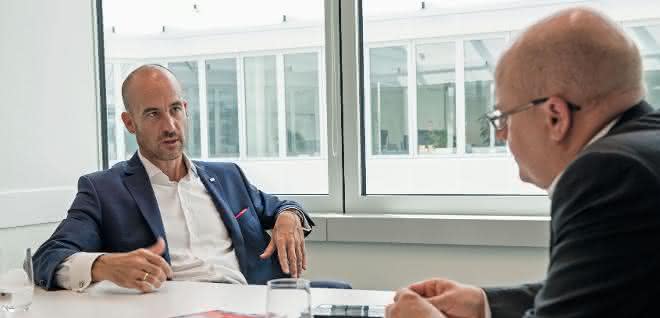
The interview with Christian Baur was conducted by Martin Schrüfer. The two met at the development and technology center of Swisslog's parent company KUKA in Augsburg.
About the person:
Dr. Christian Baur has been Chief Operating Officer (COO) of the Swisslog Group since February 2015 and in this role is responsible for areas including operational excellence, M&A, quality and purchasing. Since August 2015, he has also been Chief Executive Officer (CEO) of the Logistics Automation division (previously Warehouse & Distribution Solutions). From 2013 until he joined the Swisslog Group, he was Head of Corporate Development and M&A at KUKA AG. Prior to that, Baur held management positions at various companies, including in management consulting. Dr. Christian Baur studied mechanical engineering at the Technical University of Munich and earned his doctorate at the Technical University of Karlsruhe.


You might also be interested in
Outdoor AGV networks production and logistics
An international company in the plastics industry is automating its intralogistics at its German site with a solution from ek robotics. A specially developed vehicle model from the Out Move series, an outdoor AGV, is being used.
 read more...
Transport systems for automated material flow
The Leo transporters from Bito make it easier for users to get started with the automation of material processes, which is possible from 20,000 euros. The system is a flexible all-in-one complete solution that is ready for immediate use and can be...
read more...Automated logistics for the university hospital
As part of the new construction of the University Hospital of Reims (CHU), France, the hospital has taken a number of steps to improve the needs of its patients and the working environment of its employees.
read more...K.Hartwall: Topping-out ceremony for the German site
The topping-out wreath was raised at the new building in the TIP Innovationspark Nordheide in Buchholz near Hamburg on February 27: The new K.Hartwall plant will comprise approx. 3,500 m² of hall space and around 2,000 m² of office and social areas.
read more...Noerpel Group tests driverless high lift trucks
The Noerpel Group has tested driverless pallet trucks in one of its two logistics facilities in Giengen. During a four-week trial, two autonomous systems were used to transport goods within the warehouse.
read more...Supply and disposal of printing machines by AGV
Numerous companies rely on AGVs in intralogistics to increase efficiency and meet challenges such as the shortage of skilled workers. One such company is GGP Media GmbH in Pößneck, Thuringia.
read more...Sophisticated automation: AGV and cobot combined
On behalf of Krefeld-based Saurer Technologies, the engineering team from Project Automation & Consulting developed a solution for production logistics that combines AGVs and cobots.
read more..."Herbie" robot in the Körber portfolio
Carrybots, a specialist in mobile robotics, is a new partner in the Körber supply chain ecosystem. The aim of this collaboration is to strengthen the position of both companies in intralogistics. Herbie" enables robot-based goods-to-person processes.
read more...Demand-oriented load carrier transport
Efficient logistics with AGVs
Environmental awareness and the careful use of resources are becoming increasingly important. With advanced solutions, plant operators can significantly improve the ecological footprint of logistics processes.
read more...