

Warehouse modernization
Paper manufacturer with innovative production logistics
Paper manufacturer Franz Veit has made its intralogistics operations much more efficient with the help of Linde Material Handling and Ernst Müller Fördertechnik.

The most exciting equations are known to be those with several unknowns. One such equation can be found in the "Automation" section of paper specialist Franz Veit's specifications. How can transportation tasks be handled reliably in a production and storage environment that is constantly changing? Linde MH set about finding a solution.
Today in the supermarket, tomorrow at a children's birthday party, the day after tomorrow in a lottery kiosk or on Saturday at the soccer stadium? When you hold a Franz Veit product in your hand is, of course, up to you - but this much is certain: everyone is likely to have come into contact with the till receipts, deposit receipts, streamers, lottery rolls and similar products from Europe's leading producer at some point. It is all the more astonishing that all these products (and around 4,000 others) are produced at one and the same site.
Hirschaid near Bamberg: Since 2006, the production machines here have been running practically around the clock from Monday to Friday in three shifts. "Before moving to the open space, we had our production facility in the center of Hirschaid - which, as you can imagine, was bursting at the seams at some point. And although we haven't skimped on space here with 36,000 square meters of floor space, virtually no corner remains unused," explains authorized signatory Daniel Werner during a tour of the hall complex.
"Our machines produce an enormous output. Every day, we process around 200 tons of raw paper into a wide variety of products, which are then dispatched as quickly as possible." In between, Franz Veit has chaotically organized intralogistics, which the company wanted to optimize or automate sub-steps - especially with a view to value creation.
High throughput - and a bottleneck
Rolls of material as tall as a man in front of huge production machines, pre-packed pallets and cartons as far as the eye can see, with packing robots and other production equipment in between: at first glance, not exactly an ideal environment for automated transport processes. "But that's exactly what we were looking for," emphasizes Daniel Werner - referring specifically to the route from the production disposal area to the supply of the stretch machine in the next section of the hall. This distance had to be covered manually for a long time.
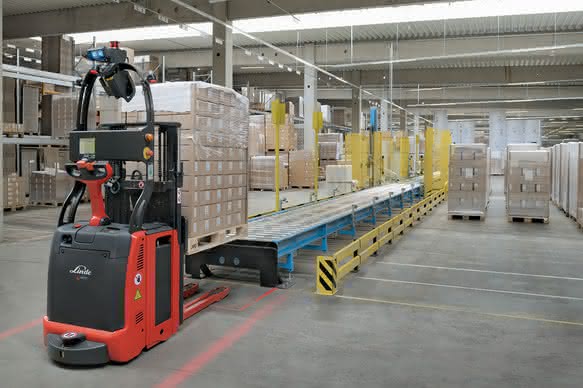
"Our employees picked up the finished goods from the paper processing machines, took them to the stretching machine by forklift and waited for the wrapping process to continue," explains Werner. During the early shift in particular, a lot of working time literally fell by the wayside: "In the morning, our colleagues first had to dispose of the production from the last two shifts - that could easily add up to 140 or 150 pallets, most of which then had to be placed on the stretching machine. All in all, that took six people around two hours."
So much flexibility is a must
Situation: unsatisfactory. Desire: automation. The initial situation at Franz Veit can be described very quickly. The search for the right solution took all the longer - which was largely due to the specifics of intralogistics described above. Daniel Werner: "Although we have recurring transport processes, we also have a constantly changing production and storage environment." Conversely, this means that any automation concept must be able to keep pace with this high degree of flexibility and "orderly chaos".
AGV systems that required mirrors, guide rails and the like were therefore ruled out from the outset by those responsible. "We have been in talks with many providers over the years. But our desired solution should work in a similar way to modern robot vacuum cleaners. You put the appliance in the room, it orients itself and does its job - even if you move a piece of furniture," explains Daniel Werner. "Unfortunately, nobody was able to help us with this - until we finally sat down with Ernst Müller Fördertechnik."
Linde Material Handling has the solution
The ideas of the long-standing Linde MH network partner for the implementation of two Linde L-Matic autonomous high-lift trucks were met with spontaneous approval by those responsible - especially as previously seemingly insurmountable hurdles virtually disappeared into thin air: thanks to geo-navigation, the Linde devices orient themselves independently in space and only require a few reference points, which can be easily adjusted at any time in a digital mapping.
"That was exactly what we were looking for," recalls Daniel Werner. There was also the advantage that the Linde L-Matic machines operate without a platform solution and can pick up the pallets directly from the floor. These were strong arguments that persuaded those responsible at Franz Veit to tackle the implementation together with Ernst Müller.
A well-coordinated team
In the meantime, the two Linde L-Matic machines in Hirschaid are doing their job as if they had always been there. One device is exclusively responsible for the disposal of the production machines. The respective machine operator places the pallet with finished goods on a defined collection point and "calls" the automated Linde device at the touch of a button. This picks up the pallets weighing up to 1,000 kilograms and transports them safely past all obstacles into the hall next door and places them on the roller conveyor belonging to the stretch machine. Once the goods have been wrapped, the second Linde L-Matic takes over at the output point; it brings the pallet to the transfer point a few meters away, where the human colleagues enter the scene. They now transport the goods promptly to the quadrant belonging to the respective order.
This interaction between man and machine also works so perfectly because the Linde L-Matic technology independently recognizes which spaces are currently free at the transfer point and then fills them up accordingly. An interesting detail: every day at midnight, the two automated vehicles swap jobs. Daniel Werner: "This is not to prevent one of them from getting bored, but to ensure an even workload, as the work routes of the two are very different." Charging the lithium-ion batteries is just as convenient: if the charge level falls below a certain threshold, the pallet trucks automatically head for the charging station.
Expectations: exceeded
From production to the stretch machine, from the stretch machine to the transfer point, loading pallets, unloading - and all over again. If you watch the tirelessly working L-Matic duo at Franz Veit, you get the impression: The two of them can't lose their cool that easily. Authorized signatory Daniel Werner can only confirm this: "The devices have now been running since November 2021. Ideally, I would need a time lapse to show you how often our production and storage environment has changed since the start of the project. What's here today will be there tomorrow - machine A moves to location B ... and so on. This has never made much of an impression on the Linde L-Matic, it has always found its way without any problems."
What is indeed impressive, however, is the performance record of the automation project. The guaranteed performance is currently being exceeded by almost 50 percent. "The current record is 298 pallets, which the vehicles have removed from production within 24 hours. This has exceeded my expectations in every respect," says a delighted Daniel Werner. So it's no wonder that the paper professionals from Upper Franconia are already considering extending automation to other process steps - for example, by enabling the production machines to call the Linde L-Matic independently. "We want to think ahead constructively here; this is also due to the fact that automation enjoys a high level of acceptance within the workforce - because we have shown our people from the outset that the devices do not take work away from them. Rather, they allow them to concentrate on other, more important activities," emphasizes Daniel Werner - and adds: "I would say that we can live very well with this distribution of roles."
http://www.linde-mh.de veit-gmbh.de http://www.ernstmueller.de


You might also be interested in
Outdoor AGV networks production and logistics
An international company in the plastics industry is automating its intralogistics at its German site with a solution from ek robotics. A specially developed vehicle model from the Out Move series, an outdoor AGV, is being used.
 read more...
Transport systems for automated material flow
The Leo transporters from Bito make it easier for users to get started with the automation of material processes, which is possible from 20,000 euros. The system is a flexible all-in-one complete solution that is ready for immediate use and can be...
read more...Automated logistics for the university hospital
As part of the new construction of the University Hospital of Reims (CHU), France, the hospital has taken a number of steps to improve the needs of its patients and the working environment of its employees.
read more...K.Hartwall: Topping-out ceremony for the German site
The topping-out wreath was raised at the new building in the TIP Innovationspark Nordheide in Buchholz near Hamburg on February 27: The new K.Hartwall plant will comprise approx. 3,500 m² of hall space and around 2,000 m² of office and social areas.
read more...Noerpel Group tests driverless high lift trucks
The Noerpel Group has tested driverless pallet trucks in one of its two logistics facilities in Giengen. During a four-week trial, two autonomous systems were used to transport goods within the warehouse.
read more...Supply and disposal of printing machines by AGV
Numerous companies rely on AGVs in intralogistics to increase efficiency and meet challenges such as the shortage of skilled workers. One such company is GGP Media GmbH in Pößneck, Thuringia.
read more...Sophisticated automation: AGV and cobot combined
On behalf of Krefeld-based Saurer Technologies, the engineering team from Project Automation & Consulting developed a solution for production logistics that combines AGVs and cobots.
read more..."Herbie" robot in the Körber portfolio
Carrybots, a specialist in mobile robotics, is a new partner in the Körber supply chain ecosystem. The aim of this collaboration is to strengthen the position of both companies in intralogistics. Herbie" enables robot-based goods-to-person processes.
read more...Demand-oriented load carrier transport
Efficient logistics with AGVs
Environmental awareness and the careful use of resources are becoming increasingly important. With advanced solutions, plant operators can significantly improve the ecological footprint of logistics processes.
read more...