

From materialfluss 1-2/2020
Multi-level shuttles ensure speed at Göpfert
Göpfert relies on multi-level shuttles from Klinkhammer and intelligent software. The result: an intelligent material flow concept with optimized arrangement of the conveyor technology. The machine manufacturer is thus increasing its performance in the warehouse.
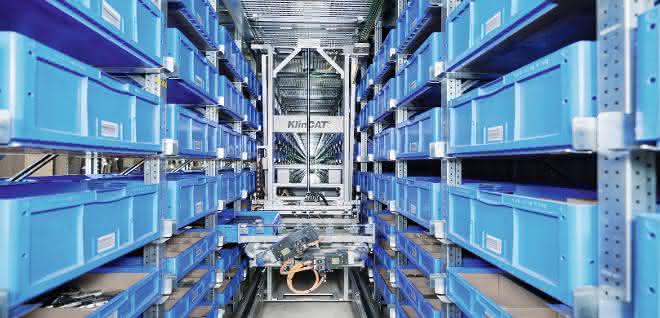
Göpfert Maschinen, manufacturer of machines for processing corrugated cardboard, is expanding its warehouse with an automatic shuttle warehouse with KlinCAT multi-level shuttles and a conveyor technology platform. The aim is to increase performance and compact the storage space. Founded in 1950 and based in the Franconian town of Wiesentheid, Göpfert is a global family business that designs and manufactures special machines for printing and die-cutting corrugated cardboard packaging and is known as a premium manufacturer of high-quality, customized systems. The average service life of a "Göpfert" is 30 years.
The challenge of company growth
The company's growth made it necessary to rethink warehousing for the assembly line and spare parts supply back in 2016. Together with Klinkhammer, manual processes were replaced by automated warehouses and paperless picking. An automated container and pallet warehouse with a shared pre-zone and combined picking workstations then ensured an optimal material flow. Due to the high annual turnover growth in the double-digit percentage range, the company again considered a performance-enhancing automation system. The choice fell on the KlinCAT multi-level shuttle warehouse, which combines the advantages of a storage and retrieval machine and a shuttle.
Digital networking of processes
Due to the wide range of items of different weights and sizes, the Klinkhammer warehouse management software integrates various storage areas - from automatic shuttle, small parts and pallet storage to manual block, lift and shelf storage and cantilever storage for bulky items. Göpfert stores a total of 32,000 items, from screws to five-ton rollers. Of these, 25,000 items are stored in the three automated systems. Manual warehousing is supported by a forklift control system and hand-held terminals. Production is also connected to the software and the forklift control system with eight assembly line warehouses and 15 pre-assembly stations. The aim was to accommodate as much stock as possible in the automated storage systems, as these serve the items directly at the picking stations according to the "goods-to-person" concept and speed up the material flow. At the same time, the incoming goods department with incoming goods inspection for external manufacturers and the outgoing goods department for new and spare parts are integrated into the material flow in terms of conveyor technology and digitally networked. The KlinkVision visualization system brings transparency to the warehouse and enables rapid alarm diagnostics in the warehouse thanks to its detailed views down to sensor and drive level.
Hybrid between stacker crane and shuttle
The rail-bound multi-level shuttle warehouse with a length of 60 meters is equipped with three KlinCAT shuttles including three maintenance platforms. Each shuttle with lifting function serves seven container levels. The shuttle warehouse is tailored to the throughput required by Göpfert and the individual article structure. With a rack height of 7.80 meters, the single-aisle shuttle warehouse offers space for 6,720 bin storage locations. Compared to conventional small parts warehouses with storage and retrieval machines, the multi-level shuttle system has a higher storage and retrieval capacity. With roughly the same floor space, the single-aisle multi-level shuttle warehouse has around three times the capacity of the existing single-aisle automated small parts warehouse. KlinCAT thus forms the hybrid between a storage and retrieval machine (SRM) and a single-level shuttle and closes the gap between the performance of a SRM with around 120 double cycles and that of a classic shuttle solution with 1,000 double cycles per aisle and hour.
"KlinCAT convinced us immediately and the decisions were made very quickly," summarizes Daniel Achtmann, Head of Logistics and Purchasing at Göpfert. "After inspecting the shuttle system in December 2018, the order was placed in January 2019 and the system was commissioned in November. With the additional performance and the newly gained storage capacity, we are well equipped for our further growth."
Space-saving design for conveyor technology
A high-performance lift acts as a link between the conveyor system and the shuttle warehouse. The storage and retrieval lanes of the shuttle warehouse are located on a platform and connect the warehouse with the existing system and the three picking and goods receiving stations. The workstations and the conveyor technology were connected with three double vertical conveyors. This means that the conveyor technology is already designed for a further expansion stage with 800 storage and 800 retrieval operations. In order to connect the new system components, two pallet picking and buffer stations had to be relocated and the existing container conveyor technology in the picking area had to be dismantled. The new picking workstations are designed so that goods can be picked from containers and pallets at the same time. If necessary, the source pallet is lowered using lifting tables to make access ergonomic. The maintenance-friendly shuttle warehouse has separate aisle access on each level; this means that the other two levels can continue to operate during service work on one level.
Various components are required for the production of printing, creasing and cutting machines for the manufacture of corrugated cardboard packaging. A special detail in automated storage is the flexible container division, which offers advantages for small parts such as screws or semi-finished products. Depending on the size of the goods to be stored, a container can be divided into up to 16 different compartments. This compresses the available storage space and multiplies the storage capacity. The exact subdivision of the storage bins is visually displayed in the warehouse management software and supports the order picker in his work.


You might also be interested in
Winner material flow PRODUCTS OF THE YEAR 2023
Conductix-Wampfler: ChargeLine 0865
Two-pole conductor rail segments for efficient opportunity charging of shuttles, suitable for thousands of cycles per day.
 read more...
Hermann Grewer celebrates his 80th birthday
Hermann Grewer, Honorary Chairman of the North Rhine-Westphalia Transport and Logistics Association (VVWL) and Honorary President of the German Road Haulage, Logistics and Disposal Association (BGL), celebrated his 80th birthday on June 6.
read more...Well chilled for sure
V-Zug Kühltechnik AG, developer and manufacturer of refrigeration appliances and part of the successful V-Zug Group, has set up a new production facility for refrigerators of all heights and dimensions at its Swiss site in Sulgen.
read more...Advantageous automation of small parts warehouses
The RSX1 shuttle system will be at the center of Rocketsolution's presence at this year's Logimat trade fair.
read more...Reduced energy requirements in the high-bay warehouse
One of Germany's leading premium car manufacturers is already focusing on energy efficiency in the production of its new SUV model with electric drive. The storage and retrieval machines in a high-bay warehouse at the production site have been...
read more...Low lift pallet truck for light duty applications
Clark has launched a new low lift pallet truck with the model designation LWio15 for light transport tasks. The truck has a load capacity of 1500 kg and is suitable for short distances in goods distribution, production or warehousing.
read more...Internationalization as an opportunity
E-commerce is in a state of flux. Changes in purchasing behavior and procurement problems are keeping e-commerce retailers busy. Logistics plays a decisive role in the overall online shopping experience.
read more...Fulfillment Center for Frisco.pl
Polish eGrocery specialist and TGW deepen partnership
TGW is building a highly automated fulfillment center for Frisco.pl in the Polish capital Warsaw. This is the second project in a row that the two companies have implemented together.
read more...Which world will it be in 2023?
Michael Schreckenberg teaches at the University of Duisburg-Essen as Professor of Physics of Transport and Traffic. Once a year, he addresses the readers of materialfluss, formerly LT-manager, with a critical and humorous expert article on transport...
read more...