

Stacker cranes, shuttle and robotics
Head-to-head race: Shuttle instead of RBG
The question "Shuttle instead of stacker crane?" is by no means an ideological dispute - rather, the practical application requirements, cost-effectiveness and efficiency are decisive for the use of the system. However, as the results of our survey show, shuttle systems are becoming increasingly popular.

In your experience, in which applications will shuttle systems be able to completely replace SRM-operated storage systems in the long term?" was the question posed by Materialfluss to system managers from a number of leading manufacturers. As the answers show, both systems will not only continue to have a right to exist in the future, but will also prove their worth in a wide variety of application environments. However, shuttle systems are increasingly gaining ground.
"Even if both systems have their basic justification, in the case of single-item picking, the shuttle systems clearly stand out due to their high speed and have clearly displaced all other systems in this area," says Notker Steigerwald, Head of Business Solutions at Dematic. "This trend will continue. Competitors who have not relied so heavily on shuttle systems in the past are therefore currently making massive upgrades".
A cut-throat competition?
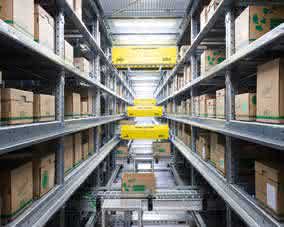
"In the lower and upper performance range, shuttle systems are already pushing classic SRMs out of the market," emphasizes Roman Schnabl, Director Product Management at Knapp AG. "However, there will also be a niche in the future where storage and retrieval machines are justified - namely where the maximum capacity of the SRMs is still sufficient and a hall is available that is suitable for the use of SRMs".
"As a supplier and manufacturer of both systems, we are firmly convinced that stacker cranes will continue to have their place in the market and retain their market share," says Volker Welsch, Head of Sales Germany at psb. "The great advantage of shuttle systems lies in their performance. This can be significantly higher per aisle than with SRMs. However, if such high performance will not be required in a project for the foreseeable future, storage and retrieval machines come into their own when it comes to costs and space utilization. When deciding between shuttle or SRM, our primary criterion is the performance requirements of the system."
"The simple scalability makes shuttles superior"
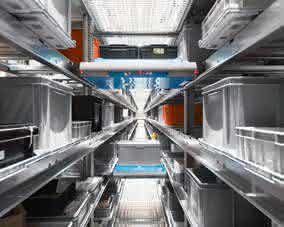
Christian Beer, owner and Managing Director of Servus Intralogistics GmbH, is convinced of the superiority of the shuttle. "The question is rather in which individual cases stacker crane-operated storage systems will survive. There will always be storage and retrieval machines, and certain services can be covered perfectly with a stacker crane. But what happens if you need more or less capacity? In terms of flexibility and market requirements, the shuttle is superior because it is much easier to adapt to new conditions," emphasizes the Servus boss.
"With the additional use or removal of shuttles, performance can be easily scaled. Our customers' customers expect short response times and want to be served faster and faster. So where intralogistics has to 'breathe' along with the customer's performance requirements, there is no way around the shuttles," emphasizes Beer.
Transport robots with swarm intelligence
"However, the term shuttle doesn't go far enough. In the course of Industry 4.0, shuttles must be able to do much more than just move back and forth in the warehouse. At Servus Intralogistics, we talk about transport robots. In order to realize batch size 1 or the one-piece flow, these transport robots must be equipped with swarm intelligence, act autonomously and find the shortest route to the destination independently. This is the only way for a system to remain scalable and yet lean and efficient. The capabilities of transport robots will be even more in demand in the future," Beer is convinced.
Individual case is decisive
"First of all, a shuttle is 'just' a storage machine, like a stacker crane, a lifting beam, a storage lift or a carousel. This list alone makes it clear that it obviously depends on the application as to which device is most suitable," emphasizes Dr. Max Winkler, Vice President Solutions & Technology at SSI Schaefer, Graz. "Typical decision criteria are throughput, cost per storage location and storage density. Conventional SRM systems are still ahead in applications with a high number of storage locations and moderate throughput requirements. In recent years, we have seen that shuttles are still in the middle of the optimization phase of a relatively new technology. While RBGs are no longer improving at the same pace in terms of costs and performance due to their longer maturity phase. As a result, the cost-benefit ratio between RBGs and shuttles has shifted in recent years.
Coexistence of technologies
"At present, there are primarily two criteria that could really speak against a shuttle system - cost-effectiveness or ROI and payloads that are too high. In order picking supply or outgoing goods consolidation, where high performance is required, shuttle systems have already strongly displaced classic miniload systems," says Eric Große, Head of Product Management Storage Systems at TGW. "In the area of 'massive storage' with high storage volumes and low throughputs, the classic miniload will continue to be the more cost-effective solution. This is supported by the trend that the maximum system height of miniload systems is now over 20 meters and continues to rise. We at TGW are convinced that there will continue to be a coexistence of technologies in the future, in which the miniload system is currently repositioning itself."
RBG scores in the heavy-duty sector and in small parts storage
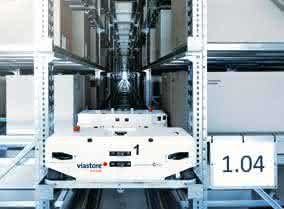
"Shuttle and SRM are two technologies that both have their specific advantages and are used within complete systems," says Thomas Preller, Sales Manager at viastore Systems. "The robust operating devices have clear advantages, especially in the heavy-duty sector. And even for small parts storage, it doesn't always have to be a shuttle solution. If a user places more value on a high number of storage locations than on maximum throughput, SRMs are still the more economically viable alternative". Ultimately, users have to weigh up which variant offers more advantages in their particular case. The sales manager therefore believes that technology-independent advice is very important: "It is important to precisely analyze the specific requirements and then select the right system for them."
"Share of shuttle systems is increasing"
According to Peter Bimmermann, Business Development Manager at Vanderlande Industries, the proportion of shuttle systems compared to SRM systems has increased significantly in recent years: "While shuttle systems were initially mainly useful in the very high output range, it is now the case that there are definitely shuttle systems that also make economic sense in the classic SRM range in terms of throughput performance." The Vanderlande manager is also convinced that the proportion of classic SRMs will continue to fall in the future. One reason, for example, is the additional benefits - low energy consumption, lower connected load, scalability, reliability and easier maintenance. He sums up: "In my opinion, the standard SRM is increasingly becoming a niche product, and the applications in which shuttles cannot be used are becoming fewer and fewer.
Reinhard Irrgang


You might also be interested in
Winner material flow PRODUCTS OF THE YEAR 2023
Conductix-Wampfler: ChargeLine 0865
Two-pole conductor rail segments for efficient opportunity charging of shuttles, suitable for thousands of cycles per day.
 read more...
Hermann Grewer celebrates his 80th birthday
Hermann Grewer, Honorary Chairman of the North Rhine-Westphalia Transport and Logistics Association (VVWL) and Honorary President of the German Road Haulage, Logistics and Disposal Association (BGL), celebrated his 80th birthday on June 6.
read more...Well chilled for sure
V-Zug Kühltechnik AG, developer and manufacturer of refrigeration appliances and part of the successful V-Zug Group, has set up a new production facility for refrigerators of all heights and dimensions at its Swiss site in Sulgen.
read more...Advantageous automation of small parts warehouses
The RSX1 shuttle system will be at the center of Rocketsolution's presence at this year's Logimat trade fair.
read more...Reduced energy requirements in the high-bay warehouse
One of Germany's leading premium car manufacturers is already focusing on energy efficiency in the production of its new SUV model with electric drive. The storage and retrieval machines in a high-bay warehouse at the production site have been...
read more...Low lift pallet truck for light duty applications
Clark has launched a new low lift pallet truck with the model designation LWio15 for light transport tasks. The truck has a load capacity of 1500 kg and is suitable for short distances in goods distribution, production or warehousing.
read more...Internationalization as an opportunity
E-commerce is in a state of flux. Changes in purchasing behavior and procurement problems are keeping e-commerce retailers busy. Logistics plays a decisive role in the overall online shopping experience.
read more...Fulfillment Center for Frisco.pl
Polish eGrocery specialist and TGW deepen partnership
TGW is building a highly automated fulfillment center for Frisco.pl in the Polish capital Warsaw. This is the second project in a row that the two companies have implemented together.
read more...Which world will it be in 2023?
Michael Schreckenberg teaches at the University of Duisburg-Essen as Professor of Physics of Transport and Traffic. Once a year, he addresses the readers of materialfluss, formerly LT-manager, with a critical and humorous expert article on transport...
read more...