

Stacker cranes, shuttle and robotics
Gebhardt modernizes logistics for medical products
Because Paul Hartmann AG's storage capacities had reached their limits, the manufacturer of medical and care products was looking for new solutions. Gebhardt therefore developed a new, highly dynamic shuttle warehouse for the long-established company at the Logistics Center South in Herbrechtingen.
Paul Hartmann AG from Heidenheim in Württemberg can look back on 200 years of success as a leading international supplier of medical, care and hygiene products. What began in 1818 as a mechanical spinning mill in Heidenheim is now a globally active group with around 10,400 employees and a presence in almost 40 countries. The long-established company supplies hospitals, care facilities and specialist retailers with high-tech products.
The Logistics Center South (LZS) in Herbrechtingen is the company's logistics hub. With 65,000 pallet spaces and around 130 employees, it is the Hartmann Group's largest fully automated high-bay warehouse. The LZS is part of the factory site, which also houses a highly automated production facility and a materials and raw materials warehouse. A new automated small parts warehouse (AKL) became necessary due to the constant growth of the company and was to be built on the site.
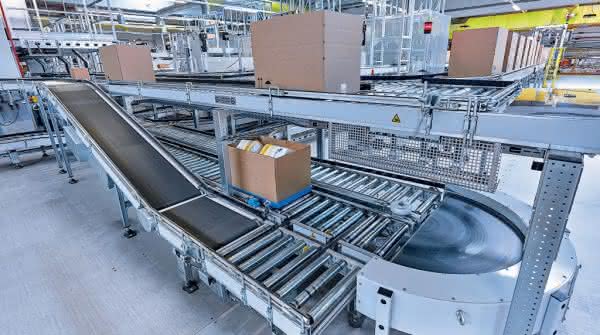
Gebhardt Fördertechnik GmbH was awarded the contract in July 2012. Following a planning phase, construction began in January 2013 and went live the following October. During this time, Gebhardt planned, delivered, installed and commissioned a three-aisle mini-load warehouse operated by 39 one-level shuttles (OLS) with four picking workstations, separate conveyor lines for shipping cartons and source trays, a central order start with automatic carton erection and labeling, the connection of the conveyor technology to manual picking areas and seven shipping workstations. In addition to the warehouse hardware, Gebhardt also supplied software such as the Gebhardt Storeware MFS, the Gebhardt Storeware WMS and the system control. The project also included the modernization of the old existing warehouse consisting of two aisles (AKL). As part of the retrofit, the warehouse was connected to the new conveyor technology and picking system.
Designing the new warehouse as an OLS warehouse was the ideal solution for project manager Thomas Engelhard from Gebhardt: "Compared to traditional miniload solutions, the shuttle system offers higher storage and retrieval performance and effective, dynamic access to goods to be stored and retrieved according to the goods-to-person principle. The modular design of the individual lane sections also allows the storage system to be flexibly extended as required. The good use of space, low maintenance and servicing requirements, quick installation and low investment and operating costs also spoke in favor of this solution.
Highly dynamic material flow
In the goods receiving area, the goods delivered from production or the pallet warehouse are repacked in cartons by an employee from the pallet onto source trays, which are then transported to the OLS warehouse via conveyor technology. All three aisles of the shuttle warehouse are each equipped with a storage/retrieval lifter in the pre-zone, which can pick up and drop off two containers at the same time. This means that each individual lifter can store or retrieve 528 trays per hour. Together, they therefore perform around 1,500 double cycles per hour. The warehouse has around 4,500 storage locations for trays and also offers additional space as a buffer for shipping cartons.
In the shuttle warehouse itself, 13 Gebhardt Storebiter 300 OLS are used per aisle to initially store the trays. The shuttles, with a maximum payload of 2 x 50 kg, are powered by a conductor rail system. The warehouse is enclosed on all sides and is constantly filled with air in order to store the items in a dust-free environment and in accordance with the quality management standards for medical products.
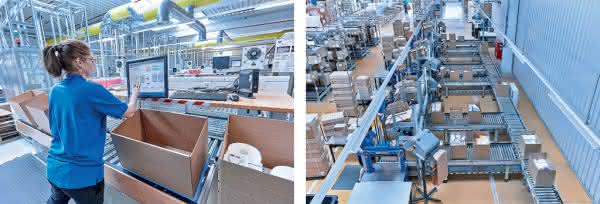
The process then begins with an order start: after the automatic carton erection, the shipping cartons are provided with a barcode label. They then travel to the separate conveyor loop for shipping cartons, which handles around 800 cartons per hour. The WMS decides which of the four picking workstations a carton should go to. Four of these shipping cartons are processed simultaneously at each work station.
At the same time, the source trays with the articles start from the shuttle warehouse to the picking workstations. They are organized according to the 1-to-end distribution principle: The picker at his workstation can pick the goods from a source tray into the four shipping cartons. In order to supply the work stations with the right articles in the right sequence according to the order, there is a tower storage system with 22 storage locations at each work station, which can perform a double cycle of 200 per hour. The Gebhardt WMS picking dialog guides the employee through the picking process: when he picks goods from the source tray, the corresponding target carton is marked with a blue light using a put-to-light process. The picker then knows which shipping carton to place the items in. On average, 250 source trays are processed per workstation.
To enable ergonomic gripping, automatically adjustable lifting platforms are installed so that the order picker is at an ideal height in relation to the conveyor system. Also for ergonomic reasons, the source trays and target cartons are tilted at an angle of 15° to the order picker. In addition, the tilting position signals to the employee that the shipping carton has not yet been fully picked. Only when the tilting device folds down does he know that the carton is ready for dispatch.
Many improvements and modernizations
The shipping cartons then run via a NERAK-S conveyor to the individual shipping lanes and to one of the seven shipping workstations. Here the cartons are given a label, strapped and transferred to the relevant route pallets and dispatched. However, if they are not yet destined for dispatch, the cartons first go to the shuttle warehouse where they are buffered in storage compartments. At the same time, the source trays from picking are returned to the shuttle warehouse via the tray conveyor loop.
Gebhardt modernized the old existing miniload warehouse - with two aisles including storage and retrieval machines - and connected it to the new conveyor technology and picking process of the new warehouse. Because larger trays are used in this warehouse, which are not compatible with the new system, a separate conveyor system had to be installed.


You might also be interested in
Winner material flow PRODUCTS OF THE YEAR 2023
Conductix-Wampfler: ChargeLine 0865
Two-pole conductor rail segments for efficient opportunity charging of shuttles, suitable for thousands of cycles per day.
 read more...
Hermann Grewer celebrates his 80th birthday
Hermann Grewer, Honorary Chairman of the North Rhine-Westphalia Transport and Logistics Association (VVWL) and Honorary President of the German Road Haulage, Logistics and Disposal Association (BGL), celebrated his 80th birthday on June 6.
read more...Well chilled for sure
V-Zug Kühltechnik AG, developer and manufacturer of refrigeration appliances and part of the successful V-Zug Group, has set up a new production facility for refrigerators of all heights and dimensions at its Swiss site in Sulgen.
read more...Advantageous automation of small parts warehouses
The RSX1 shuttle system will be at the center of Rocketsolution's presence at this year's Logimat trade fair.
read more...Reduced energy requirements in the high-bay warehouse
One of Germany's leading premium car manufacturers is already focusing on energy efficiency in the production of its new SUV model with electric drive. The storage and retrieval machines in a high-bay warehouse at the production site have been...
read more...Low lift pallet truck for light duty applications
Clark has launched a new low lift pallet truck with the model designation LWio15 for light transport tasks. The truck has a load capacity of 1500 kg and is suitable for short distances in goods distribution, production or warehousing.
read more...Internationalization as an opportunity
E-commerce is in a state of flux. Changes in purchasing behavior and procurement problems are keeping e-commerce retailers busy. Logistics plays a decisive role in the overall online shopping experience.
read more...Fulfillment Center for Frisco.pl
Polish eGrocery specialist and TGW deepen partnership
TGW is building a highly automated fulfillment center for Frisco.pl in the Polish capital Warsaw. This is the second project in a row that the two companies have implemented together.
read more...Which world will it be in 2023?
Michael Schreckenberg teaches at the University of Duisburg-Essen as Professor of Physics of Transport and Traffic. Once a year, he addresses the readers of materialfluss, formerly LT-manager, with a critical and humorous expert article on transport...
read more...