

Stacker cranes, shuttle and robotics
Compact, flexible and precisely timed
The new materials management center (MWZ) at Maschinenfabrik Reinhausen offers transparency and availability for production supply. With three storage systems, multi-order picking stations, tugger trains loaded for removal and a warehouse management system including a forklift guidance system, it ensures that production is stocked.
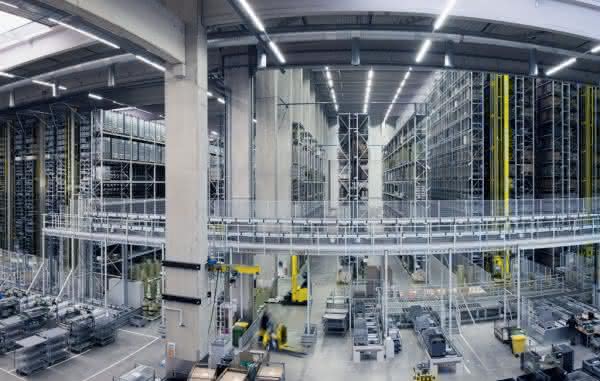
psb intralogistics has implemented the complete intralogistics of the new materials management center (MWZ) for the Regensburg-based Maschinenfabrik Reinhausen GmbH (MR). This supports Maschinenfabrik Reinhausen in achieving delivery reliability of 99.3 percent.
A variety of reasons made the new MWZ necessary, as Jürgen Liebl, Project Manager and Head of Production Logistics at MR, explains. The available space and storage capacity were insufficient for the company's growth. Previously, there were a total of nine company-owned warehouse locations at the Regensburg-Reinhausen and Haslbach sites, as well as two additional external locations with a total area of around 15,000 m². "The many locations in the past were a logistical disaster," emphasizes Liebl: for a logistical transport round trip, trucks had to drive 32 km through Regensburg. Furthermore, some of the warehouse technology was outdated. There were also many interfaces and parties involved, including an external service provider for the "sleeper parts" and "a low level of IT support and automation."
One general contractor each for construction and intralogistics
The search for the ideal solution for a new, efficient MWZ was not easy for MR. Various scenarios were considered and played through. After a detailed examination, those responsible at MR decided to realize the MWZ themselves on an acquired plot of land adjacent to the Haslbach production site and to implement the construction of the hall and the realization of the intralogistics with a general contractor in each case.
MR awarded the contract for the planning and implementation of the entire intralogistics system to Pirmasens-based specialist psb intralogistics. "We deliberately looked for a family-run, medium-sized company," emphasizes Liebl, "with whom we can discuss on an equal footing and who treat us as an A-customer."
"We deliberately looked for a family-run, medium-sized company as a partner with whom we can discuss things as equals and who treats us as an A-customer."Jürgen Liebl Head of Production Logistics at MR
The strategic objectives of the new MWZ, for which a total investment of 24.5 million euros has been budgeted, include increasing competitiveness, raising quality standards, reducing inventories and costs, increasing availability and taking TCO into account while reducing logistics costs, including quality costs.
After the planning phase, construction began in March 2014 and the system went live in January 2016. psb's scope of supply includes the automated small parts warehouse (AKL) and the high-bay warehouse (HRL), each with storage and retrieval machines (RBG) as well as the manual warehouse for large load carriers (GLT), the pallet and container conveyor technology, the warehouse management system psb selektron-WMS and selektron-SCADA for visualization.
Efficient storage systems
The three storage systems are compactly fitted into the 100 m long, 76 m wide and 26 m high building of the new MWZ, making optimum use of the available space.
The five-aisle high-bay warehouse (HBW) measuring 55 x 23 x 22 m (LxWxH) and served by five psb maxloader stacker cranes offers 8,700 storage locations for 1,200 x 800 mm Euro pallets and pallet boxes.
At the same time, a large number of half pallets are also stored double-deep in the HBW. The loaded large load carriers (GLT) can be up to 1,800 m high and may weigh a maximum of 1,000 kg. The HBW performs 40 double cycles per hour for Euro pallets per aisle. The four-aisle mini-load warehouse, served by four sprinter stacker cranes, is 41 m long, 16 m wide and 15 m high and offers 46,000 storage locations for containers and trays that can be stored double-deep. In addition to the 600 x 400 mm THMs used, the system is already designed to handle 400 x 300 mm containers. The miniload system performs around 120 double cycles per aisle per hour. The four-aisle large parts warehouse installed between the miniload and high-bay warehouse accommodates oversized pallets and pallet cages on up to 2,000 storage locations.
Customized production and order-related assembly
The three different storage systems and their precise interaction are necessary for MR's typical production logistics processes. Liebl: "We built the materials management center as a buffer for externally procured parts and as a buffer or for stocking parts manufactured in-house.
The parts manufactured to customer order are kept in the storage facilities until they are needed for assembly, which is carried out on a customer order basis; final assembly begins five days before the respective delivery date.
Up to 6,000 deliveries with the required parts pass through the incoming goods department every year. Prior to storage, the parts are checked at special locations, then prepared for storage in the palletizing area, repacked into standard containers if necessary and "married" to the container barcode in the system. The goods can be identified at any time by scanning the barcodes, and additional information such as the storage date or the next transport destination for the container can also be called up.
The storage station for the small parts warehouse is located in the immediate vicinity of the goods receiving area. At two storage workstations, employees pack the palletized containers onto trays and link them to these by scanning. The weight and contour are also checked. As Liebl explains, the selektron warehouse management system (WMS) installed by psb "knows the weight of the parts, the weight of the tray and the empty weight of our containers via transfer from the higher-level SAP system, calculates the total weight for each storage process and can therefore immediately detect deviations in the number of items".
Complete transparency of parts and processes
As containers are repeatedly removed from the trays during the production process, the psb WMS identifies trays with a fill level of less than 50% (can be parameterized) and conveys them to the goods receiving area, where they are refilled. In addition, the psb selektron software specifies the free spaces on the tray where the container can be placed. These locations are displayed on the screen for the employee during storage.
Each individual container is automatically photographed before being stored on the conveyor system, so that the contents of the entire tray can be checked by calling up the material number stored in the psb selektron WMS, which further increases the quality of the processes.
The parts destined for the HBW after palletizing are placed on one of the two storage lanes by forklift truck or electric pallet truck. Light barriers and scanners recognize and differentiate between Euro pallets, pallet cages, pallet boxes or half pallets.
The system also decides whether an entire pallet or a partial quantity should be removed from the HBW. The containers are then transported to one of the two full retrieval lanes or one of the four picking workstations. There, the employee can move the pallet to the optimum ergonomic height and remove heavy parts using the column-mounted slewing crane.
The manual warehouse for large load carriers accommodates all units that exceed the basic dimensions of a Euro pallet or are higher than 1,800 mm. Pallets up to a size of 3.75 x 1.3 x 2 m (WxLxH) can be stored. The warehouse is operated by a reach truck with a mast height of 13 m, which is equipped with assistance systems such as lift height pre-count, mast stabilizer and tine camera system. The operator receives the driving orders from the forklift guidance system via a touch monitor.
Ergonomic multi-order picking for up to five routes
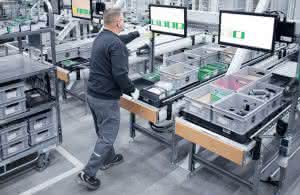
"The miniload is the storage area with the highest turnover," says Liebl about the storage system with its 46,000 storage locations for trays, each of which can hold up to ten containers with different items. Up to 60 trays per hour are made available for picking at each of the four picking workstations in the AKL pre-zone.
Multi-order picking" allows parts for up to five order containers to be picked at the picking stations. Employees are guided in their activities by dialogs on a touchscreen monitor. For example, different colors are used to indicate whether single or full picks via Kanban or negative picking programmed in the psb selektron are involved. Around 4,000 picks are made per day in the miniload in two-shift operation, on average around 250 picks per hour, and at peak times it can be 500 picks per hour.
The containers prepared at the order picking stations of the miniload are distributed to one of six sorter lanes by the conveyor technology. In general, as Jochen Hartman, who was responsible for sales at psb, emphasizes, the decoupling of the work steps during order picking and distribution to the tugger trains increases performance.
Loading for removal
Each of the sorter lanes corresponds to a number of destinations in production or assembly. These destinations are distributed across the sorter lanes in such a way that the subsequent exit route of the tugger trains is taken into account. In addition, "whether the workstation in production or assembly is on the left or right in the direction of travel" is taken into account for ergonomic and efficient unloading. Each loading and unloading step of the tugger trains is recorded and booked using a barcode scanner so that the movement of parts is transparent at all times. A total of ten tugger train tractors with transport trolleys are used in the tugger train concept to supply all areas of production in Haslbach and assembly in Regensburg.
A number of significant improvements have been achieved with the new MWZ. Liebl mentions the compactness of the entire facility: "We now have an area of around 7,630 m² and have therefore reduced the number of square meters by 50 percent compared to the previous many warehouses". Due to the small area, it was "imperative to adhere to the processes in order to guarantee a fast material flow". This means that the production areas can now be supplied with material within two to four hours, depending on requirements. The psb selektron WMS makes a significant contribution to this.
Innovative guidance system for the tugger trains
Together with psb, MR has developed a forklift guidance system that also functions as a guidance system for the tugger trains and is integrated into the WMS. The driver of the tugger train sees the material booked to a slot via barcode on a transport screen.
Supplier overview
Storage and retrieval machines, conveyor technology, control system, WMS, forklift control system: psb intralogistics GmbH, Pirmasens General contractor for the building: Bolckmans GmbH, Schwalmtal Rack construction: Nedcon B.V., Doetinchem (NL) Container washing system: Hobart GmbH, Offenburg
Another decisive factor is the communication between the SAP system used in the ERP function and the selektron WMS, which takes place via a single iDoc interface. For example, the stock removal and transportation requirements are sent to selektron via iDoc and then reported back to SAP after execution. As Liebl emphasizes, only the employees at MWZ need to be able to use selektron, as all information, such as stock levels, storage locations, orders and the quality of materials, can be viewed via SAP using iDoc communication.
Successful cooperation
As far as the cooperation between MR and psb is concerned, Liebl is satisfied: "I experienced for myself that the project teams complemented each other excellently with their specialist knowledge, resulting in a cooperative project collaboration." The close cooperation between the family businesses was important for the success of the project. Everyone involved, from the project teams to the service teams and the managing directors, got to know each other personally. Liebl: "This is how a relationship was built". This is how high-tech and communication lead to success together.
Reinhard Irrgang


You might also be interested in
Winner material flow PRODUCTS OF THE YEAR 2023
Conductix-Wampfler: ChargeLine 0865
Two-pole conductor rail segments for efficient opportunity charging of shuttles, suitable for thousands of cycles per day.
 read more...
Hermann Grewer celebrates his 80th birthday
Hermann Grewer, Honorary Chairman of the North Rhine-Westphalia Transport and Logistics Association (VVWL) and Honorary President of the German Road Haulage, Logistics and Disposal Association (BGL), celebrated his 80th birthday on June 6.
read more...Well chilled for sure
V-Zug Kühltechnik AG, developer and manufacturer of refrigeration appliances and part of the successful V-Zug Group, has set up a new production facility for refrigerators of all heights and dimensions at its Swiss site in Sulgen.
read more...Advantageous automation of small parts warehouses
The RSX1 shuttle system will be at the center of Rocketsolution's presence at this year's Logimat trade fair.
read more...Reduced energy requirements in the high-bay warehouse
One of Germany's leading premium car manufacturers is already focusing on energy efficiency in the production of its new SUV model with electric drive. The storage and retrieval machines in a high-bay warehouse at the production site have been...
read more...Low lift pallet truck for light duty applications
Clark has launched a new low lift pallet truck with the model designation LWio15 for light transport tasks. The truck has a load capacity of 1500 kg and is suitable for short distances in goods distribution, production or warehousing.
read more...Internationalization as an opportunity
E-commerce is in a state of flux. Changes in purchasing behavior and procurement problems are keeping e-commerce retailers busy. Logistics plays a decisive role in the overall online shopping experience.
read more...Fulfillment Center for Frisco.pl
Polish eGrocery specialist and TGW deepen partnership
TGW is building a highly automated fulfillment center for Frisco.pl in the Polish capital Warsaw. This is the second project in a row that the two companies have implemented together.
read more...Which world will it be in 2023?
Michael Schreckenberg teaches at the University of Duisburg-Essen as Professor of Physics of Transport and Traffic. Once a year, he addresses the readers of materialfluss, formerly LT-manager, with a critical and humorous expert article on transport...
read more...