

Supply chain management study
Upward trend in digitization is emerging
Has the pandemic had a positive impact as a catalyst for digitalization projects in business? Has digitalization in supply management actually progressed? What digitalization measures are the participants dealing with in practice? An Inform study has addressed these questions. The study also provides a picture of the mood regarding current obstacles to such projects and gives an overview of which technologies those responsible in SCM and logistics are specifically turning to.
"In addition to general cost reductions, an increased need for crisis resistance and resilience is driving digitalization projects," says Stefan Witwicki, Head of Inventory & Supply Chain at INFORM. "This is a good thing, as long as it is accompanied by a willingness to rethink business models and processes instead of just wanting to safeguard the status quo. Can companies really create added value from their data and adapt to it? That will be crucial."
The most important results of the INFORM trend report at a glance:
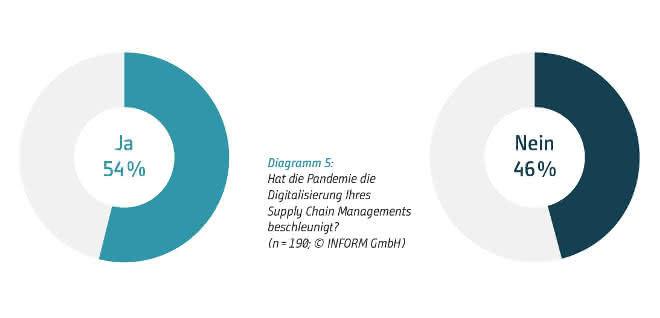
- Resilience: Most respondents (93%) consider the digitalization of their supply chain management (SCM) to be crucial in order to be more resilient in future crises. The majority (86%) of companies also consider the digitalization of SCM to be highly or very highly relevant. For more than half of companies (54%), the pandemic has accelerated digitalization projects.
- Digitalization of SCM: 81% of respondents have initiated or are planning specific digitalization projects in inventory management and warehouse management. Projects were most frequently initiated in inventory management (60%), warehouse management (54%) and production planning and control (45%). The most frequently planned projects are in supplier management (39%), sustainability in SCM (34%) and supply chain risk management (33%).
- Know-how: At least a third (34%) of respondents feel well informed about the state of the art and possible applications in this area. Nevertheless, many respondents would like support with specific use cases (35%) or even feel poorly informed (23%). Respondents most frequently obtain information via internet research (73%), specialist journals (42%) or their own, predominantly internal professional network (32%).
- Artificial intelligence: Only a quarter (25%) of respondents are already using or implementing AI in logistics or SCM processes. Nevertheless, most companies that are not yet at this stage see an acute (28%) or future (57%) need for action. Overall, almost all respondents (92%) believe that those who invest in AI today will be better or significantly better positioned on the market in five years' time. The three most important areas of application for AI in logistics and supply chain management are sales planning and demand forecasting (56%), order processing and tracking (44%) and production optimization (34%).
- Obstacles: The companies that do not yet use AI in SCM and logistics cite a lack of time (62%), a lack of expertise (52%) and an inadequate IT infrastructure (46%) as the reasons for this.
"Even though we are probably still at the beginning with regard to AI solutions in logistics and SCM, the following study results show that the majority of respondents already see a clear benefit in their use," says Witwicki. "On a positive note, companies are definitely willing to implement digitalization and AI projects if the framework conditions allow it. The great potential of AI in the supply chain is still waiting to be discovered. But if you don't invest now, you'll be left behind in five years at the latest."


You might also be interested in
New version of Röhlig Realtime
Röhlig Logistics presents the enhanced version of "Röhlig Realtime". The company is supplementing its digital service portfolio with a central platform that ensures greater transparency and networking throughout supply chain management.
 read more...
Inventory effort reduced to a minimum via cloud solution
Lacroix Electronics, electronics supplier and part of the globally active Lacroix Group, has successfully optimized its inventory process with the help of Remira.
read more...Körber Business Area Supply Chain: Edward Auriemma becomes CEO of the Software Division
Edward Auriemma will be the new CEO for the software business of the Körber Business Area Supply Chain, a joint venture with KKR, from July 8, 2024.
read more...project44 revises Movement platform
project44, a platform for supply chain visibility, is updating its Movement platform with two new features: Firstly, there is an update for transparency and real-time tracking in crisis situations. The other new feature is Detention & Demurrage...
read more...Extended Osca software generation
Setlog will be presenting its enhanced supply chain management software Osca DC (Digital Core) at LogiMAT 2024. The cloud-based tool provides companies with transparency for their supply chain and improves management, collaboration and communication.
read more...ConnectChains: Improving logistics for disaster relief
The Logistics Hall of Fame brought together top-class international experts for the first time at the ConnectChains conference at the Federal Ministry of Transport in Berlin for networking and knowledge transfer. The players in humanitarian...
read more...Supply Chain Management Software
Setlog is now part of Rhenus
The software manufacturer Setlog has been part of the Rhenus Group since October 24, 2023. Setlog was founded in 2001 by Guido Brackelsberg, Ralf Düster and Jakob Gielen and has since developed into a specialist for end-to-end supply chain...
read more...German Logistics Association (BVL) presents study on cyber security
The cross-company protection of supply chains against cyber attacks has so far only been a marginal issue for most companies.
read more...Increased throughput thanks to greenfield-brownfield project
For 25 years, Witron has been the partner of choice for the Austrian food group Spar for the construction and expansion of its central warehouse in Wels. In the fourth construction phase, capacity, efficiency and performance increased dramatically....
read more...