

Software in logistics and transportation
Successful changeover
Klinkhammer expanded the automated small parts warehouse and order picking at toy manufacturer Simba Dickie in Sonneberg. In the course of this, the system integrator relied on its partner SWAN to introduce the SAP Extended Warehouse Management System at the Simba Dickie Group.
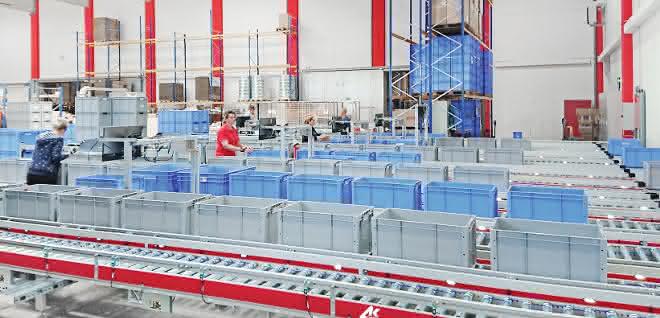
The toy manufacturer with around 3,000 employees at 30 locations worldwide is optimizing its logistics at the Sonneberg site by expanding the automated small parts warehouse, including order picking, and building a new automated pallet high-bay warehouse. At the same time, the conversion from SAP WM to SAP EWM was carried out.
Extensions and software conversion
The requirements for warehouse automation at the Simba Dickie Group have increased continuously in recent years. The company's product portfolio consists of over 4,000 items in the toy sector with over 20 brands such as Smoby, BIG, Eichhorn, Majorette, Aquaplay, Schuco and Noris. As part of the expansion and introduction of new processes, the warehouse management system was converted to the modern SAP EWM. The IT team led by Dirk Gensch, Head of Logistics/IT at the Simba Dickie Group, together with Klinkhammer and the certified SAP Silver Partner SWAN, replaced the system technology and warehouse management software in order to bring it up to the new standard. The digital network, from goods receipt to dispatch, integrates an automatic small parts and pallet high-bay warehouse, ergonomic picking and packing stations as well as manual pallet warehouses, which are operated via a forklift control system and pick-by-voice based on SAP. The direct connection of the SAP EWM material flow computer to the control systems of the automated warehouse and conveyor technology enabled optimum integration into the existing SAP landscape.
Picking performance increased
With Klinkhammer, the Simba Dickie Group is expanding its existing three-aisle automated small parts warehouse and adding four aisles, an integrated order consolidation buffer and modern picking workstations. This will increase the warehouse capacity by 18,240 to 31,920 container storage locations. The storage and retrieval performance of 600 bins per hour enables high picking performance and consistent efficiency. Depending on requirements and the size of the items, two small containers with a footprint of 600 x 400 mm can be stored in one compartment instead of one container with a footprint of 800 x 600 mm. An order consolidation buffer for intermediate storage and order consolidation is located in the last row of shelves on the lower container levels for lateral removal of the containers.
High-performance multi-order picking
An ergonomic multi-order picking concept with optimized order allocation reduces error rates and simplifies workflows and processes. Two ergonomic storage tables per workstation enable the simultaneous picking of eight orders using the multi-order picking method. Efficient batch formation and order grouping reduce trips in the small parts warehouse and increase the performance of the automated system. When the bins are delivered to the picking workstations, the employee scans the source bin with his Pro-Glove scan glove. The compartment of the subdivided bin from which goods are to be removed is clearly marked in color on the monitor. The employee scans the EAN article barcode, sees the product image, the article number and the description on the monitor and verifies the removal of the correct article via EAN scan. The quantity to be picked is displayed and can also be quickly corrected by entering a reason for change on the touchscreen. The picker then places the goods in the green marked target container and confirms the pick. Safety mechanisms and transparently visualized dialogues increase picking quality.
Optimized storage and retrieval strategies
Route-optimized putaway and retrieval strategies were optimized for the Simba Dickie Group's range of articles in order to design material flows as efficiently as possible, minimize travel distances and maximize storage capacities. SAP EWM controls the allocation of storage locations and uses criteria such as dimensions, turnover frequency and article groupings to increase the performance of the automated system. Complex replenishment strategies ensure fast and flexible processes and absorb performance peaks, for example in the trade fair business. "Thanks to the close cooperation and intensive coordination between Klinkhammer, SWAN and the Simba Dickie Group, it was possible to migrate the stock to the new system and the warehouse management software on a tight schedule," explains Dirk Gensch. "With the retrofit during ongoing operations, the system expansions and the simultaneous software changeover, we have managed a successful changeover in order to map our complex and demanding processes in a future-proof, scalable system." The conversion concept for the expansion of the automated small parts warehouse by four aisles and picking stations included five construction stages, so that the existing system could be operated with as little downtime as possible during ongoing operations. Systems and software can be adapted to further growth as well as to new or changed business models.
Pick-by-voice dialogues and forklift trips optimized
In the existing manual pallet warehouse with around 28,000 storage locations, replenishment is carried out using a forklift guidance system with mobile terminals and printers, and picking is carried out using pick-by-voice based on SAP EWM in mesh trolleys. Optimized process design, ergonomic dialogues and fast database access guarantee short response times and high performance. Complex storage strategies for replenishment enable route-optimized forklift trips.
Software developed step by step
After the specification phase of the processes, the software was developed in iterations. After each phase of the software development cycle, the new developments were handed over to the Simba Dickie Group team for testing. Change requests were quickly and easily incorporated into current developments. For example, the display of the product image or product text in the virtual picking test system could be checked by the Simba Dickie Group in order to influence the optimum size and required content at an early stage. The graphical user interface technology SapuI5 of the SAP warehouse management software brings the user-friendliness familiar from smartphones to the industrial environment of the SAP world.
Visualization for fast alarm diagnostics
Klinkhammer's system visualization system enables detailed views down to sensor and drive level. This enables rapid alarm diagnostics in the warehouse and minimizes downtimes. Statistics can also be generated from this data and made available for further processing.


You might also be interested in
Winner material flow PRODUCTS OF THE YEAR 2023
Conductix-Wampfler: ChargeLine 0865
Two-pole conductor rail segments for efficient opportunity charging of shuttles, suitable for thousands of cycles per day.
 read more...
Hermann Grewer celebrates his 80th birthday
Hermann Grewer, Honorary Chairman of the North Rhine-Westphalia Transport and Logistics Association (VVWL) and Honorary President of the German Road Haulage, Logistics and Disposal Association (BGL), celebrated his 80th birthday on June 6.
read more...Well chilled for sure
V-Zug Kühltechnik AG, developer and manufacturer of refrigeration appliances and part of the successful V-Zug Group, has set up a new production facility for refrigerators of all heights and dimensions at its Swiss site in Sulgen.
read more...Advantageous automation of small parts warehouses
The RSX1 shuttle system will be at the center of Rocketsolution's presence at this year's Logimat trade fair.
read more...Reduced energy requirements in the high-bay warehouse
One of Germany's leading premium car manufacturers is already focusing on energy efficiency in the production of its new SUV model with electric drive. The storage and retrieval machines in a high-bay warehouse at the production site have been...
read more...Low lift pallet truck for light duty applications
Clark has launched a new low lift pallet truck with the model designation LWio15 for light transport tasks. The truck has a load capacity of 1500 kg and is suitable for short distances in goods distribution, production or warehousing.
read more...Internationalization as an opportunity
E-commerce is in a state of flux. Changes in purchasing behavior and procurement problems are keeping e-commerce retailers busy. Logistics plays a decisive role in the overall online shopping experience.
read more...Fulfillment Center for Frisco.pl
Polish eGrocery specialist and TGW deepen partnership
TGW is building a highly automated fulfillment center for Frisco.pl in the Polish capital Warsaw. This is the second project in a row that the two companies have implemented together.
read more...Which world will it be in 2023?
Michael Schreckenberg teaches at the University of Duisburg-Essen as Professor of Physics of Transport and Traffic. Once a year, he addresses the readers of materialfluss, formerly LT-manager, with a critical and humorous expert article on transport...
read more...