

Packaging technology
Easypack celebrates the fine art of packaging
According to one estimate, around 80 percent of transport damage is due to inadequate transport packaging and insufficient transport securing. Packaging and filling material cost money and take up space. How do companies manage the balancing act between protection, cost optimization, cargo space utilization and environmentally friendly packaging?

A good 2.78 billion consignments were transported in Germany alone in 2014 - more than four-fifths of which were parcels. And the trend is still rising - partly due to the boom in e-commerce. This development poses challenges for shippers, transport companies and consumers. This is because parcels are sometimes used to transport sensitive or perishable goods and products. They need to be protected from damage and dirt - by packaging and filling material. The dilemma: both cost money and take up space. Space that is lacking in the warehouse, sprinter or truck for other shipments. Companies are therefore faced with the task of mastering the balancing act between protection, cost optimization, warehouse and loading space utilization and consumer expectations for packaging that is as small and environmentally friendly as possible.
What exactly is important here? First of all, packaging costs money and, above all, space. It needs to be quick to grab, easy to assemble and usable for as many products as possible. This streamlines processes and enables better prices for purchasing.
Too much air is often transported

This balancing act is often solved by using as few different packaging sizes as possible. The result is parcels in which mainly air is transported. It is not uncommon for less than 20 percent of the package to actually be used for the goods. This in turn gives rise to new difficulties: Postage, which the recipient usually has to pay, increases with the package dimensions. More fillers are needed, which also cause costs and take up space in the warehouse. If savings are made here, the stability of the packaging - and therefore the goods - are jeopardized. After all, nobody can predict whether this parcel will be one of many that end up at the bottom of the Sprinter or at the top. Experts estimate that around 80 percent of transport damage is due to inadequate transport packaging and insufficient transport securing. According to the German Corrugated Cardboard Association, this causes over 300 million euros worth of damage to German retailers alone every year. According to the association, 62.5 percent of the damage that occurs in central warehouses and order picking warehouses is due to instability.
Loose filling material is expensive and annoys the recipient
The size and strength of the packaging are two of the three important factors for stability. Factor number three is the fixing of the goods in the package. This can be done in different ways - but should also be planned with ecological and financial aspects in mind. The smaller the goods in the large box, the more filling material needs to be used. Wood wool, corn chips and similar materials must fill the entire cavity to provide protection. This is costly, has an impact on the weight of the parcel and often leads to resentment on the part of the consumer, who ultimately has to dispose of the loose filling material or return it to the recycling cycle. The situation is different when using sturdy paper cushions, which, thanks to various packaging techniques, make it possible to dispense with complete void filling even for heavy products. This is not only cost-effective, the cushions can even be reused by the recipient if required.
The financial outlay for packaging should also not be neglected. Here, decisions are often made based on favorable offers - regardless of the consideration of which packaging sizes would make sense. The packaging-related logistics costs are higher than the costs for the packaging itself: 70 to 75 percent of the packaging costs are attributable to factors such as transportation, return, handling, damage, storage space requirements, losses and others. The packaging itself only accounts for 25 to 30 percent. Saving here is therefore not only the wrong approach - it also leads to increased indirect packaging costs.
Recommended: four or six standard packs
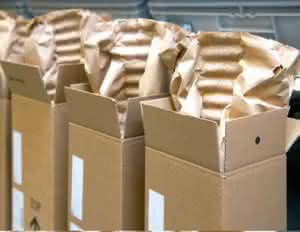
So what needs to be considered? First of all: Standardized packaging is advantageous if it is tailored to the goods, the processes in the warehouse and the transport. Depending on the product range, one or two standard packs may not be enough, but perhaps four or six. A strategic approach is required to find this out. First of all, the goods must be analyzed: What are its dimensions and how heavy is it? How fragile is it? Does it place special demands on the packaging? Does it have sharp corners and edges that could damage the packaging? These questions become particularly complex when several products are to be shipped together, as is common in online retail.
The entire process is then considered, from packaging to transportation and delivery. This is because there is a risk of damage every time the parcel is handled, reloaded or loaded into a vehicle. Added to this are the stresses during the journey, such as bends, braking and uneven paths or roads. What happens if the box falls to the ground? Or falls in such a way that it lands on a corner? If it is placed at the bottom of the Sprinter due to the route planning - and heavy books or copy paper are stacked on top of it?
These questions are also about fillers. They prevent the products from being thrown back and forth in the carton, causing damage or destroying the packaging from the inside.
Fixing the goods with little material
What is needed is packaging that is stable enough, offers sufficient space and in which the goods can be securely fixed with little material. A manufacturer of photo and video accessories has solved this challenge by using six different carton sizes. The packaging process has been optimized as far as possible so that the automatic labelling and allocation of the shipping cartons to the packing stations takes place automatically. The appropriate cartons are provided by four carton erectors. Once the goods have been packed, the cartons are placed on pallets with the help of a robot and automatically wrapped in film. Only very heterogeneous loads are palletized manually.
Baret Davidian
Contact:
Easypack Maschinen GmbH 59494 Soest Tel.: 0 29 21 / 5 90 34-0 E-Mail:


You might also be interested in
Dematic and Hai Robotics launch partnership for flexible AMR solutions
Dematic and Hai Robotics have recently agreed a Europe-wide partnership to work together as integration partners in the field of warehouse automation. Through this cooperation, the provider of automation solutions for supply chains and the...
 read more...
The market for service robots
A recent report from IDTechEx analyzes the global market for service robots and examines key applications for delivery and logistics robots, cleaning and disinfection robots, social robots and more.
read more...Application phase for Innovation Award 2026 begins
How can robotics help to make packaging more sustainable? Kuka is looking for creative and innovative ideas in the new round of the Innovation Award.
read more...Exoskeleton with AI power
Robotics company German Bionic presents its most advanced exoskeleton model to date, called 'Exia', which is fully controlled by augmented AI.
read more...Strategic partnership for the promotion of AI
Jungheinrich and Merantix have announced a strategic partnership. The aim of the cooperation is to promote applications based on artificial intelligence (AI) in the industry.
read more...New robotics organization founded
Omron has announced the establishment of a global robotics organization effective April 1, 2025. It will operate in parallel with Omron's automation business so that both areas can complement and support each other.
read more...No-code tool for programming robot user interfaces
ABB provides 'AppStudio', a software tool that allows users of all skill levels to quickly and easily create customized, graphical user interfaces for robots.
read more...SLAM navigation in real time
'Freestyle Localize', 'Trailer Find' and 'Scanner Switch' are three new features of Sigmatek's real-time location software forcontour-based navigation 'SlamLoc'.
read more...Robotic solution: Aiming high under your own steam
The Skypod system is now used in more than 100 order picking warehouses worldwide by companies in all kinds of industries. The autonomous Skypod robots are able to overcome height differences of up to 12 meters.
read more...