

Order-picking technology
Material Flow Round Table: Pick-by-Human - Obsolete or Indispensable?
Will robots become human assistants or even replace them completely? This was the central question at the first round table of 2016, which focused on the 'future' of order picking and the role that humans will play in the automated picking process in the future.

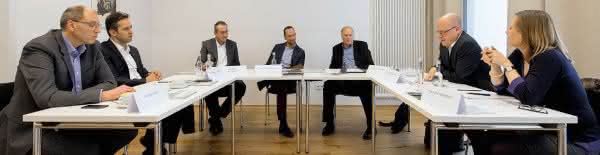
The hype surrounding Industry 4.0 is also bringing automated order picking into focus. Materialfluss editor-in-chief Martin Schrüfer and editor Susanne Frank moderated a panel discussion with four experts in Munich.
Martin Stich, Managing Director of Witron Logistik + Informatik GmbH, Parkstein; Frederik Brantner, Managing Director of Magazino GmbH, Munich; Eduard Wagner, Senior Project Manager of Dr. Thomas + Partner GmbH & Co. KG, Karlsruhe, and Volker Welsch, Sales Manager of psb intralogistics GmbH, Pforzheim, attended the event.
The meeting of the "seasoned" salespeople and managers with the start-up founder of Magazino, who naturally attests to the promising future of the picking robot, was certainly the attraction of the round. However, at the start, attention was focused on the technologies that have been familiar and yet quite widespread to date. Pick-by-voice, pick-by-light or pick-by-vision - which technology do our experts prefer? Especially when they themselves have to lend a hand in the warehouse if half the workforce is absent due to a flu epidemic?
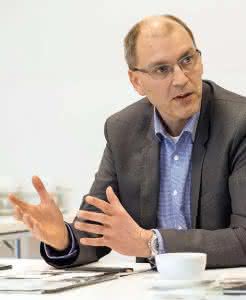
For Witron CTO Martin Stich, when choosing the right picking technology, it is important to consider the industry in which you operate, whether you have to handle heavy or light weights and which products are involved. The decisive factor for many companies is the highest possible degree of automation: "If you invest in mechanization, you don't want to create a system where there are semi-automatic systems and people have to carry out activities again.
Headphones, light and data glasses - all just transitional technologies?
We are trying to replace these jobs with appropriate technology. The aim is not to completely rationalize these jobs, but to create a more highly qualified working environment."
For Eduard Wagner from Dr. Thomas + Partner, the human element in the order picking process is far from being a thing of the past. "As a software manufacturer, we are advocates of a healthy mix of automation and flexibility. Automation at a very high level often has the disadvantage that in peak situations you are at the mercy of the given infrastructure. Especially at Christmas time, when the famous 300 percent peak takes effect, two-stage processes from highly automated mini-load warehouses in conjunction with human-driven subsystems help. Of course, such concepts are dependent on people. We also have customers who want software systems to do almost everything for them and decide for them what to do next. But even then, we are very careful not to ignore the special abilities of humans," says Wagner.
If Volker Welsch from psb intralogistics had to help out in the warehouse himself, he would prefer a picking process where he doesn't have to walk as much. He is skeptical about the two technologies with voice guidance or data glasses: "I tried pick-by-voice for a day and realized that I wouldn't want to do it permanently. I also tried out pick-by-vision. As someone who wears glasses, it was uncomfortable for me when something was stuck onto my expensive glasses frame. I would like to have an assisted process in which the technology brings something to the workplace and I can demonstrate my human skills." He would be more comfortable with screen support and pick-by-light. Welsch remembers a project in England in which the picker was shown photos of the items, combined with an audio system that also announced the item. However, the sound was very quickly switched off again, "because people prefer to rely on their eyes and don't want to be talked at all day long. That's annoying," says Welsch.
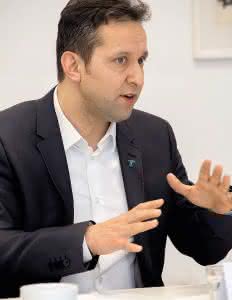
Humans are superior to robots when it comes to hand-eye coordination - yet Frederik Brantner, the founder of Magazino, which has launched a picking robot on the market, describes manual picking techniques - whether voice-controlled or light-controlled - as a temporary solution. He thinks it would be "pretty crazy" if humans were reduced to the only thing they can do better at the moment, namely hand-eye coordination, and everything else was taken away from them. He is convinced that this will no longer be the case in 10 years' time, because robots will have taken over these tasks by then. "When it comes to automation, it depends on what kind of warehouse you operate. If you run an e-commerce warehouse today with a batch size of 1 and an insane range, then you need people walking around. In the future, however, there will be technologies that replace this. That won't be the case in two years, but perhaps in five or six years."
"I would argue against that," Welsch interjects, betting that people in the order picking sector will still be around in ten years' time.
"Of course, it will be around for a while yet, because humans simply have a better grip," Brantner concedes. "At the moment, 20 percent of picking can be done with robots. But if you consider the speed at which the entire image processing and gripping technology is developing, in a few years it will perhaps be 50 or 70 percent. A lot of money is still being invested in picking stations today. A picking station can easily cost a hundred thousand or a hundred and twenty thousand euros. If you look at the articles, 20 to 30 percent could already be handled and picked by robots."
Do the processes have to adapt to the robot or vice versa?
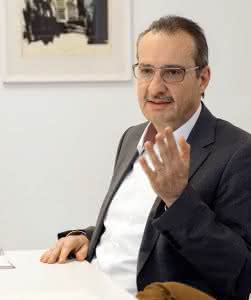
"I believe that if the customer's environment is set up for this mechanization, such technology can be used," agrees Stich. "As long as I have sensible pallets or load carriers that I can pass through the entire logistics chain, the easier it is to automate logistics processes. It's the same with robots. If I provide the products through the network in such a way that a robot can also handle them effectively, then it makes sense. The environment has to be right."
Brantner disagrees. He believes that the technology that is currently emerging does not require all of these criteria to be met. "The starting point is different. We are not saying, I want exactly this container shape or this pallet in this size and if it deviates from it, then it won't work, but we are building technologies that recognize what kind of object it is and adapt to it."
Eduard Wagner takes a more nuanced view and returns to Martin Stich's statements.
"The problem is to create suitable structures for suitable processes. Today, it is no longer acceptable for cabbage and turnips to arrive in the incoming goods department. Parties have to talk to each other in order to build a high-performance logistics process. Systems are clearly in competition with people, who are now able to use a manually operated picking system to shorten routes using optimization methods, so that 350 picks per hour are possible on the floor. It is not the case that you can push a picking workstation up to 1,000 picks through automation alone.
Wagner continues: "We operate in an area where high performance is required. But in e-commerce, customers often don't dare to automate too much and because they don't know how their business will develop, they have to do it with people first. However, we don't drive the people to provide this service, but the systems, the IT behind it, which is able to generate such short tours that relaxed working in such centers is still possible."
Welsch believes that humans, with their skills and haptics, remain superior to technology. He cannot imagine any number of robots driving through the warehouse and moving a million parts at the end of the day. A great deal of technology is certainly used to support us. But in the end, it's the human being who packs, adds the filling material and puts the bill on top.
"Hand-eye coordination is extremely difficult for the robot. There are many things that humans can do better," admits Brantner, "but the world of robotics is changing massively. Robots have a seeing eye, they have 3D cameras and many more sensors. They can perceive their environment and make decisions." Brantner is the only one in the group who can well imagine robots taking over what humans currently do, namely driving through the warehouse, collecting and picking parts: "It will still take a while, but it will be faster than you think and they will be able to make decisions. The warehouse is the best place to create the right environment in which robots can operate."
Fully automated systems already manage without humans
The software expert from Dr. Thomas + Partner also believes that breaking new ground is the right thing to do. "It's good when Mr. Brantner has a vision - otherwise he wouldn't be able to provide us with ingenious systems. We want to use them at some point. Personally, I see the initial goal as assistance and not robots replacing people. We shouldn't just look at picking, but at the entire logistics chain. I think there are endless possibilities in the area of assistance." Managing Director Martin Stich sees the robot as a handling device that carries out certain processes. He cites the order picking machine that Witron has developed for retailers as an example. "The system depalletizes the incoming products fully automatically at goods receipt and then picks them again fully automatically onto a load carrier. We don't call it a robot, but a COM - that stands for Case-OrderMachine - a technology that works without people. We believe that mechanization makes economic sense. This technology has been around for 12 years and we have sold 700 machines so far." However, the decisive factor is not having a robot, but rather aligning the entire logistics accordingly.
Stich continues: "But there are areas where humans make sense again. When the technology is ready and the framework conditions are met, we as manufacturers will of course think about further automation."
psb Sales Manager Volker Welsch brings returns logistics in e-commerce into the discussion. "In the fashion sector, returns account for 70 percent. That would be inconceivable without people, because the returned goods have to be unpacked and qualified. People will always be needed here, regardless of whether it's a manual process or an automated warehouse."
Cost per pick is no longer the top priority
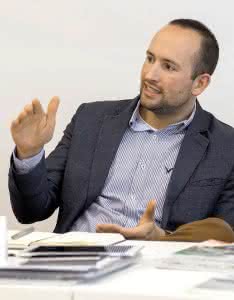
Stich is of the opinion that we will have to move more and more towards mechanization in the future. "Logistics will become increasingly automated, partly due to demographic change. In addition, ergonomic conditions are becoming increasingly important. If you look at the developments in Finland, where there are already legal weight restrictions, a company will pay more and more attention to whether the weight is right. And think, what's the point of calculating the cost per pick if I no longer have the people available?"
The question is, how can future automation look like that has the required flexibility without the risk of a high investment?
"Humans will still be around in the warehouse for a while," replies Brantner, because packing something and adding a note - humans can still do that better today. But initially there will be one robot in the warehouse and 100 employees, then more robots will gradually be added. Of course, it will only work if it pays off. And if it's cheaper than having humans do it."
"Of course the systems have to pay for themselves," agrees Stich. "But today, companies are asking themselves how long I can keep up the investment. Can I even get the workforce that is willing to work in the frozen food sector? That's why, in my opinion, we need to move faster and faster into mechanization. It would already make sense to use robots in refrigeration centers in particular. Wagner agrees with this: "At 28 degrees below zero, you have to have a robot."
Do the assembled experts have any tips on how entrepreneurs can future-proof their warehouses?
Martin Stich advises solutions that can meet market requirements quickly and flexibly. The logistics systems must be prepared for changes in the environment. "In France, for example, so-called pick-up centers are currently being built. The customer orders online and collects the goods from the center. This requires a completely different logistics concept to store delivery."
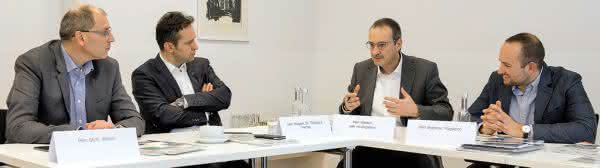
Eduard Wagner recommends keeping an eye on legislation: "If you have processes that rely heavily on people, then I should be prepared for the fact that the legislator will impose stricter requirements on me and I will no longer be able to use people in certain areas. I have to automate flexibly from the outset. For us as a software provider, flexibility means you have to have an infrastructure that is able to keep up with this change."
Brantner emphasizes once again that technical developments will progress much faster. We should not be guided by the past. There may be much more technology in the future, and we should be prepared for that."
Welsch brings in another aspect and reminds everyone in the group of their social responsibility: "I always hear fears from different directions, not just from warehouse employees who are worried about how they will get their family through in 10 years' time if robots are supposed to do everything. Entrepreneurs are also worried about their business in connection with the diffuse cloud of Logistics 4.0. I believe we have a socio-political responsibility to take the people who are affected with us and communicate clearly what our goals are, that we want to support them and not steal their jobs."
The round table series is one of the trademarks of "Materialfluss". A round table of logistics service providers on the topic of contract logistics was last published in the Market 2016 issue. The upcoming round table will focus on the topic of "Automated guided vehicles".


You might also be interested in
Circular load carriers for more sustainable supply chains
With the planned Industrial Accelerator Act, the European Union wants to accelerate the transformation of industry towards low-carbon production processes and resource-efficient supply chains. Logistics and transportation are also increasingly...
 read more...
Integration of a robotics solution
Lyreco modernizes logistics center in France
Lyreco is pressing ahead with the automation of its central site in Villaines-la-Juhel with an investment volume of over 25 million euros.
read more...Dragsbæk halves pallet area
By using automated pallet solutions from Palomat, Dragsbæk has halved the space required for pallets, optimized processes and sustainably improved working conditions.
read more...Pixels instead of paper
With the solutions from Logistikbude, Bekuplast, manufacturer of plastic containers, keeps an eye on its load carriers, saves costs and can work more efficiently with forwarding partners.
read more...Flexibility in saving space
Purus Plastics has developed a new retail range. The company operates a processing plant for plastics; recycling creates new products from secondary raw materials, including pallets.
read more...Solutions for the food industry
At Werit, the focus is on customer-specific solutions, sustainable recycling and pooling systems and products made from recyclate. The stand concept is divided into four areas: Products and innovations in the food sector, customer solutions,...
read more...Pallets with QR code
At the Epal Germany stand, visitors can gain an insight into the reusable system propagated by Epal, the life cycle of an Epal pallet and the newly developed QR pallet.
read more...The path of the Euro pallet into the IoT
With the introduction of the EPAL Euro Pallet QR in 2024, the European Pallet Association (EPAL) aims to set a new standard for the classic Euro pallet, which has been used successfully for over 60 years, and pave the way for ecologically...
read more...Retail range: flexibility to save space
Purus Plastics has developed a new retail range that is designed to attract the interest of retailers in particular. The company operates a modern plastics processing plant in Arzberg, Bavaria; new products are created from secondary raw materials...
read more...