

Logistics software
The path to slot management in real time
Logisticians are used to high cost pressure. After all, nothing works without the right timing and adherence to deadlines. But the demands continue to rise: while it used to be considered punctual to deliver on the agreed day, today the calculation is down to the minute. It won't be long before the high customer requirements can no longer be met without artificial intelligence (AI).
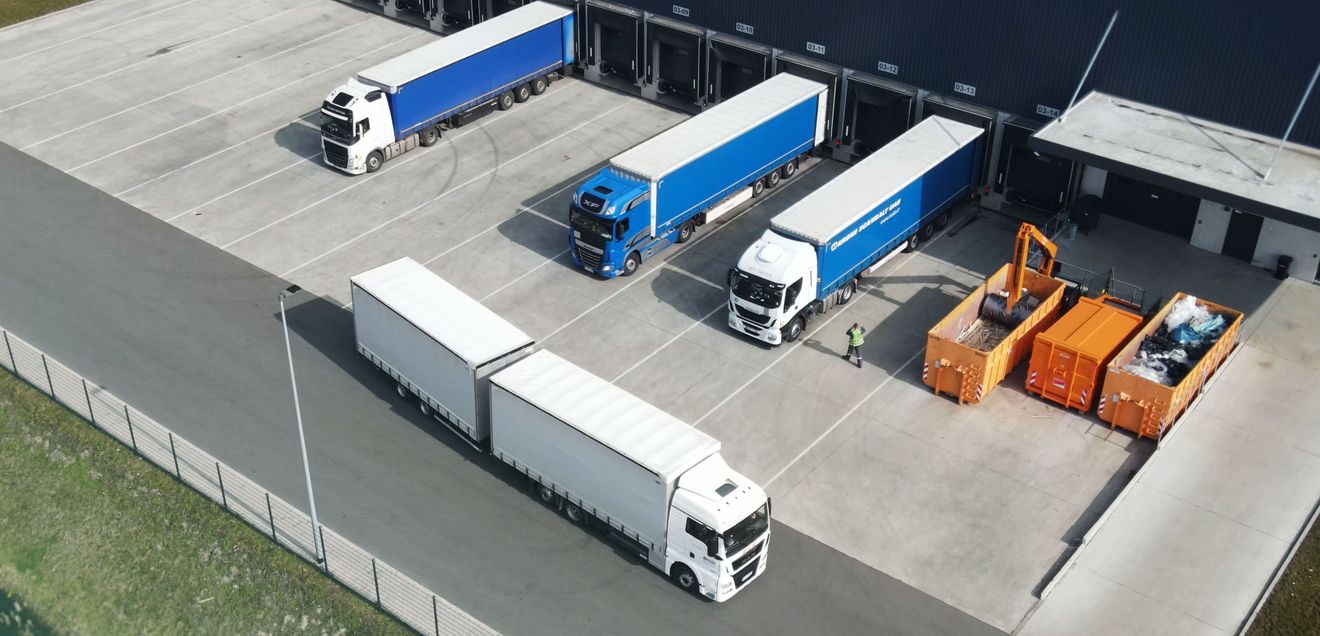
Time slot management or slot management solutions are central tools in yard logistics, but unfortunately in most cases they are not designed for new tasks and optimization. Instead, the market is characterized by on-premise systems that are designed to be web-based but installed locally. They are usually part of existing architectures of warehouse management systems (WMS) and transport management systems (TMS) or integrated via add-ons. Their range of functions is rather rudimentary.
However, there are also an increasing number of cloud-based time slot management systems on the market. Providers include start-ups as well as established players who offer slot management as part of their TMS or B2B solution. However, even with cloud solutions, users have to live with disadvantages in many areas. For example, although start-up applications are often stylish and easy to use, they are hardly integrated with corresponding backend processes and only cover limited use cases. The cloud platforms of established manufacturers, on the other hand, mainly offer simple, static functions. Only a few providers enable dynamic booking and optimization of slots in real time.
In practice, there are a whole series of pain points that companies struggle with. Overbooking of loading and unloading capacities is just as common as an imbalance in the unloading cycle. Some companies work with time slot bookings, others without. In general, unforeseen events repeatedly ensure that time slots cannot be adhered to. The challenges are complex. Products and loading quantities can vary greatly. Registration processes at the plant and several different loading points contribute to volatile scheduling requirements. However, many systems do not support a multi-stage approach that differentiates between the time window duration and the loading time at the gate.
Most systems ignore reality
The main problem, however, is that most systems cannot prevent long waiting times because they do not take into account the real situation, in which delays occur time and again due to traffic disruptions or problems in internal logistics. In addition, often not all trucks are booked in. Companies that want to take a new approach to slot management should therefore first define clear tasks and objectives:
- Is it sufficient to manage purely static loading and unloading dates on the basis of a digital calendar?
- Is it just a matter of planning gates and staging areas or should other resources such as forklift trucks and loading teams be managed?
- Should only the pure loading time at the gate or at the loading point be included in the time window or the entire process duration?
A decision must also be made in advance as to whether external partners such as freight forwarders or suppliers should also be involved and whether the system should serve as a platform for joint communication. For example, pallet information, attachments such as delivery bills or consignment notes and transport orders could be conveniently and transparently exchanged digitally.
Overall, time slot management can be made more flexible, especially with real-time data and continuous optimization of time slot planning based on GPS data from trucks and other means of transport. This makes it clear which transport will actually arrive at the planned time, which can perhaps be brought forward, and when, how and where it should be loaded or unloaded.
What contemporary solutions should master
In conjunction with the Internet of Things (IoT), cloud solutions have significantly increased the potential for innovation. When all business partners exchange real-time data via telematics and smartphone apps, this is a game changer. Compared to on-premise solutions, user management via the cloud is much simpler and cheaper to use. Availability and performance can also be scaled better. When it comes to slot management, however, the integration capability of solutions is the most important factor. They should guarantee tracking and tracing, the integration of real-time data and a connection to the systems for transportation and warehouse management.
In existing systems, slot times are usually only offered as fixed dates. The estimation of loading times is based on assumptions and experience, which often prove to be inadequate. More flexibility and higher capacity utilization at the loading points can only be achieved by calculating dynamic time slots. This requires data on product ranges, load carriers and loading teams, for example.
New concepts are based on machine learning and artificial intelligence. They attempt to calculate an optimum for several or many slots and move slots to other locations. To do this, however, precise records must be kept and a range of data and rules stored, such as the exact loading time of a pallet cage or pallet. The more diverse a product range is and the more suppliers are involved, the more machine learning can help to understand the individual processes and increase capacity utilization. Consequently, the potential that can be leveraged by AI is particularly high where there are many delivery and loading activities, for example in food retail or drugstores.
The supreme discipline: intelligent linking of all partners
Networking is the decisive basis for optimized logistics. The Internet of Things provides the necessary functionality. This includes tracking and tracing using GPS and sensor data in real time, which flows to all process participants. However, this can hardly be implemented without trustworthy platforms that receive and distribute this data. Only the intelligent linking of all partners contributes to high capacity utilization, short waiting times and punctual delivery.
A modern slot management system, which also incorporates information from the IoT, constantly checks the booked time slots and adjusts them to the current situation. Isolines (geofences) can be used to automatically trigger the removal from storage and thus the occupancy of gates or loading points. With the help of apps, drivers can register in advance and are navigated directly to the loading point via a telematics unit or app.
It is crucial that a time slot management tool can be operated really intuitively - without training. This is achieved by designing it for the use cases of different user groups. After all, employees in the forwarding companies, contact persons at the companies and in production have different processes and priorities. Cloud solutions are quickly available and require hardly any change management. When it comes to a stand-alone application, a complete location can theoretically even be switched on within a few days. If time slot management is to be interwoven with other systems - such as SAP - the implementation will take correspondingly longer.
Location logistics is still largely in its infancy when it comes to implementing technological innovations. Paper and Excel dominate, and the parties involved are a long way from networking - partly because their interests differ greatly. Solutions need to be found for these challenges: in the form of standards, but also in the form of financial incentives that motivate the partners - for example in the form of decreasing demurrage charges. The technology is available. What is needed now is a rethink and organizational change.


You might also be interested in
Circular load carriers for more sustainable supply chains
With the planned Industrial Accelerator Act, the European Union wants to accelerate the transformation of industry towards low-carbon production processes and resource-efficient supply chains. Logistics and transportation are also increasingly...
 read more...
Integration of a robotics solution
Lyreco modernizes logistics center in France
Lyreco is pressing ahead with the automation of its central site in Villaines-la-Juhel with an investment volume of over 25 million euros.
read more...Dragsbæk halves pallet area
By using automated pallet solutions from Palomat, Dragsbæk has halved the space required for pallets, optimized processes and sustainably improved working conditions.
read more...Pixels instead of paper
With the solutions from Logistikbude, Bekuplast, manufacturer of plastic containers, keeps an eye on its load carriers, saves costs and can work more efficiently with forwarding partners.
read more...Flexibility in saving space
Purus Plastics has developed a new retail range. The company operates a processing plant for plastics; recycling creates new products from secondary raw materials, including pallets.
read more...Solutions for the food industry
At Werit, the focus is on customer-specific solutions, sustainable recycling and pooling systems and products made from recyclate. The stand concept is divided into four areas: Products and innovations in the food sector, customer solutions,...
read more...Pallets with QR code
At the Epal Germany stand, visitors can gain an insight into the reusable system propagated by Epal, the life cycle of an Epal pallet and the newly developed QR pallet.
read more...The path of the Euro pallet into the IoT
With the introduction of the EPAL Euro Pallet QR in 2024, the European Pallet Association (EPAL) aims to set a new standard for the classic Euro pallet, which has been used successfully for over 60 years, and pave the way for ecologically...
read more...Retail range: flexibility to save space
Purus Plastics has developed a new retail range that is designed to attract the interest of retailers in particular. The company operates a modern plastics processing plant in Arzberg, Bavaria; new products are created from secondary raw materials...
read more...