

Freight Tracking
The future of digital quality assurance
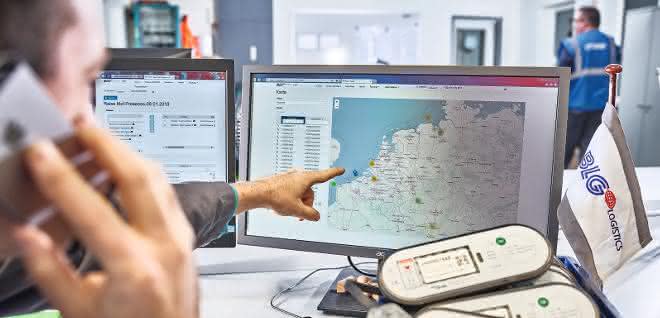
Freight Quality Tracking is a new service from BLG Logistics that enables real-time monitoring of freight quality, location and status data. With the help of precise analysis and evaluation of the data, immediate action can be taken in the event of delays, damage or even loss of the transported goods and transport costs can be kept low.
Ever since the MSC Zoe shipwreck, the call for containers to be fitted with sensors can no longer be ignored. How many containers actually went overboard and where they are now can only be traced with difficulty in retrospect. The oceanographers at the Federal Maritime and Hydrographic Agency (BSH) only have basic data available for this, such as the position of the container ship and the exact time of the loss of cargo.
The topic of sensor technology is also very important to the seaport and logistics service provider BLG Logistics. It not only forms the framework for the activities at this year's LogiMAT, but is also reflected in very specific innovation and research topics. Jakub Piotrowski, Head of Sustainability and Digitalization, is looking forward to the trade fair with excitement: "From 19 to 21 February, we will be presenting findings from projects that deal with sensor-based services for the first time." The intention is to generate a new digital service to increase transparency in the supply chain. One outstanding project is Freight Quality Tracking. The project aims to bring more transparency to the supply chain. This is particularly important in view of the continuing rapid increase in container handling. Over 90 percent of goods traded worldwide are now handled by sea.
Advantages of freight quality tracking
- The supply chain becomes more transparent and efficient for all
parties involved
- Simple handling of the sensors and the
evaluated data
- Material and information flow can be synchronized
be synchronized
- Early intervention is possible in the event of deviations
- Conditions can be documented, assigned to the
assigned and improved
Suppliers, countries, logistics service providers, customers:
Everything is becoming increasingly complex
At the same time, the complexity of supply chains is constantly increasing. "On the one hand, the challenge arises from the growing number of logistics service providers, suppliers, customers, countries and transport routes. On the other hand, customer expectations in terms of quality, price and time are also increasing," Jakub Piotrowski is certain. According to a study by the Initiative for Global Excellence in Supply Chain Operations, industrial companies are increasingly viewing variant diversity as a success factor. Now more than ever, logistics companies are therefore required to offer intelligent solutions for customer-oriented logistics, as digitalization is massively changing logistics and its processes.
Freight Quality Tracking is a new service from BLG Logistics that addresses precisely these expectations. With Freight Quality Tracking, BLG Logistics is working on a smart service for the seamless monitoring of goods. This involves determining the location and condition of products in the supply chain in real time. Freight Quality Tracking is part of a comprehensive digitalization offensive with which BLG Logistics is heading towards the smart logistics of the future. In 2018, the central "Sustainability and Digitalization" department was reorganized for this purpose. It bundles the numerous activities that BLG Logistics develops and promotes because they contribute to the company's success both today and in the future. In addition to sustainability topics and research projects, these include Logistics 4.0 and 100-day projects. The idea for Freight Quality Tracking was born in one of the 100-day projects.
As complex as the supply chains are, so individual are the suitable solutions. This is why BLG's service begins with the selection of the sensor. "We have tested numerous sensor manufacturers. Each has different strengths that are useful depending on the customer's requirements," explains Laura Weingarten, Business Development Manager for Sustainability and Digitalization. In addition to humidity, temperature and position, light and vibrations are influencing factors that can have an impact on the quality and punctuality of the goods. BLG determines whether and to what extent the factors are relevant on an individual basis with the respective customer.
Real-time freight data
The sensor is then mounted either directly on the package or on the container. The recorded data on the condition and position of the goods can then be transmitted in real time. The customer can view the location and condition data of their freight at any time via the cloud-based platform. This data can be used to take ad-hoc measures or to evaluate and improve routes and processes retrospectively.
The data collected is not simply made available to the customer, but can be intelligently linked, evaluated and visualized. BLG has programmed its own IoT platform for this purpose, on which the sensor data is evaluated. "This makes it possible, for example, to track whether and to what extent the cold chain has been interrupted," emphasizes Laura Weingarten. Not only can conditions be documented, but the data portal also provides information on where a problem occurred. This knowledge is particularly useful for identifying sources of error and improving processes.
The aim of freight quality tracking is to gain a better overview of the supply chain and to be able to intervene more quickly if something does not run smoothly on the transport route. For example, if a container does not reach the ship on time, the customer can intervene at an early stage and decide what measures can be taken to prevent costly reworking or even a production stoppage. The project is now close to market maturity. In the current test phase, BLG Logistics is working with interested customers to find the best sensors for them. A sensor on the container would also have been the first step in the right direction in the current case of the MSC Zoe accident.
About the authors:
Jakub Piotrowski is head of the central "Sustainability and Digitalization" department at BLG Logistics. Since November 1, 2018, the various activities that all contribute to the success of the company today and in the future have been brought together there. These include digitalization and Logistics 4.0 projects as well as research projects and sustainability topics.
Laura Weingarten is Business Development Manager. She specializes in sensor technology in the supply chain and manages the SaSCh funding project on behalf of BLG. The vision of the SaSCh project is to develop a system for a networked, intelligent supply chain that consistently records quality and condition-relevant data.
continuously recorded.


You might also be interested in
e2open bonded warehouse solution for several European countries
e2open, a provider of networked supply chain platforms, has expanded its customs warehouse management in Europe. Companies that import goods to Europe now have the option of using various customs warehouse programs.
 read more...
New start-up aims to facilitate access to robotics
Pssbl.Robotics, a start-up founded jointly by Schubert and Weiss, aims to simplify the introduction of robotics in mechanical and plant engineering.
read more...Test shipment with RoRo Car Carrier via Bremerhaven
Last August, the RoRo Car Carrier MV Cosco Shengshi moored in the northern port of Bremerhaven and started its first test shipment in order to expand the service to Europe.
read more...Rhenus grows at sea and on the road
At the northern tip of Lower Saxony, the logistics service provider is preparing for the growing import of cars via Cuxhaven; in Nuremberg, Rhenus is building a new logistics center next to the existing high-bay warehouse; in Dietzenbach, Hesse, the...
read more...Hermann Grewer celebrates his 80th birthday
Hermann Grewer, Honorary Chairman of the North Rhine-Westphalia Transport and Logistics Association (VVWL) and Honorary President of the German Road Haulage, Logistics and Disposal Association (BGL), celebrated his 80th birthday on June 6.
read more...Group7 expands corporate headquarters
The logistics service provider is planning 60,000 square meters of service and logistics center and an administration building with 5,000 square meters of floor space near Munich Airport.
read more...Cross-channel logistics: overcoming hurdles after Brexit
Hardly any other event has presented European road freight transport with such enormous challenges as Brexit. But there are solutions.
read more...Transport Logistic 2023
After a four-year break with a virtual interlude in 2021, Transport Logistic will return to the Munich exhibition grounds from May 9 to 12, 2023.
read more...Focus on internationalization
L.I.T. will be represented twice at Transport Logistic. The Brake-based logistics service provider's service portfolio ranges from warehousing and transportation using various modes of transport to contract logistics and comprehensive value-added...
read more...