

Strategy: Pfenning Logistics
"Our USP is the combination of warehousing and transportation"
The logistics service provider Pfenning Logistics has also made a name for itself in recent years with the development of logistics real estate. materialfluss editor-in-chief Martin Schrüfer spoke to Managing Director Martin Königstein about the development of the enterprising company.
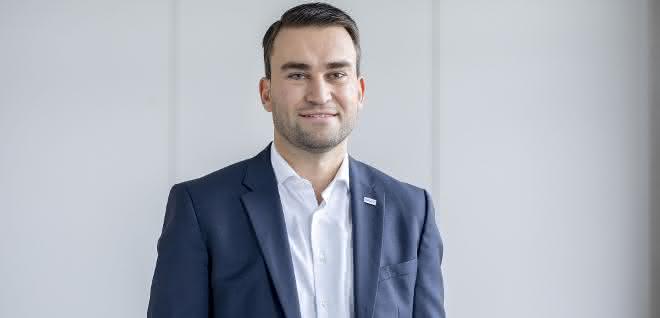
materialfluss: Mr. Königstein, you have been responsible for Sales, Marketing, Logistics Management, Logistics Operations North, Strategy and Mergers and Acquisitions at Pfenning since February. Which areas have kept you most busy since then, or to which have you devoted particular attention?
Martin Königstein: I'm not a newcomer. I've been responsible for Sales & Strategy at the Pfenning Group for three years now and, as Managing Director, I'm responsible for various subsidiaries. Here, I have been instrumental in developing and implementing the sales and strategic orientation together with the shareholders and fellow managing directors. All areas have the same importance, as the demand for warehousing, transportation and high-quality services remains consistently high. For me personally, the operational part has been added for our activities in Neuss, Bremen and Bad Hersfeld. We are working intensively on optimizing and improving our individual customer processes at these locations. Coupled with the wide range of industries, we offer tangible added value as a contract logistics provider.
We are increasingly placing our customers and employees at the center of our sales and operational activities, as we cover the entire supply chain for our customers with concentrated expertise. Digitalization, sustainability, investment in new locations and innovative approaches to the shortage of skilled workers are being promoted by our management alongside our growth strategy.
mfl: What milestones has Pfenning already achieved this year and which are still to follow by the end of the year?
Königstein: The year began with a new addition to our Pfenning family: a joint venture was founded with Oelrich Logistics GmbH in Ladbergen in Münsterland to strengthen our geographical importance in northern Germany and in the Berlin and Augsburg region. In Q2/2022, weexpanded our presence in the Rhine-Main region to 45,000m2 with the Waldlaubersheim site near Bingen, thereby opening up further growth potential for an important existing customer. In addition to our core region of Rhine-Neckar, we were thus able to secure an important strategic location as a geographical expansion of our activities. This is complemented by existing locations near Koblenz as well as Cologne, Düsseldorf and the new building near Bad Hersfeld. This year, we also acquired new customers from the chemical industry, the food industry and the DIY consumer goods sector.
mfl: What do you see as the USP of Pfenning Logistics?
Königstein: Our transport flows are also being intensively optimized and evaluated on the basis of company integrations. The aim here is to offer reliable, Germany-wide processing of all shipment sizes for our customers with optimum capacity utilization. The expansion of our USP, namely the combination of warehousing and transportation, is a major concern for us. This includes strong partnerships with our clients to secure space and guarantee the availability of goods. Our most important "construction sites" in the literal sense include the current project developments in East Hesse. The multicube osthessen with a planned total logistics area of 106,000m2 is being built in Mecklar and the freshcube osthessen, which will also be the new headquarters of our subsidiary HFL Herbst Frischelogistik, in the neighboring municipality of Bad Hersfeld. After extensive planning and coordination work with the local stakeholders, construction work was able to begin as planned. We are now focusing our combined energies on making the space available for our customer Nestlé Germany by May 2023.
A possible addition to our group of companies in the area of inorganic growth is also conceivable. Our acquisition focus is either on regionality or on expanding the portfolio. The investment budget is ready.
mfl: What is the natural goal of your company's expansion? Does size really matter?
Königstein: Growth at any price is not our strategy. We are developing because the market is changing and customers' needs are being diversified by consumers. That's why we are committed to deepening our service portfolio and offering flexible value-added services. With a nationwide network of transport connections and warehouse locations, we create synergy effects and can offer our customers solutions from a single source.
What we have discovered: We are strongly defined on the market by our successful multicube concept. However, we also have very good storage space throughout Germany, which can also be made available at short notice and with flexible services, such as personnel solutions. Especially in times of disrupted supply chains and production stoppages, the need for modern warehouses at short notice has increased. This is why we have launched the Warehouses+ concept, which enables us to meet precisely such requests alongside our long-term and sustainable multicubes.
mfl: Logistics service providers often have a negative public image, despite all their efforts in the area of sustainability, especially when it comes to relocations. Have you noticed a change in the public image here?
Königstein: You have to distinguish between different levels of publicity and discourse here. I have noticed that over the course of the pandemic and as a result of disrupted supply chains, a great deal of awareness has arisen about how essential logistics is for our economy and society. This discourse also includes the fact that we need to move away from just-in-time production concepts in favor of buffer warehouses and larger safety stocks.
At the same time, there is also the micro level, when we have a specific settlement project in a municipality. This is about taking into account the interests of local stakeholders. There is no "one size fits all", which is why we attach great importance to communicating openly and transparently from the outset. Our local cooperation partners appreciate this, as they see that we back up our words with deeds when it comes to sustainability measures in the context of a logistics property. In this context, it is helpful for us to refer to compliance with high standards, for example through certifications such as the DGNB (German Sustainable Building Council) and the work of the Logix logistics real estate initiative.
mfl: How is Pfenning Logistics preparing for the expected recession - what if the e-commerce boom ends?
Königstein: The diversity of sectors in the six areas (automotive & industry, chemicals, pharmaceuticals, consumer goods, food and retail) is our strength, enabling us to respond quickly to market reactions in terms of personnel and storage space. During the lockdowns in 2020 and 2021, we faced challenges in some sectors, but were able to offset these with growth in other areas.
At present, I do not expect the e-commerce boom to end abruptly; it is more likely that the market will become saturated. In France and Germany, for example, e-commerce sales have doubled on average as a result of the pandemic according to McKinsey analyses, while in countries such as the UK, the US and Spain they have even tripled or quadrupled. The challenges of the pandemic and the war are more likely to be reflected in volatility as a result of reduced predictability in incoming goods, the individuality of the service, the shortage of skilled workers and increased cost pressure. We have good solutions for the market here with our multicubes and our personnel service - we also operate a close risk management system and seek a solution-oriented exchange with our customers. overall, we therefore expect the logistics market to continue to develop positively in the medium term.
The article appeared in materialfluss 8-9/22.


You might also be interested in
e2open bonded warehouse solution for several European countries
e2open, a provider of networked supply chain platforms, has expanded its customs warehouse management in Europe. Companies that import goods to Europe now have the option of using various customs warehouse programs.
 read more...
New start-up aims to facilitate access to robotics
Pssbl.Robotics, a start-up founded jointly by Schubert and Weiss, aims to simplify the introduction of robotics in mechanical and plant engineering.
read more...Test shipment with RoRo Car Carrier via Bremerhaven
Last August, the RoRo Car Carrier MV Cosco Shengshi moored in the northern port of Bremerhaven and started its first test shipment in order to expand the service to Europe.
read more...Rhenus grows at sea and on the road
At the northern tip of Lower Saxony, the logistics service provider is preparing for the growing import of cars via Cuxhaven; in Nuremberg, Rhenus is building a new logistics center next to the existing high-bay warehouse; in Dietzenbach, Hesse, the...
read more...Hermann Grewer celebrates his 80th birthday
Hermann Grewer, Honorary Chairman of the North Rhine-Westphalia Transport and Logistics Association (VVWL) and Honorary President of the German Road Haulage, Logistics and Disposal Association (BGL), celebrated his 80th birthday on June 6.
read more...Group7 expands corporate headquarters
The logistics service provider is planning 60,000 square meters of service and logistics center and an administration building with 5,000 square meters of floor space near Munich Airport.
read more...Cross-channel logistics: overcoming hurdles after Brexit
Hardly any other event has presented European road freight transport with such enormous challenges as Brexit. But there are solutions.
read more...Transport Logistic 2023
After a four-year break with a virtual interlude in 2021, Transport Logistic will return to the Munich exhibition grounds from May 9 to 12, 2023.
read more...Focus on internationalization
L.I.T. will be represented twice at Transport Logistic. The Brake-based logistics service provider's service portfolio ranges from warehousing and transportation using various modes of transport to contract logistics and comprehensive value-added...
read more...