

Forklifts & Components
Lithium-ion batteries in deep-freeze applications
More and more companies want to utilize the advantages of lithium-ion batteries in forklift trucks and warehouse equipment for their intralogistics processes. But is this also possible in temperature-controlled environments, for example in cold stores? How can the performance of lithium-ion batteries be maintained even in cold and fluctuating temperatures?
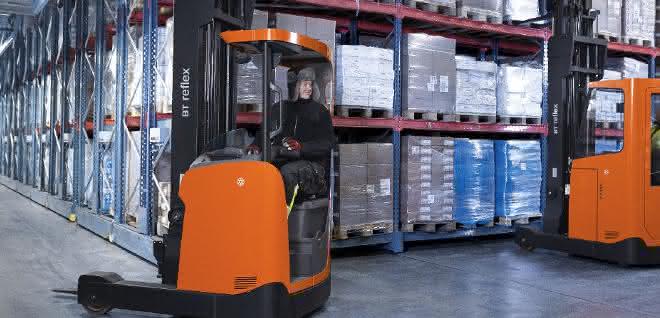
he energy-efficient lithium-ion technology scores points with operators and drivers in many respects. Lithium-ion batteries enable multi-shift operation without the usual battery changes and the cost of replacement batteries. Breaks and downtimes are used to quickly recharge the batteries with short intermediate charges whenever possible. The batteries are no longer charged all at the same time, but spread throughout the day. This saves valuable time for the changing process. In addition, intelligent charging management ensures that expensive power peaks are avoided.
It is therefore obvious that this technology should also be used for time-critical processes in food logistics. In the industry, a distinction is made between dry goods, fresh goods and frozen goods. While the dry range is stored at normal room temperatures, goods from the fresh range, such as dairy products, sausage, fresh meat and fresh fish as well as fruit and vegetables, must be stored at temperatures of 2 to 4 or 8 degrees Celsius. These products generally have a short shelf life and therefore need to be turned over very quickly. Frozen food and ice cream are even stored at freezing temperatures of -18 degrees Celsius and colder.
Is it even economically feasible to use lithium-ion batteries in refrigerated or deep-freeze environments? Or are capacity losses and thus a shortening of the battery service life to be feared? What many fleet operators do not yet know is that the use of lithium-ion batteries makes sense in several respects, even under extreme environmental conditions. The battery system produced by Toyota is designed to meet the needs of industrial trucks and is also available in a cold storage version. The system differs from conventional batteries used in private applications due to its significantly more robust design, the high quality of the individual cells and modules and more complex safety components. Each individual module and the battery system as a whole are protected against dust and splash water. According to Toyota, the self-contained system is maintenance-free and does not release gases into the environment during charging or operation. This means there is no need for special ventilation of the charging area and operators do not have to fill up with water or handle acid.
By keeping the appliance permanently in the freezer area, a number of advantages can be achieved, such as
- No misted-up windows,
- Avoidance of corrosion,
- Reduced stress on the machine and material in general, especially the seals and battery
Operators should therefore design the logistics processes as well as the charging processes in such a way that temperature changes for the truck and battery are avoided. To this end, the integrated thermal management system monitors the temperature and voltage in the individual battery modules and keeps them constantly within the optimum temperature range with the help of the battery heater.
The battery system offered by Toyota Material Handling is energy-efficient. The battery heater is only activated when a module falls below a previously defined temperature. This prevents the battery from becoming too cold and thus losing capacity. This has a positive effect on availability and operating costs and increases the service life of the appliances. Thanks to thermal management and the battery heater, the truck can remain permanently in the deep-freeze range, even at temperatures as low as -30 degrees Celsius. The additional costs for the increased energy consumption are offset by savings due to the reduced wear on the battery and device.


You might also be interested in
Winner material flow PRODUCTS OF THE YEAR 2023
Conductix-Wampfler: ChargeLine 0865
Two-pole conductor rail segments for efficient opportunity charging of shuttles, suitable for thousands of cycles per day.
 read more...
Hermann Grewer celebrates his 80th birthday
Hermann Grewer, Honorary Chairman of the North Rhine-Westphalia Transport and Logistics Association (VVWL) and Honorary President of the German Road Haulage, Logistics and Disposal Association (BGL), celebrated his 80th birthday on June 6.
read more...Well chilled for sure
V-Zug Kühltechnik AG, developer and manufacturer of refrigeration appliances and part of the successful V-Zug Group, has set up a new production facility for refrigerators of all heights and dimensions at its Swiss site in Sulgen.
read more...Advantageous automation of small parts warehouses
The RSX1 shuttle system will be at the center of Rocketsolution's presence at this year's Logimat trade fair.
read more...Reduced energy requirements in the high-bay warehouse
One of Germany's leading premium car manufacturers is already focusing on energy efficiency in the production of its new SUV model with electric drive. The storage and retrieval machines in a high-bay warehouse at the production site have been...
read more...Low lift pallet truck for light duty applications
Clark has launched a new low lift pallet truck with the model designation LWio15 for light transport tasks. The truck has a load capacity of 1500 kg and is suitable for short distances in goods distribution, production or warehousing.
read more...Internationalization as an opportunity
E-commerce is in a state of flux. Changes in purchasing behavior and procurement problems are keeping e-commerce retailers busy. Logistics plays a decisive role in the overall online shopping experience.
read more...Fulfillment Center for Frisco.pl
Polish eGrocery specialist and TGW deepen partnership
TGW is building a highly automated fulfillment center for Frisco.pl in the Polish capital Warsaw. This is the second project in a row that the two companies have implemented together.
read more...Which world will it be in 2023?
Michael Schreckenberg teaches at the University of Duisburg-Essen as Professor of Physics of Transport and Traffic. Once a year, he addresses the readers of materialfluss, formerly LT-manager, with a critical and humorous expert article on transport...
read more...