

Forklifts & Components
Fuel cell trucks from Jungheinrich for fresh produce logistics companies
The French logistics service provider Prelodis has opted for a fleet of Jungheinrich industrial trucks powered by fuel cells. This solution, which originates from the special construction plant in Lüneburg, underlines the manufacturer's broad expertise in the energy supply of industrial trucks.

Prelodis, which stands for Préparation Logistique Distribution, handles around 270,000 tons of fruit and vegetables every year. Prelodis has invested nine million euros in a 1,858 square meter distribution center for the development of the Grand Frais retail chain in the Paris region and beyond in the north and west of France. The operator is Prelocentre, a subsidiary of the logistics service provider. The logistics center, which was built in Saint-Cyr-en-Val (Loiret) south of Orléans in October 2015, has also underpinned the retail chain's positive image. This is because the highlight of the intralogistics solution is the fleet of material handling equipment that Jungheinrich's Lüneburg special construction plant has modified for operation with fuel cells.
Philippe Giroux, President of Prelodis, which was founded in 2001, is investing in the fleet with the aim of increasing the productivity of intralogistics processes. At the same time, he wants to protect the environment by running the industrial trucks on green-certified hydrogen from renewable energy sources, thereby reducing CO2 emissions.
"Our main requirement was to be able to refuel the vehicles within three minutes and thus save 75 percent of the time compared to changing the battery," explains Giroux. "Because this requirement has been met, we operate in three shifts with virtually no interruptions." The decision to use fuel cells eliminates the need for battery changes and the battery charging room that the operator would otherwise have had to set up. These are all advantages that result in greater convenience and safety, as well as reduced space consumption, as no charging stations are required in the building.
"Our main requirement was to be able to refuel the vehicles within three minutes and thus save 75 percent of the time compared to changing the battery."Philippe Giroux, President Prelodis
Studies and tests in advance
Prelodis had enquired with two manufacturers about the fuel cell technology and opted for Jungheinrich. The fuel cells are GenDrive units from Plug Power. The specialist for fuel cell technology is Jungheinrich's cooperation partner for the entire system, including vehicles, fuel cells and the hydrogen charging station, whose terminal is connected to a storage unit outside the building.
The project was preceded by a study lasting a good 18 months, for which Jungheinrich set up a project team in France and provided 25 industrial trucks. Initial tests were carried out with an EFG 216 electric forklift truck and an ECE 220 horizontal order picker. Jungheinrich adapted the battery compartment of the industrial trucks to the dimensions of the energy converter in order to be able to install the fuel cells in a shock-resistant and tilt-proof manner.
Conversion and customizing at the Lüneburg plant
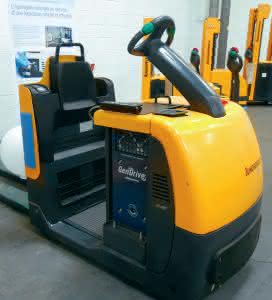
The Lüneburg special construction plant is able to convert all new vehicles, which are designed for operation with 24 to 80 volt lead-acid batteries, to fuel cells under very special operating conditions. The desired conversions to the trucks are carried out by the customizing department at the Lüneburg plant. As part of this task, Jungheinrich will prepare an overall certification in accordance with the European guidelines for the truck and the fuel cell, including all necessary tests and certificates. According to Giroux, the fact that Jungheinrich has a coordinated service concept thanks to its cooperation with Plug Power also spoke in its favor, thus ensuring smooth operations. Jungheinrich has also solved the problem of dissipating the heat generated during fuel cell operation through slots in the battery compartment. In terms of industrial trucks, Prelodis mainly uses ESE electric low-platform trucks. In addition, EFG 216 electric counterbalance trucks and ECE 220 horizontal order pickers are also on display in Saint-Cy-ren-Val.
Economic efficiency requires a large fleet
Prelodis expects the fuel cells to run for ten years. Giroux comments: "In terms of the amortization period, we calculate six to seven years for the use of an industrial truck powered by a fuel cell. We assume a shorter period for several devices. In this case, the investment in the complex hydrogen infrastructure and the costs for its regular maintenance would be spread across the vehicles and therefore amortized more quickly." It is also crucial for rapid amortization that Prelocentre manages to switch from the current two-shift to three-shift operation. This would make it possible to achieve the required cost-effectiveness, especially as many battery changes and the associated time expenditure would be eliminated.
"The solution chosen for the Saint-Cyr-en-Val site can be used as a template for equipping other sites," concludes Giroux. It thus forms a basis for Grand Frais' goal of opening fifty additional sales markets over the next five years.
Jürgen Warmbold


You might also be interested in
New low lift pallet truck with lithium-ion technology
Clark presents a completely newly developed electric pallet truck with lithium-ion technology (Li-Ion).
 read more...
material flow PRODUCT OF THE YEAR 2024
Category 3: Conductix-Wampfler - ContactCharger
The KontaktCharger is the solution for efficient and economical conductive charging of lithium-ion vehicle batteries in intralogistics.
read more...ReachStacker with hydrogen fuel cell
Hyster, a provider of container handling solutions, has delivered a reach stacker with a hydrogen fuel cell to the Port of Valencia in Spain. It is part of the H2Ports project. The aim of H2Ports is to introduce hydrogen-powered vehicles and...
read more...Material flow in pure culture
Electromobility is booming and the demand for batteries is greater than ever. In order to serve this market, more and more battery plants are currently being built in Europe. Mobile systems from SEW-Eurodrive are being used in the new plant of a...
read more...Winner material flow PRODUCTS OF THE YEAR 2023
Wagner Group: Fire protection solution for the storage of lithium-ion batteries at Kettler Alu-Rad
For the fully automated high-bay warehouse at the new production site, in which up to 50,000 e-bikes can be packed ready for dispatch and stored with installed batteries, Wagner implemented a customized fire protection solution that reduces the risk...
read more...Winner material flow PRODUCTS OF THE YEAR 2023
Conductix-Wampfler: ChargeLine 0865
Two-pole conductor rail segments for efficient opportunity charging of shuttles, suitable for thousands of cycles per day.
read more...Intelligent charging with solar energy
Charge industrial trucks with solar power and optimize your own consumption? This is now possible with a new function in the Charge & Connect portal from Fronius Perfect Charging.
read more...Paper manufacturer with innovative production logistics
Paper manufacturer Franz Veit has made its intralogistics operations much more efficient with the help of Linde Material Handling and Ernst Müller Fördertechnik.
read more...Battery logistics and more
Alfred Schuon presented its portfolio of transport and contract logistics services at Transport Logistic. The focus was also on the company's expertise in battery logistics.
read more...