

Interview with Linde Material Handling's Stefan Prokosch
"Synergies that make the Group more efficient"
Just over a year ago, Andreas Krinninger, Head of Linde Material Handling, was appointed to the Executive Board of the KION parent company and responsibilities for the brands were reorganized. Since then, Stefan Prokosch has been responsible for the Aschaffenburg-based company as Senior Vice President Brand Management Linde Material Handling. In materialfluss, Prokosch reports on the background to the reorganization and new products.
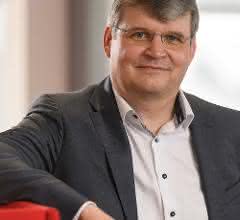
materialfluss: Mr. Prokosch, in the spring of this year there was some landmark restructuring in the KION Group (see materialfluss 6/21). You yourself have been promoted to Senior Vice President Brand Management at Linde Material Handling (MH). How do you see your new responsibilities?
Stefan Prokosch: The answer is quite simple: I am now the one who steers the Linde brand internally and represents it externally. A kind of "marketing officer", if you like.
mfl: If I have understood the new direction of the KION Group correctly, the three truck manufacturers in the Group - i.e. Still, Linde MH and Baoli - will remain independent and autonomous. So what is the real benefit of the restructuring that took place in the spring?
Prokosch: The benefits, but also the changes, lie in the internal processes that we can optimize through the new structures. It makes no sense for the three manufacturers to work separately in the areas of finance, IT or purchasing. In these areas
Synergies and opportunities for collaboration that will make the Group much more efficient overall. For example, by developing and using standardized systems in the background even more than before. However, it is very important that we present ourselves to our customers - i.e. in our operating business - strictly as an independent company, with our own products and innovations, our own services and sales structures. We will continue to consciously act as a competitor there.
mfl: Has this competition between the three forklift manufacturers increased or decreased since the spring?
Prokosch: Competition between the brands was fierce, is fierce and will remain fierce. We want to and will continue to appear and advertise on the market with different product portfolios and with different focuses for the respective brands. Accordingly, we at Linde MH naturally want to attract as many users as possible to our products. The sales department receives all the resources it needs for successful marketing.
mfl: Now the difference between the brands is not so easily recognizable. If we look at the two "main brands": What does Still stand for and what does Linde MH stand for?
Prokosch: I can definitely tell you what Linde MH stands for - innovation and performance. Linde MH also stands for great versatility with a very broad product portfolio and a wide range of special solutions. However, I see the biggest difference to our sister company Still and all other competitors when it comes to robustness. Linde trucks are often used by our customers in tougher applications. We also transfer many developments from the classic hydrostatic truck to the electric truck, such as the double pedal control from the very beginning and now also the elastomer ring bearings as shock absorbers on the front axle. This has been rated very positively by our customers. Another example is the reach trucks. With the Linde R-X model, in which the battery is located under the seat, we have created a spacious workplace for the driver. And with the order pickers, we also take account of the different order picking concepts of our customers with two different solutions.
mfl: I would like to address another topic that is currently on everyone's lips: environmental protection. This means that combustion forklift trucks are not very popular with users at the moment. Will Linde MH even dare to launch a new V-type truck on the market in the coming years?
Prokosch: It was only in 2019 that we launched a new combustion forklift in Berlin with the 1202 series. With great success. This year, we expect to sell around 11,000 vehicles from this series. That is much more than we had originally forecast. One reason is that there are simply still too many applications where a forklift powered by an internal combustion engine makes sense or is even necessary. For example, not all companies today have the infrastructure to be able to charge electrically. In addition, batteries don't like cold temperatures and not everyone has the option of parking their forklifts indoors in winter. Last but not least, there are very tough applications, such as continuous use at the load limit, where diesel or gas drives really come into their own.
Nevertheless, with our particularly powerful Linde X20-X35 electric forklift trucks, we have brought vehicles onto the market for the first time that raise the electric drive to the performance level of an internal combustion engine drive. And I am absolutely certain that our new forklift trucks will enable many customers to make the switch. We don't want to patronize them in their choice of drive energy, but rather offer them the right type of energy for their individual use. That's why - even if more and more genuine alternatives to the V-drive come onto the market - I assume that there will certainly still be many applications for combustion engines for many years to come.
mfl: So Linde dares to bring out another IC engine-powered truck in the next few years?
Prokosch: In fact, there will also be a new internal combustion engine series for the 3.5 to 5-tonne load class. You can look forward to seeing what we will be presenting in the course of next year.
mfl: And in order to be well prepared for all eventualities, you have recently started using your "mix assembly line" and want to put another one into operation?
Prokosch: That is correct. But let me go into a little more detail to answer this question: We analyzed our market very closely a few years ago. In particular, we examined how our incoming orders are changing and what challenges this poses for us. The most important result we found was that volumes change much less within a tonnage than between drive types. In other words, we may see a stronger shift from combustion engines to electric forklift trucks in different years. If you look at the tonnage, the shift is much smaller. In addition, the trend over the next few years will continue to move towards electric forklift trucks. And so it is only logical that we make ourselves independent of which drive type our customers choose in the factory.
mfl: And how have you implemented this strategy in concrete terms?
Prokosch: The basis for this was the decision taken six years ago to create a common platform for all future Linde counterbalance trucks in the 1.4 to 5 tonne load range. In this context, for example, we standardized the mast between electric and V-type trucks, the axle concepts and the driver's workstation. We have even developed a new combination bolt that covers 65 percent of all bolted connections, thus significantly reducing the number of bolt variants. With mixed assembly, we can compensate for production fluctuations, no longer have to change cycles and can run the assembly lines continuously at one production speed. The ultimate aim is to have two belts with five series, one of which we can assemble on both belts. This makes us very independent and allows us to react flexibly to any fluctuations in the product mix. At the same time, we maintain a relatively constant workload on these two belts, resulting in a very stable workload in our factory.
The article appeared in materialfluss 1-2/22.


You might also be interested in
Winner material flow PRODUCTS OF THE YEAR 2023
Conductix-Wampfler: ChargeLine 0865
Two-pole conductor rail segments for efficient opportunity charging of shuttles, suitable for thousands of cycles per day.
 read more...
Hermann Grewer celebrates his 80th birthday
Hermann Grewer, Honorary Chairman of the North Rhine-Westphalia Transport and Logistics Association (VVWL) and Honorary President of the German Road Haulage, Logistics and Disposal Association (BGL), celebrated his 80th birthday on June 6.
read more...Well chilled for sure
V-Zug Kühltechnik AG, developer and manufacturer of refrigeration appliances and part of the successful V-Zug Group, has set up a new production facility for refrigerators of all heights and dimensions at its Swiss site in Sulgen.
read more...Advantageous automation of small parts warehouses
The RSX1 shuttle system will be at the center of Rocketsolution's presence at this year's Logimat trade fair.
read more...Reduced energy requirements in the high-bay warehouse
One of Germany's leading premium car manufacturers is already focusing on energy efficiency in the production of its new SUV model with electric drive. The storage and retrieval machines in a high-bay warehouse at the production site have been...
read more...Low lift pallet truck for light duty applications
Clark has launched a new low lift pallet truck with the model designation LWio15 for light transport tasks. The truck has a load capacity of 1500 kg and is suitable for short distances in goods distribution, production or warehousing.
read more...Internationalization as an opportunity
E-commerce is in a state of flux. Changes in purchasing behavior and procurement problems are keeping e-commerce retailers busy. Logistics plays a decisive role in the overall online shopping experience.
read more...Fulfillment Center for Frisco.pl
Polish eGrocery specialist and TGW deepen partnership
TGW is building a highly automated fulfillment center for Frisco.pl in the Polish capital Warsaw. This is the second project in a row that the two companies have implemented together.
read more...Which world will it be in 2023?
Michael Schreckenberg teaches at the University of Duisburg-Essen as Professor of Physics of Transport and Traffic. Once a year, he addresses the readers of materialfluss, formerly LT-manager, with a critical and humorous expert article on transport...
read more...