

Interroll clarifies
Study: One in four German companies wants to outsource more production processes in future
25 percent of companies in Germany expect to outsource more production processes over the next five years. Smaller companies with an annual turnover of up to 50 million euros are particularly concerned with this.
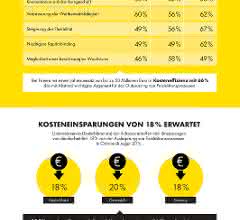
Around half of all companies are hoping for more flexibility as a result. This was revealed by the "Outsourcing in Production" study, for which 300 C-level decision-makers in companies with 50 or more employees in Germany, Austria and Switzerland were surveyed on behalf of Interroll in July and August 2020.
Responding more quickly to a rapidly changing world - this is what companies want to achieve by outsourcing production processes such as manufacturing, distribution, logistics or warehousing to business partners. However, cost aspects are often the main driver, especially for smaller companies. On average, 60 percent of all companies, regardless of their size, hope to reduce expenditure. For companies with an annual turnover of up to 50 million euros, cost efficiency is by far the most important argument for outsourcing production processes at 66%. In mechanical engineering and industrial manufacturing, two thirds of companies pursue this goal. In the other sectors and company sizes, greater effectiveness by concentrating on the core business is the most common argument, relegating savings to second place.
On average, companies want to save 18.3 percent of the costs of their production processes through outsourcing, while companies with an annual turnover of less than 50 million euros are even hoping for 20.2 percent less costs with outsourced production processes. One in three companies in the wholesale and retail sector even has a savings target of more than 30 percent.
Agile and cost-efficient through difficult times
The coronavirus pandemic, as well as competitive pressure and other economic challenges, have caused problems for many manufacturing and trading companies in Germany. "SMEs and smaller industrial companies in particular need to review their cost situation. At the same time, it is becoming more important to focus energy on the core business," says Jens Karolyi, Senior Vice President Corporate Marketing & Culture at Interroll. "Agility through decentralized structures helps, because in uncertain times it is important to be able to react flexibly to new circumstances. Outsourcing is coming to the fore as a strategy."
In principle, the benefits outweigh the risks from the company's perspective. Doubters are outnumbered: only 13 percent of respondents state that the risks outweigh the opportunities of outsourcing. In contrast, 17 percent see more opportunities than risks. In comparison with other countries in the DACH region, Swiss companies are particularly convinced of the benefits (38%).
So far, however, only 65 percent of all respondents are satisfied with production outsourcing, compared to 70 percent in the services sector. However, there is also more experience there, as services are outsourced even more frequently overall.
"Outsourcing enables companies to respond to increasing cost pressure with flexible solutions," says Jens Karolyi. "Especially in difficult economic times like these, companies need strong partners they can rely on."


You might also be interested in
e2open bonded warehouse solution for several European countries
e2open, a provider of networked supply chain platforms, has expanded its customs warehouse management in Europe. Companies that import goods to Europe now have the option of using various customs warehouse programs.
 read more...
New start-up aims to facilitate access to robotics
Pssbl.Robotics, a start-up founded jointly by Schubert and Weiss, aims to simplify the introduction of robotics in mechanical and plant engineering.
read more...Test shipment with RoRo Car Carrier via Bremerhaven
Last August, the RoRo Car Carrier MV Cosco Shengshi moored in the northern port of Bremerhaven and started its first test shipment in order to expand the service to Europe.
read more...Rhenus grows at sea and on the road
At the northern tip of Lower Saxony, the logistics service provider is preparing for the growing import of cars via Cuxhaven; in Nuremberg, Rhenus is building a new logistics center next to the existing high-bay warehouse; in Dietzenbach, Hesse, the...
read more...Hermann Grewer celebrates his 80th birthday
Hermann Grewer, Honorary Chairman of the North Rhine-Westphalia Transport and Logistics Association (VVWL) and Honorary President of the German Road Haulage, Logistics and Disposal Association (BGL), celebrated his 80th birthday on June 6.
read more...Group7 expands corporate headquarters
The logistics service provider is planning 60,000 square meters of service and logistics center and an administration building with 5,000 square meters of floor space near Munich Airport.
read more...Cross-channel logistics: overcoming hurdles after Brexit
Hardly any other event has presented European road freight transport with such enormous challenges as Brexit. But there are solutions.
read more...Transport Logistic 2023
After a four-year break with a virtual interlude in 2021, Transport Logistic will return to the Munich exhibition grounds from May 9 to 12, 2023.
read more...Focus on internationalization
L.I.T. will be represented twice at Transport Logistic. The Brake-based logistics service provider's service portfolio ranges from warehousing and transportation using various modes of transport to contract logistics and comprehensive value-added...
read more...