

Automation
Spare parts stored efficiently
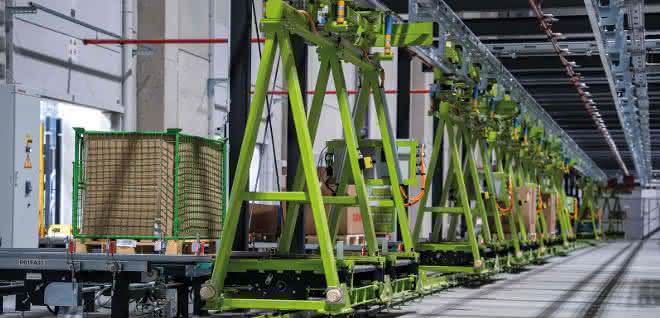
Unitechnik Systems realized an automated high-bay warehouse in silo design for the agricultural machinery manufacturer Claas in Hamm-Uentrop. A key link between the automated warehouse and the goods-to-person picking area is an electric monorail system.
If an agricultural machine breaks down suddenly and, in the worst case, during the harvest season, this can have costly consequences for the farmer. In order to minimize the duration of such breakdowns, Claas requires the constant availability of around 200,000 spare parts and their rapid delivery. Claas has invested around 22 million euros in the expansion of its central spare parts warehouse in Hamm-Uentrop to ensure that its storage capacity can cope with the increasing number of orders and spare parts in the future. The investment has resulted in a total of 58,000 pallet spaces and goods-to-person picking, which are integrated into the logistics processes of the spare parts center. Together with Claas, Unitechnik developed a scalable solution with high system performance.
The challenge of spare parts logistics
One challenge in agricultural machinery spare parts logistics is the high diversity and variance of parts: many machines are manufactured in small quantities to customer specifications. Electronic components are increasingly being installed, as well as large and bulky finished products. In order to cope with the increasing order volume in the future, a significant expansion of the plant is already planned in the concept. "Automation in spare parts logistics is the supreme discipline. In contrast to production logistics, peak times can only be planned to a limited extent, as they are beyond the control of the system operator," says Yusuf Kaya, Key Account Manager at Unitechnik Systems. The high performance requirements are met by an efficient material flow: both the storage and retrieval machines and the electric overhead conveyor vehicles are equipped with two load handling devices.
A high-bay warehouse in silo design was built on an area of 6,000 m². Of the nine aisles, the two outer ones are double-deep. All nine storage and retrieval machines are equipped with two load handling devices. They each pick up a pallet or pallet cage from the 30-metre-high rack and transfer them in pairs to the conveyor system. The pallet conveyor system in front of the high-bay warehouse is arranged in such a way that two storage and two retrieval stations are positioned next to each other. For example, the retrieval lanes for aisles 2 and 3 are next to each other. This allows the overhead monorail system to pick up two load carriers at a time.
EMS instead of conventional continuous conveyor technology
The electric monorail system (EMS) is the logistical backbone of the system. It connects the high-bay warehouse with the picking stations, the goods receiving area and the full-pallet retrieval area. It plays the most important role in the material flow with regard to the rapid storage and retrieval of pallets: In one second, the EMS vehicles cover a distance of 1.5 meters and thus travel around five times as fast as the pallet on a continuous conveyor system. In the current expansion stage, a throughput of up to 400 vehicles per hour is achieved; with a load of two pallets per vehicle, this corresponds to a peak performance of 800 pallets per hour. This is four times as much as a round trip with conventional conveyor technology. The high throughput capacity is particularly in demand during peak periods in the harvest season. With the EMS, Claas benefits from a solution that can be expanded and scaled up as required by adding further vehicles.
Yusuf Kaya explains how the EMS is integrated into the material flow: "The electric monorail system picks the pallets from the retrieval points of the high-bay warehouse and moves them to the picking Us. There it transfers two pallets at a time to the continuous conveyor system. From here, the pallets are transported to the picking stations. The return pallets are transported to the high-bay warehouse by the empty EMS vehicle. These steps are fully automated." Unitechnik designed the picking area according to the goods-to-person principle. Depending on the order volume, the parts are either immediately packed into the target container or pre-consolidated.
Ergonomic picking stations thanks to VR
In order to make the picking process as ergonomic and efficient as possible, workstation and conveyor technology alternatives were simulated in advance and discussed with the customer. "When designing workstations, we relied on virtual reality," reports Yusuf Kaya. "With the help of the virtual preview through VR glasses, we were able to realistically display and optimize the workstations." The result is a space-saving and convenient solution.
Software for efficient material flow
Whether the physical possibilities are actually used is decided by the brain of the system - the software. This is where the UniWare warehouse management software from Unitechnik comes into play. In this project, UniWare has combined the function of an extended material flow control system (MFS) with integrated system visualization. In addition to the intelligent routing of the load carriers, the storage locations in the high-bay warehouse are also managed and regularly optimized by UniWare. The operator always has an overview via the freely zoomable visualization: from the complete system overview to the switching status of an individual sensor. UniWare can be operated from the control station or via tablets and smartphones.
Equipped for today and tomorrow
"We are very satisfied with Unitechnik's performance," summarizes Dietmar Düsing, Head of Logistics and Member of the Management Board of Claas Service and Parts GmbH. "The work was carried out parallel to ongoing operations throughout the entire project. We stayed on schedule and within budget, which is not a matter of course for a project of this size." The future-oriented expansion of the logistics center enabled Claas to create additional storage space and comprehensively restructure its warehouse processes. The logistics planning already provides for future expansions.


You might also be interested in
Winner material flow PRODUCTS OF THE YEAR 2023
Conductix-Wampfler: ChargeLine 0865
Two-pole conductor rail segments for efficient opportunity charging of shuttles, suitable for thousands of cycles per day.
 read more...
Hermann Grewer celebrates his 80th birthday
Hermann Grewer, Honorary Chairman of the North Rhine-Westphalia Transport and Logistics Association (VVWL) and Honorary President of the German Road Haulage, Logistics and Disposal Association (BGL), celebrated his 80th birthday on June 6.
read more...Well chilled for sure
V-Zug Kühltechnik AG, developer and manufacturer of refrigeration appliances and part of the successful V-Zug Group, has set up a new production facility for refrigerators of all heights and dimensions at its Swiss site in Sulgen.
read more...Advantageous automation of small parts warehouses
The RSX1 shuttle system will be at the center of Rocketsolution's presence at this year's Logimat trade fair.
read more...Reduced energy requirements in the high-bay warehouse
One of Germany's leading premium car manufacturers is already focusing on energy efficiency in the production of its new SUV model with electric drive. The storage and retrieval machines in a high-bay warehouse at the production site have been...
read more...Low lift pallet truck for light duty applications
Clark has launched a new low lift pallet truck with the model designation LWio15 for light transport tasks. The truck has a load capacity of 1500 kg and is suitable for short distances in goods distribution, production or warehousing.
read more...Internationalization as an opportunity
E-commerce is in a state of flux. Changes in purchasing behavior and procurement problems are keeping e-commerce retailers busy. Logistics plays a decisive role in the overall online shopping experience.
read more...Fulfillment Center for Frisco.pl
Polish eGrocery specialist and TGW deepen partnership
TGW is building a highly automated fulfillment center for Frisco.pl in the Polish capital Warsaw. This is the second project in a row that the two companies have implemented together.
read more...Which world will it be in 2023?
Michael Schreckenberg teaches at the University of Duisburg-Essen as Professor of Physics of Transport and Traffic. Once a year, he addresses the readers of materialfluss, formerly LT-manager, with a critical and humorous expert article on transport...
read more...