

Retrofit project at the DPD parcel distribution center
On the right track
SEW-Eurodrive installed new drive technology as part of a retrofit project at the DPD parcel distribution center in Worms. The automation experts completed the conversion in just one day at the weekend, ensuring smooth parcel distribution in the Rheinhessen-Mannheim region.
In the afternoon, around half past three in the morning, the huge hall at DPD Deutschland GmbH in Worms, Rhineland-Palatinate, comes to life. Pick-up vehicles dock at 19 gates of the distribution center and bring parcels of all shapes and sizes from Mannheim, Mainz, Heidelberg, Bad Kreuznach, Monsheim, Gau-Odernheim and Bürstadt to the central depot. On average, 30,000 parcels per day are received in local traffic. Depending on the season, this figure rises to up to 38,000. 42,000 to 48,000 parcels are processed at peak times in long-distance traffic, i.e. outgoing parcels. From the Worms depot, they make their way to their destinations via long-distance overnight transport. "Our aim is to have things quiet here again by 9 pm. By then all the goods should have been distributed and loaded," says Michael Meitzler, Handling Manager at DPD Worms. For this to succeed, the technology has to be right.
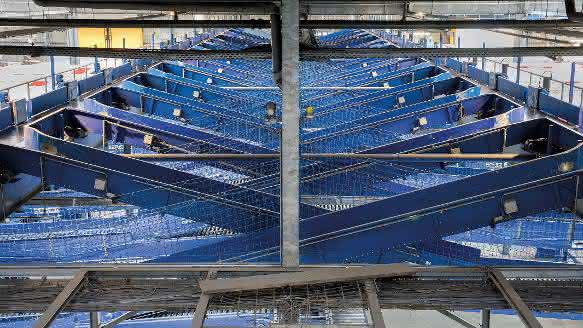
Pushers guide to the right destination
"We rely on the pushers to work," states Michael Feneis, Technical Manager Depot 167 DPD Worms. "That's why we rely on SEW-Eurodrive." Drive and control technology from the Bruchsal-based automation specialist was installed in the system from the very beginning, when it was put into operation in 1994. The drives of the pushers (deflectors), which guide the parcels from the steel conveyor belt in the right direction to the exit transfer bridge, were getting on in years and needed to be replaced. As part of a retrofit project, the drive and control technology along sorter line B was completely replaced in 2019: 28 pushers, whose materials and mechanics remained the same as before, were given new drives.
In addition to the synchronous motors, SEW-Eurodrive installed six control cabinets, each with a controller, a supply module and up to five axis modules. Each individual axis module controls the synchronous motor of a pusher and ensures that the packages are given a proper push at the right time and in the right place. This directs them onto the correct conveyor route to the swap body and thus to the right destination.
Conversion in a short time
The retrofit project was designed for a weekend. On Friday, after the end of the shift in the DPD hall, Gabriel Currle, Service Electronics SEW-Eurodrive and project manager of the Worms project, arrived with his team for the first preparatory work on sorter line B. Two electricians and two fitters from the mechanical service team spent Saturday dismantling the existing control cabinets, installing the new control cabinets, dismantling the old drives, installing the new drives and laying all the cables.
The configuration of the drive functions, data backup, tests and commissioning were carried out by two service engineers from the electronics service. Everything was done by the evening. "I would never have thought that it could all be done in one day," says an impressed Michael Feneis. The technical manager expressly praises the smooth running of the conversion and the SEW service: "You can really rely on them!"
Precise movement
Some of the Sorterline A pushers are equipped with technology that is over 25 years old. "It still does what it's supposed to," confirms the Head of Technology, emphasizing that this speaks for the reliability and quality of SEW products. Everything else runs smoothly at the Worms distribution center too: the parcel data is recorded at the entrance gates in the unloading station at two central scanning stations: Dimensions, volume, weight. From now on, all parcel data, including the destination address, is stored in the computer. From the scanning station, the parcels are transported to the two steel belt sorters A and B and pass through the reading station, where the destination address is detected on the label. A rotary encoder is then used to control the pusher that moves the parcel to the correct changeover bridge - over the entire surface and with pinpoint accuracy, so that the parcel makes the sudden change of direction cleanly. "The challenge is to ensure that the pusher hits exactly the right point given the variety of different parcels. Both damage and jams must be avoided at all costs," explains Michael Meitzler. Light barriers would detect a jam and stop the belt.
Equipped for the future
Parcel distribution currently works perfectly without image processing and other sensors. However, it could be upgraded: if, for example, force and position control of the pusher deflection were to be implemented at the rejection stations in order to handle the parcels individually and gently, this would already be possible today with Movi-C components: "We are prepared for this. The automation system that has now been installed could implement a control system with new sensors immediately," confirms Gabriel Currle. Michael Feneis also believes that the system is equipped for the future: "If a module fails, we can simply replace it via plug and play, without having to set new parameters. This is because the Movi-C controller takes over the complete data management of the axis system in the system. In terms of maintenance, we only have to change the filters on the control cabinet's air conditioning unit from time to time. Apart from that, we only have minimal maintenance work," confirms Feneis. Everyone involved - the technical manager, the handling manager and the service provider SEW-Eurodrive - is pleased with the interaction and the smooth operation. At 9 p.m., the central depot in Worms is actually quiet - until the next morning when the parcels arrive. Then the parcels will arrive here that have been sent on the road overnight from another DPD distribution center by long-distance transport and are now being delivered to the end customer by delivery vehicle.
(published in materialfluss 10/20)


You might also be interested in
Lenze and Sonepar launch sales partnership
The Lenze Group and Sonepar Germany have entered into a long-term cooperation agreement. The aim is to make Lenze drive technology more widely available via the Sonepar sales network.
 read more...
Partner for intralogistics drive solutions
Heidrive will be presenting drive solutions for conveyor and warehouse technology at LogiMAT 2025. Sister company Allied Motion will also be represented on the stand.
read more...Focus on energy efficiency
At SPS, ABB will be showcasing products and solutions for machine, plant and control engineering that increase energy efficiency, reduceCO2 emissions and open up potential for optimizing processes.
read more...Adapted to driverless transport systems
Travel and steering drives from SPN Schwaben Präzision offer high flexibility and quality and are tailored to the requirements of manufacturers of driverless transport systems.
read more...Smooth sorting - efficient and scalable solutions
Sorting systems have become an integral part of distribution and distribution centers. Their variety is just as great as the variety of goods to be transported.
read more...Space-saving drive solutions for conveyor and storage technology
At LogiMAT 2024, Heidrive presented drive solutions for conveyor and warehouse technology. Sister company Allied Motion was also represented on the stand.also represented at the stand.
read more...Acquisition complements Xcelerator portfolio
Siemens takes over industrial drive technology division from ebm-papst
Siemens AG has signed an agreement to acquire the industrial drive technology (IDT) business of ebm-papst. With the planned acquisition, Siemens intends to further expand its position in the field of factory automation and digitalization.
read more...Tubular direct drives from Servotecnica for sorting machines
Automated sorting systems place high demands on the drives installed in them: they have to be extremely fast and work precisely at the same time. The linear direct drives of the SVTL series from Servotecnica offer the required properties and also...
read more...Coordinated system components for sorting systems
The demands on handling capacity in the logistics industry are constantly increasing. To meet these challenges, SEW-Eurodrive offers various scalable solutions for the sorter and its infeed.
read more...