

Conveyor and lifting technology
Material Flow Round Table: The balancing act to the ideal path
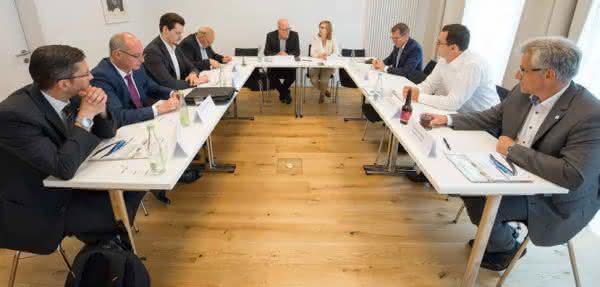
Conveying and lifting technology today and tomorrow - where does the industry stand in modern warehouse logistics and which instrument does it play in the orchestra? At the Material Flow Round Table, German and international experts highlighted the challenges facing the materials handling industry and how the balancing act between high dynamics, flexibility and cost-effectiveness can be achieved.

This time, half a dozen "high-caliber" conveyor technology experts travelled to Parsdorf for the Material Flow Round Table. Among them: Andreas Koch, Group Manager Product Management Conveying, SSI Schäfer Noell GmbH, Giebelstadt; Robert Lugauer, Managing Director, Interroll Automation GmbH, Sinsheim; Werner Späth, Commercial Director, FAB GmbH, Waldshut-Tiengen; Jürg Möckli, CEO, Ferag AG, Hinwil, Switzerland; Eric Große, Senior Product Manager, TGW, Langen and Manfred W. Schleicher, Managing Partner, Wegener+Stapel Fördertechnik GmbH, Bergen.
Well-filled order books
The industry is optimistic about the future. The order books are well filled and the demand for high-performance systems is good, all participants confirm in unison. Andreas Koch, SSI Schäfer Noell, reported on great successes on the American market in recent years. E-commerce is still on everyone's lips. However, there is still some catching up to do in terms of automation in the food sector. "We have done a lot as a general contractor, particularly in the frozen food and beverage sectors," says Koch.
Robert Lugauer, Interroll, also confirms increased demand from the food, fashion and frozen food sectors. "In the last two years, we have been involved in numerous projects as a component manufacturer together with system generators."
As far as the order situation is concerned, Werner Späth, FAB GmbH, can only agree with the previous speakers. "We are currently putting off several orders because the final decision is still pending. We are benefiting from the vacation period because the managing directors usually make their decisions before the start of their vacation," hopes the commercial manager. As a pallet conveyor technology manufacturer, the company is currently heavily involved in the furniture sector and in truck loading and unloading. The B2C sector plays less of a role for his company, reveals Späth.
Jürg Möckli, CEO of Swiss company Ferag AG, is an industry newcomer and his company is currently in the process of making a name for itself in intralogistics. "We are primarily active in the industrial sector where processes need to be optimized, such as in injection moulding plants or in the filling of plastic cartridges." However, the fashion industry in America is also a field of activity for the Swiss company, as is the food sector.
"The order books are well filled, but there can always be more," says Eric Große, TGW, adding: "For us, the electronics industry and the spare parts business is a growth area. If you look towards fashion, then of course e-commerce is a driver. More and more companies are trying to centralize and at the same time bring their e-commerce into the facilities." In the food sector, as in the frozen food sector, it's not just about the pallet, but increasingly about container picking and automatic palletizing. "This is a trend that we have been observing for two to three years," says Große.
Manfred W. Schleicher, Wegener + Stapel Fördertechnik GmbH, is the managing partner of a company that has its roots in the automotive sector, but has recently started fishing in other ponds, such as distribution. "We're not chasing the million-dollar project like the big players here at the table. There are some interesting inquiries for us in the area of e-commerce. It's about the online business with ready meals, which is run by small start-up companies that started in the 'garage' ten years ago and now need logistical set-ups. There are also inquiries from the pharmaceutical and cosmetics sectors." As far as the core business of automotive, production logistics and assembly supply is concerned, Schleicher speaks of the best six months in six years: "We are delighted that we now also have orders on the table from other sectors and can play our part accordingly."
Systems must be able to grow with you
E-commerce is the big driver of logistics and intralogistics. Multichannel is a complex business. Very different order volumes have to be handled in increasingly tight time frames. How does conveyor technology manage this balancing act? What requirements need to be met?
"When we talk about retail or the fashion sector, there are companies that already have a branch network and can no longer escape the e-commerce business," says Andreas Koch, explaining further: "If you like, mail order is ultimately an additional branch that is relatively widespread and you suddenly have an end customer. On the other hand, there is store delivery, which has a completely different structure. Supplying both from one warehouse stock, from one coherent picking system, is a challenge. This requires technology that is highly dynamic on the one hand and highly flexible on the other." Ultimately, it comes down to systems that can grow with the customer's requirements, says Koch.
Whether the existing technology is sufficient or something completely new has to be created varies greatly, according to Große. Large companies find it easier to plan on a greenfield site and set up something new than small companies that are trying to supplement their supplies with the e-commerce component. "The difficulty here is the dynamics. A system that used to have a medium throughput suddenly has to be able to do ten times that. You have to try to integrate new concepts into the old existing systems. Then, for example, a miniload or a pallet warehouse becomes the replenishment basis for the highly dynamic areas of the system. Of course, IT also plays a role again because completely new processes have to be mapped. This applies throughout - from incoming goods to outgoing goods. However, it's not just about the plant, but about the entire supply chain. The trick is to design the whole thing in such a way that you really enable an economical investment," says Große.
"It gets complicated when the issue of returns is added to online deliveries in the fashion sector," adds Manfred Schleicher. "These returns are known to be 50 to 70 percent. This means that these goods are then added on top."
Große confirms that returns handling is the be-all and end-all when it comes to e-commerce. Peaks occur because the aim is to get these returns back into the flow of goods very quickly. There are various solutions here, but no silver bullet.
The balancing act between highly dynamic systems and cost efficiency
What advice do you give a customer who is looking for new intralogistics solutions but doesn't yet know how their business will develop? - Jürg Möckli: "The challenge is to record the customer data correctly and generate a project that responds to these customer specifications. It's always a question of balancing high dynamics and cost efficiency. You have to find the right balance and not oversize or undersize. It must be possible to adapt the technology to the future - at any time," Möckli emphasizes.
Große says this is possible because every supplier today has a standard modular system with conveyor technology, storage technology and IT control: "As long as you use this modular system and build a good overall system from it, it is very easy to expand. Of course, it makes no sense to persuade a start-up company to buy a 5 million euro system."
Robert Lugauer does not see the major challenge in scaling different solutions for different business volumes or investment volumes. The core problem of flexibilization is more about large investment projects, where you have to deal with the volatility of the respective industry. "As far as I know, there are up to six peaks a year in the fashion sector, which have to be managed in parallel with the store business or end customer business. Secondly, I see the challenge of flexibilization in the different picking requirements. The batch sizes vary greatly between the end customer business and the store business. The entire picking process must be highly flexible in order to be able to react to this. Of course, the design of the material flow layout plays a role here. How do I set up the warehouse? What do I do with fast-moving items? How should the pre-zone be designed? What should a transport system look like that sits between the warehouse and picking area like a spider in a web? That is the main challenge," believes Lugauer. He is of the opinion that this is independent of the industry and applies to food as well as fashion or e-commerce. However, transport logistics must also be integrated, which again results in time windows that need to be taken into account.
Space for big and small fish
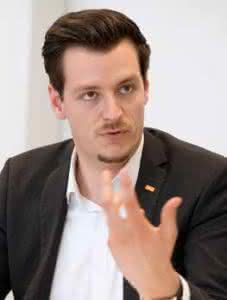
Werner Späth takes up the topic of modularity once again. With its 60 employees, FAB focuses on special solutions and scores points with its flat organization. "Of course, we also have our standard conveyor technology, but there are also cases where these modules no longer function optimally. As a small company, we can go much deeper into special solutions. Large companies are often far too slow to handle such projects. There is often a lack of interest. It's good for us that these modules don't cover everything, otherwise we smaller companies would have a problem," smiles Späth. "If we had to deal with container conveyor technology, overhead conveyors and e-commerce, the balancing act would be too great for us. That's why we are still pulling ourselves out of this modularity to some extent. We do our business with medium-sized customers with special requirements. The market there is relatively small - fortunately for us."
Lugauer agrees and reveals: "As a component manufacturer, we are still very much involved in such "neither fish nor fowl" projects because we also work with smaller system integrators and provide customized solutions. However, we do have an interest in ensuring that our components in the module business are well integrated into large-scale systems. Special solutions are notoriously complex to implement. Nobody can afford to reinvent the wheel every time. However, the customer wants a special solution at the price of a standard solution."
The pressure is on to go "live" faster and faster
"That's one aspect," interjects Große. "The other aspect is the implementation time." You always have to be "live" faster and always with a new solution. That's not really feasible.
According to Koch, the speed of implementation is leading to these standards being developed and brought to market. These modules need to be dimensioned in such a way that they retain their individuality, but fit into a large system as a building block. The industry solution and the special e-commerce solution would not exist anyway!
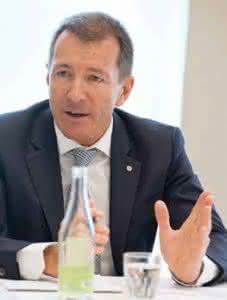
"Of course people like to go for standardized solutions," Möckli admits. "But there is a large market for engineered solutions and there is usually no competition in these projects. We invest around 10 to 12 percent of our turnover in research and development and hold numerous patents. Our strength lies in bringing this engineering to the customer." The time factor is not important. It is about optimizing processes. "In our experience, the customer is then prepared to wait perhaps two to three months longer," reports the Ferag CEO.
Conveyor technology of the future - where is the trend heading?
Are there innovations that stand out - the material flow editors want to know. "The innovation is in the system," Möckli sums it up. Große adds: "It's more details such as the decentralized control of conveyor technology components or the issue of reliability. In the past, one large motor drove the entire conveyor. If the motor failed, the system came to a standstill. Today, we try to break it down to individual components - keyword: motor roller." According to the product manager, there have also been leaps in the development of sensors and control systems. "The issue of infeed and outfeed is not insignificant. A lot has happened here in recent years."
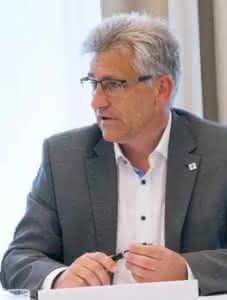
Schleicher confirms: "Today, it's more about innovations in the areas of IT, sensor technology and communication interfaces. The aim is to be able to integrate image processing systems, camera systems and the like as easily as possible and not have to write new software straight away."
"Users must have a certain affinity with the new media," Koch points out. "A company isn't just made up of young people who have all grown up with smartphones. In my experience, order pickers who used to work with pen and paper and were the best there suddenly dropped off at a picking station with screen support." Späth reports that the new technologies are not yet a reality everywhere. "This year, we received several inquiries for manual storage and retrieval machines because the customer wanted to extend their existing racking system by several aisles. However, the manufacturer no longer had these devices in its range and was unable to supply them."
Energy efficiency remains an issue
At the end of the discussion, there is the question of energy efficiency. The material flow editorial team wants to know: "Is this old hat or are manufacturers being actively approached about it?"
Möckli can confirm that there is still a high level of attention for this: "Energy tends to become more expensive. Energy efficiency plays a corresponding role for the investment in every tender. The energy consumption is offset against the amortization period. It's about the number of drives and also about compressed air consumption. The customer pays a lot of attention to this and if you can offer an energy-efficient system, you certainly have an advantage." Koch adds another aspect: "You should keep the energy that is ultimately wasted as low as possible and feed back braking energy, for example. Renewable energies and their appropriate use are also on the agenda. And you can only do that if you have the right IT systems."
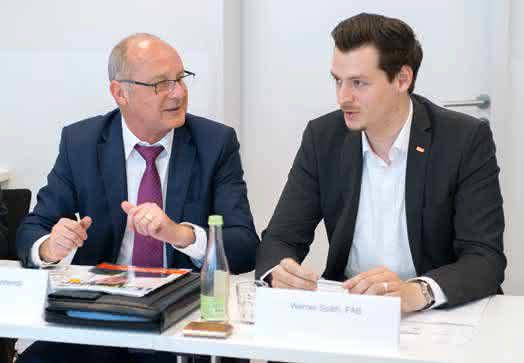
Schleicher also confirms: "If energy efficiency wasn't such a big issue, we wouldn't have been able to get 24-volt technology through so quickly. We have been tilting at windmills for a long time. If 24-volt technology manages with 35 watts and 400-volt technology consumes 120 watts, then that's an argument that no one can ignore."
Späth has the final word: "I think it will also give us a qualitative edge if we take a step forward with the 24-volt motorized roller or 48-volt pallet conveyor technology. This is definitely a very important topic and will remain so in the coming years.
Walter Dorsch


You might also be interested in
Winner material flow PRODUCTS OF THE YEAR 2023
Conductix-Wampfler: ChargeLine 0865
Two-pole conductor rail segments for efficient opportunity charging of shuttles, suitable for thousands of cycles per day.
 read more...
Hermann Grewer celebrates his 80th birthday
Hermann Grewer, Honorary Chairman of the North Rhine-Westphalia Transport and Logistics Association (VVWL) and Honorary President of the German Road Haulage, Logistics and Disposal Association (BGL), celebrated his 80th birthday on June 6.
read more...Well chilled for sure
V-Zug Kühltechnik AG, developer and manufacturer of refrigeration appliances and part of the successful V-Zug Group, has set up a new production facility for refrigerators of all heights and dimensions at its Swiss site in Sulgen.
read more...Advantageous automation of small parts warehouses
The RSX1 shuttle system will be at the center of Rocketsolution's presence at this year's Logimat trade fair.
read more...Reduced energy requirements in the high-bay warehouse
One of Germany's leading premium car manufacturers is already focusing on energy efficiency in the production of its new SUV model with electric drive. The storage and retrieval machines in a high-bay warehouse at the production site have been...
read more...Low lift pallet truck for light duty applications
Clark has launched a new low lift pallet truck with the model designation LWio15 for light transport tasks. The truck has a load capacity of 1500 kg and is suitable for short distances in goods distribution, production or warehousing.
read more...Internationalization as an opportunity
E-commerce is in a state of flux. Changes in purchasing behavior and procurement problems are keeping e-commerce retailers busy. Logistics plays a decisive role in the overall online shopping experience.
read more...Fulfillment Center for Frisco.pl
Polish eGrocery specialist and TGW deepen partnership
TGW is building a highly automated fulfillment center for Frisco.pl in the Polish capital Warsaw. This is the second project in a row that the two companies have implemented together.
read more...Which world will it be in 2023?
Michael Schreckenberg teaches at the University of Duisburg-Essen as Professor of Physics of Transport and Traffic. Once a year, he addresses the readers of materialfluss, formerly LT-manager, with a critical and humorous expert article on transport...
read more...