

HaRo technology in use
Full automation for increasing demand
Rapidly growing production figures require a rethink of manufacturing processes: With a fully automated and flexibly expandable conveyor system for truck loading, a Leipzig-based manufacturer of battery systems for the electric car industry is meeting the growing demand.
For many car manufacturers, 2030 will be the year in which the combustion engine is finally phased out and the focus will be exclusively on the sale of purely electric vehicles. In order to meet the current steadily growing demand for electric models, battery manufacturing companies in particular will be forced to expand their capacities and ensure continuous production. It is therefore more important than ever to automate internal material flows in order to guarantee safety, flexibility and quality in the long term. Not least in view of the fact that the majority of all automotive suppliers deliver "just in time" and production parts must be ready for delivery within a few minutes.
Around 1.5 years ago, the electromobility supplier approached the conveyor technology manufacturer HaRo Anlagen- und Fördertechnik from the Sauerland region with this request. In its inquiry, the company had already specifically defined the requirements for the new conveyor system: An interface is to be installed from production for onward transportation to the car manufacturer's final assembly line for transporting and storing steel pallets for the battery cells. With a maximum total weight of 21 tons, another special feature of the project is the load of the conveyed goods. Up to four pallets, each with a filling weight of one ton, are to be stacked on top of each other in the system.
Individual specifications
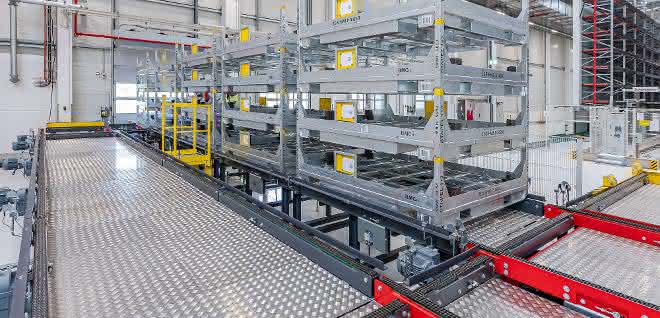
The Rüthen-based family business was ultimately able to meet these requirements with a comprehensive concept, as HaRo Group Design Manager Markus Löseke explains: "For our customer, we designed a system consisting of triplex heavy-duty chain conveyors and vertical conveyors with a hydraulic pallet stacking function. This combination, which was manufactured according to the individual specifications of the battery cell manufacturer, enables a fully automated material flow from production through to loading the truck: first, the battery-loaded steel pallets are loaded onto the triplex chain conveyor in front of the stacker using an automated guided vehicle (AGV). The hydraulic rack stacker, equipped with a double-strand triplex chain conveyor, enables up to four steel pallets to be stacked. Once the stacking process is complete, the four pallets are transported fully automatically along the approximately 22-metre-long conveyor to the truck transfer point. "The conveyor line consists of chain conveyors with particularly robust triplex chains that can easily withstand the high load of up to 5 pallet stacks with a total weight of 21 tons," says Markus Löseke from HaRo. In addition, the motors of the chain conveyors are equipped with frequency inverters, which can be used to individually adjust the transport speed of the steel pallets. "This ensures smooth, even and safe conveying," emphasizes the HaRo design manager.
At the end of the conveyor section, the pallet blocks are then automatically transferred to the truck loading bridge: With the help of the chain conveyors, the conveyed goods are moved smoothly into the truck trailer for onward transportation. "Here too, the conveyor speed is adapted to the speed of the conveyors in the truck trailer thanks to the frequency converters," says HaRo. However, it is not only the loading of the trucks that is carried out in the same way as described; the unloading of the empty pallets is also identical. Before being reloaded, the empty pallets are transferred fully automatically from the trailer to the parallel second conveyor line, which is connected via corner transfers, and run through the parallel path to the stacking point, where the steel pallets are then picked up by the AGV and transported back to production.
In view of the constantly growing demand for battery cells for electromobility, a smooth and reliable production process is a top priority for the Leipzig-based supplier. In order to be able to completely rule out a production stop, both conveyor lines are each equipped with two emergency organization stations for forklift trucks. "If the AGV should ever fail, the pallets can also be loaded manually with a forklift in an emergency," explains Markus Löseke about the background to the dual loading option. And should one of the two systems fail completely, both conveyor lines can operate in reverse mode and be used for both loading and unloading the trucks. If the batteries are not available at the car manufacturer in time, production comes to a standstill.
Process data is exchanged
In addition to preventing downtime in the age of Industry 4.0 and increasing digitalization, intelligent networking is also a top priority in this project. The system's process data, such as the system status or any error messages, are exchanged at any time via OPC UA. Light barriers, safety fences and personnel recognition also ensure maximum safety for employees.
While the system described has already been in use for almost a year, the automotive supplier is already planning to expand its existing systems, making use of an intelligent concept from the HaRo Group: thanks to the modular system, the systems from the Rüthen-based conveyor technology manufacturer can be flexibly expanded. An option that is currently more important than ever, especially for suppliers of electromobility. And so the Leipzig-based company is already in contact with the HaRo Group to implement a further chain conveyor system in order to maintain on-time delivery capability even during expected peak production figures and meet growing demand.
The article appeared in materialfluss 10/22.


You might also be interested in
Outdoor AGV networks production and logistics
An international company in the plastics industry is automating its intralogistics at its German site with a solution from ek robotics. A specially developed vehicle model from the Out Move series, an outdoor AGV, is being used.
 read more...
Transport systems for automated material flow
The Leo transporters from Bito make it easier for users to get started with the automation of material processes, which is possible from 20,000 euros. The system is a flexible all-in-one complete solution that is ready for immediate use and can be...
read more...Automated logistics for the university hospital
As part of the new construction of the University Hospital of Reims (CHU), France, the hospital has taken a number of steps to improve the needs of its patients and the working environment of its employees.
read more...K.Hartwall: Topping-out ceremony for the German site
The topping-out wreath was raised at the new building in the TIP Innovationspark Nordheide in Buchholz near Hamburg on February 27: The new K.Hartwall plant will comprise approx. 3,500 m² of hall space and around 2,000 m² of office and social areas.
read more...Noerpel Group tests driverless high lift trucks
The Noerpel Group has tested driverless pallet trucks in one of its two logistics facilities in Giengen. During a four-week trial, two autonomous systems were used to transport goods within the warehouse.
read more...Supply and disposal of printing machines by AGV
Numerous companies rely on AGVs in intralogistics to increase efficiency and meet challenges such as the shortage of skilled workers. One such company is GGP Media GmbH in Pößneck, Thuringia.
read more...Sophisticated automation: AGV and cobot combined
On behalf of Krefeld-based Saurer Technologies, the engineering team from Project Automation & Consulting developed a solution for production logistics that combines AGVs and cobots.
read more..."Herbie" robot in the Körber portfolio
Carrybots, a specialist in mobile robotics, is a new partner in the Körber supply chain ecosystem. The aim of this collaboration is to strengthen the position of both companies in intralogistics. Herbie" enables robot-based goods-to-person processes.
read more...Demand-oriented load carrier transport
Efficient logistics with AGVs
Environmental awareness and the careful use of resources are becoming increasingly important. With advanced solutions, plant operators can significantly improve the ecological footprint of logistics processes.
read more...