

Interview with the new Vanderlande CEO
"It feels good to be back home"
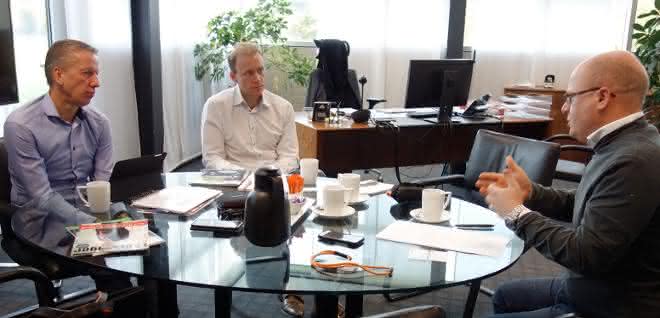
Since September 1, the German branch of the intralogistics company Vanderlande has a new boss: Markus Ehrmann has taken over from Matthias Kramm. materialfluss met Ehrmann, General Manager Customer Center Germany and Terry Verkuijlen, Execute Vice President Warehousing and Parcel, in Mönchengladbach for the first interview.
materialfluss: Mr. Ehrmann, you have worked in the Automotive, Aviation and General Industry segments and are now new to intralogistics. How were your first few weeks in your new role?
Markus Ehrmann: Very exciting, positively exciting. I'm enthusiastic about the corporate culture at Vanderlande, I've met very nice colleagues and the cooperation is very good. That applies both here in Mönchengladbach and beyond. The view of the customers and the dynamics of the industry is also very impressive, it's a different world to automotive, where the battles are much tougher. In intralogistics, there is more talk of dynamic growth and a very positive outlook for the future.
mfl: Less hardball means?
Ehrmann: People are more open, come to joint results quickly and want to implement them quickly. You notice that in the negotiations.
mfl: How does it feel to be working in Germany again?
Ehrmann: Very good, I really enjoyed my time in America, but the travel times are much shorter here. Here I can easily get on a plane in the morning and sit in a meeting at lunchtime, which is not really possible in the USA. It feels good to be back home. My wife and I wanted to return to Germany so that our children could grow up here. When the opportunity arose at Vanderlande - you can't plan something like that - I grabbed it, so to speak(smiles).
mfl: What about your specialist knowledge? Do you already know the difference between a shuttle and an SRM?
Ehrmann: I've seen both before(laughs) and of course I already know the difference. I am constantly working on expanding my specialist knowledge and have been able to visit some of the systems implemented at our customers. Of course, I have also visited our Group's own supply centers where we manufacture our products. I want to get to know the product first hand.
mfl: And then there's specialist literature in the evening?
Ehrmann: Yes, I've stocked up on that(laughs). My favorite thing is the product data sheets, and it's even better when they're explained to me.
mfl: Mr. Verkuijlen, you've been with Vanderlande considerably longer, 22 years. The technological change in all those years must be impressive...
Terry Verkuijlen: Yes, there is a huge difference in technology, but also in the size of the projects. When I started, projects with one to three million euros were major projects, today we are talking about ten million and more. The proportion of software has become much larger since then, which also makes a big difference compared to back then. But even the hardware can still be pushed to its physical limits (smiles).
mfl: How are the tasks divided between the two of you?
Verkuijlen: In 2009, Vanderlande's organizational structure was fundamentally changed. Previously, we were regionally oriented and it was very difficult to find a common strategy. This was no longer compatible with the company's growth. Two business units were established, both of which have customer contact: Airports, which accounted for two thirds of our turnover ten years ago, and Warehousing & Parcel. In recent years, we have grown so strongly in the Warehousing & Parcel division that turnover is now split three ways between Airports, Warehousing and Parcel. This does not mean that the Airports division has lost out, but that the growth in the other two divisions has been so enormous. I am responsible for all customer contacts in Warehousing & Parcel, i.e. sales, implementation and project services. The business units are divided into four customer centers. One of these is the GmbH, which is responsible for all predominantly German-speaking customers. One is in Spain, which also looks after Latin America, one in North America and an International Customer Center in Veghel, which looks after the rest.
mfl: How do you organize the key account business?
Verkuijlen: Customers such as Zalando, Amazon, DHL and UPS are looked after by the customer center closest to the company's headquarters.
mfl: So far you have not mentioned your parent company Toyota. How does it come into the structure?
Verkuijlen: There is actually no "Toyota" in this structure. We were taken over last year, but our strategy, our structure and our management board have not changed. Toyota gives us the freedom we need to continue to drive growth and profit. The influence of Japan is very limited. However, we are seeing more and more AGVs in our plants that we did not have in our portfolio, but which now come from Toyota. We are exploiting these synergies. Toyota accepts our more than 70 years of experience in the field of intralogistics.
mfl: Does a Toyota forklift or AGV necessarily have to drive around in the systems?
Verkuijlen: No, that is decided on a case-by-case basis.
Ehrmann: The software also has to match the hardware, of course there are solutions where a Toyota truck is more suitable.
mfl: So you develop together at the software interfaces?
Verkuijlen: Yes, that is already happening. In battery technology, for example, Toyota is much further ahead than Vanderlande. After the past year and a half, we can say that the collaboration is going perfectly. The takeover by Toyota was much better for Vanderlande than possibly by an investor who only wants a return and has no know-how.
Ehrmann: The cooperation is also evident in the investments. There is a willingness to put more money into research and development. Or, for example, to expand the site here.
mfl: What is your roadmap for 2019?
Ehrmann: We want to further intensify our collaboration with existing customers and maintain these partnerships. The 2020 financial year, which starts for us in April 2019, will bring many interesting projects. We will develop slightly positively in the German-speaking area.
Verkuijlen: We grew very strongly last year. My goal now is stability to take a deep breath. But the market won't allow that, as our existing customers are pushing ahead with so many projects. We can't say no to that. The next year therefore looks very positive.
mfl: What does that mean in figures?
Verkuijlen: Between ten and 15 percent.
mfl: Many industries would be very envious ...
Verkuijlen: Yes, even though we often have to turn down orders. Our growth is limited because we can't find enough experienced employees. Ten to 15 percent growth is still acceptable. But if we were to exceed that, we would have to take on so many new employees that the quality would possibly drop.
Ehrmann: Vanderlande stands for high quality. Maintaining this in the growth phase is a difficult balance. In addition to the new projects, the biggest task is to distribute the knowledge among the employees. It would be nice to do more projects, but it is not feasible.
mfl: Would that be possible via acquisitions?
Verkuijlen: No, because the company you would acquire would also be working at full capacity. Just consolidating turnover - what would that achieve? We only make acquisitions if we could develop the products one step further. Just to generate turnover? No.
Ehrmann: The pocket sorter is a good example. We bought it from a small company in Bielefeld, which we acquired and are now integrating. It makes sense to multiply this niche product in our sales channels. The bag sorter is important in the fashion sector, and we want to be attractive for our customers here too.
mfl: Are there any other areas that would be suitable for acquisition?
Ehrmann: We have already invested in a start-up in the robotics sector. The topic of robotics is becoming increasingly important, if only because of the shortage of personnel. Automation is the answer here. For people, it is more attractive to have complex tasks than balancing packets of pasta from left to right.
mfl: Before we drift off into philosophy, let me come back to the segments. What more can you do in the segments in which Vanderlande is active?
Verkuijlen: In the warehousing sector, it's the food, retail, fashion and e-commerce segments. In parcel services, the large market players. Just look at Amazon and Zalando: They will soon need a new warehouse every month! And there are no signs that this could change any time soon. Airports, warehousing and parcel have different business cycles. For airports, an economic crisis or the signs that one could be coming would only have an impact on investments after three or four years, whereas in the e-commerce or parcel sector, it would have an immediate impact. Warehousing is somewhere in between. This gives us the advantage that economic cycles hardly affect our business. However, our existing customers should not account for more than twenty or thirty percent of our turnover, otherwise we become too dependent. On the other hand, this share helps us to balance everything out. We were hardly affected by the crisis in 2008 and 2009.
mfl: Is this independence also given in the area of territories? What does it mean for Vanderlande if growth slows down in Germany, for example?
Verkuijlen: It all balances out.
mfl: Is the crisis being talked up in Germany?
Ehrmann: We don't see that, I was with a customer just a few days ago who wants to double in the next five years. The customer currently makes four to five billion euros with fashion - and they want to double that. They need capacity for this. We don't see any flattening out in our segments.
mfl: How is turnover developing in the service and maintenance sector?
Verkuijlen: We are also growing strongly here, very strongly in fact. What is shifting is the proportion of traditional maintenance towards process optimization.
Ehrmann: We are currently setting up a team in Mönchengladbach that will work in the area of process engineering and data mining. The task is to go into existing plants, use smart data mining to identify issues and increase output. The systems are usually technically available, but the performance is often suboptimal. This topic is in high demand and we are gearing up for it.
mfl: Do you see a trend towards getting people out of the warehouse completely and replacing them with automation?
Verkuijlen: There is a trend to reduce the number of employees in the warehouse as much as possible. I don't think we'll see a reduction to zero in the next ten to 15 years. Technology is developing rapidly, but is not yet at the level where we can send everyone home. That won't happen any time soon.
mfl: Why?
Verkuijlen: The products in e-commerce are so different that people are needed to handle them. What we are seeing more and more is collaboration between humans and robots. Finding employees in the warehouse is difficult. So if you want to grow as a company, you almost inevitably have to look for a solution in automation. At the moment, you can only achieve full automation in the production sector.
Ehrmann: There is a lot of potential in human/robot collaboration. A human can virtually monitor four or five cobots and delegate standard order picking to them, only intervening in the more difficult cases.
mfl: What are you planning for LogiMAT?
Verkuijlen: The big topic will be robotics. At our Smart Item Robot stand, we will be showing an exhibit in which several cobots are used side by side. And also a variant of our Adapto system in conjunction with a workstation. Our tray sorter will also be on display at the Toyota stand.
mfl: Space for exhibitors is limited in Stuttgart ...
Verkuijlen: Yes. And what's more, technology is developing fast, but not as fast as the next LogiMAT is always just around the corner.
Ehrmann: We are not the industry that can show a new iPhone every year(laughs). Nevertheless, LogiMAT is our most important trade fair.
Verkuijlen: I still dare to say that one LogiMAT every two years would be enough. We like to see our existing customers at the trade fair, but if we needed the trade fair for new projects or new customers, we would be doing something wrong. The added value on site is limited for us.
mfl: Has that been the case for some time?
Verkuijlen: Yes. If I have to receive a new inquiry from a contact at LogiMAT, my sales force would not have worked well in advance.
Ehrmann: As I said, we work closely with our existing customers, so there are few surprises in this area at a trade fair.
mfl: Gentlemen, thank you for the interview.
Martin Schrüfer spoke to Markus Ehrmann and Terry Verkuijlen at Vanderlande's Customer Center in Mönchengladbach.


You might also be interested in
Outdoor AGV networks production and logistics
An international company in the plastics industry is automating its intralogistics at its German site with a solution from ek robotics. A specially developed vehicle model from the Out Move series, an outdoor AGV, is being used.
 read more...
Transport systems for automated material flow
The Leo transporters from Bito make it easier for users to get started with the automation of material processes, which is possible from 20,000 euros. The system is a flexible all-in-one complete solution that is ready for immediate use and can be...
read more...Automated logistics for the university hospital
As part of the new construction of the University Hospital of Reims (CHU), France, the hospital has taken a number of steps to improve the needs of its patients and the working environment of its employees.
read more...K.Hartwall: Topping-out ceremony for the German site
The topping-out wreath was raised at the new building in the TIP Innovationspark Nordheide in Buchholz near Hamburg on February 27: The new K.Hartwall plant will comprise approx. 3,500 m² of hall space and around 2,000 m² of office and social areas.
read more...Noerpel Group tests driverless high lift trucks
The Noerpel Group has tested driverless pallet trucks in one of its two logistics facilities in Giengen. During a four-week trial, two autonomous systems were used to transport goods within the warehouse.
read more...Supply and disposal of printing machines by AGV
Numerous companies rely on AGVs in intralogistics to increase efficiency and meet challenges such as the shortage of skilled workers. One such company is GGP Media GmbH in Pößneck, Thuringia.
read more...Sophisticated automation: AGV and cobot combined
On behalf of Krefeld-based Saurer Technologies, the engineering team from Project Automation & Consulting developed a solution for production logistics that combines AGVs and cobots.
read more..."Herbie" robot in the Körber portfolio
Carrybots, a specialist in mobile robotics, is a new partner in the Körber supply chain ecosystem. The aim of this collaboration is to strengthen the position of both companies in intralogistics. Herbie" enables robot-based goods-to-person processes.
read more...Demand-oriented load carrier transport
Efficient logistics with AGVs
Environmental awareness and the careful use of resources are becoming increasingly important. With advanced solutions, plant operators can significantly improve the ecological footprint of logistics processes.
read more...