

From materialfluss 10/2019
Recognize loads with barcodes from a distance
Linking barcode loads with RFID pallets: This makes load carriers reliably identifiable, even if they are not visually accessible.
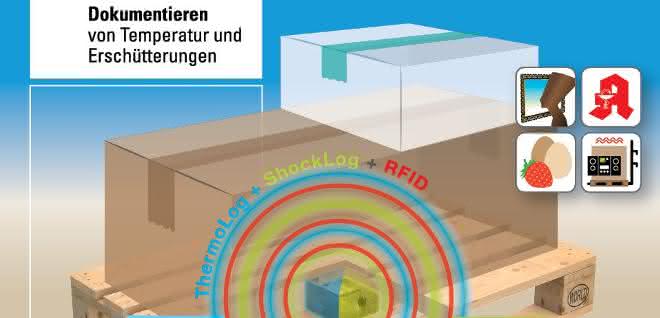
Barcodes can be found on all products, outer packaging and load carriers. They set the communication standard for controlling logistics and are present everywhere. These inexpensive codes can be read reliably - however, a visual connection must be possible. In addition, the amount of information they contain is limited and it is not possible to write new information on them.
In practical use, it would be advantageous to provide load carriers with additional information during the logistics chain, for example data on intermediate logistics stations (tracking), the recording of temperature curves or the registration of transport vibrations, damage and manipulation. It should also be possible to document the position of individual load carriers and loads on the vehicles, during handling or in the warehouse. The localization of loads from a distance and without a visual connection would facilitate rapid access. Another requirement is to be able to identify entire loads as they approach the logistics station or warehouse.
How can such requirements be met? How can users continue to benefit from the advantages of barcode technology and keep the necessary organizational changes and financial outlay within limits? Supplementary requirements have long been realized with RFID technology. Until now, the hardware costs for equipping loads with transponders and the necessary permanently installed communication equipment were expensive. Cheaper solutions are now available. The loads are no longer individually equipped with transponders. Instead, users can now access RFID Euro pallets that circulate in their own logistics cycle. Handheld devices and smartphones are used to communicate with the company's own warehouse management system.
They communicate between pallet transponders and operational systems and synchronize: during pallet loading and entry into the warehouse, during preparation for shipping and loading, at the transport stations, at the recipient's entrance and during storage and pallet unloading. In addition to barcode-based information on load details, RFID transponders can be used to record and synchronize data from the logistics stations and, if necessary, temperature profiles and vibration events during transport.
Targeted use for greater efficiency
In specific practical cases, it can be advantageous to install RFID-based systems in addition to existing barcode systems. For example, to be able to localize and identify pallet loads on the vehicle, at the ramp, during interim storage or in the hub quickly and without line of sight. Another case: recording the complete logistics process of each pallet electronically in the sense of shipment tracking; here, all processes, including any transport problems, can be documented directly and tamper-proof. Another application for both systems is to identify vehicle loads simultaneously, quickly and "through the tarpaulin" - without optical scanning of the individual load carriers. This means that unloading processes can be organized more quickly in the run-up to the ramp.
The combined use is also advantageous for determining the actual load temperatures in temperature-controlled logistics, for example for food and pharmaceuticals. Tracking the logistics process is also advantageous as proof of excessive shocks when transporting fragile and sensitive goods such as electronics, glass or works of art. These measures can either be set up for all shipments - for one hundred percent proof of compliance with regulations - or for the test-based identification of defects with subsequent optimization of processes.
RFID pallets are easy to handle in the cycle
Transponders cost money, so RFID pallets should not go into the general Euro pallet pool, but remain in the company's own pool. This is not a problem for intensively used logistics relationships; the unloaded RFID pallet can also be easily identified in the stack using a handheld device or a suitably equipped smartphone. Conversely, the RFID pallet fully complies with the applicable regulations for Euro pallets. The RFID transponder is not visually recognizable.


You might also be interested in
Datalogic: Gryphon GD4600 Series
High performance 2D handheld scanner
The Gryphon GD4600 series from Datalogic offers professional 2D handheld scanners for retail, industry, logistics and healthcare.
 read more...
Intelligent Kanban solution thanks to RFID
Kanban systems make everyday production easier - Otto Roth showed what this looks like in concrete terms at Logimat in Stuttgart. The C-parts management expert presented its wide range of products.
read more...When the manhole cover recognizes the car
Tönnjes and Kathrein develop the ID e-reader Inroad with integrated RFID technology.
read more...CCL Faubel shows applications of smart labels
Paper labels can only represent one status of a container or storage bin. Every change in status requires a new label. CCL Faubel will be demonstrating at Logimat 2024 how this time-consuming process of manual replacement can be replaced.
read more...Secure keys for automated intralogistics processes
Euchner's new CKS2 key system promises significantly simplified handling to safely start or stop dangerous machine movements.
read more...Identification technology and RFID
Networked container terminals: 5G campus networks for Eurogate
Deutsche Telekom is equipping port terminals in Hamburg, Bremerhaven and Wilhelmshaven with local 5G networks by spring 2024.
read more...Cooperation for load carriers
The Munich-based family business Baumann Paletten will be working with Logistics Arts on the digital development of EUR load carriers in future
read more...Winner material flow PRODUCTS OF THE YEAR 2023
IPP: RUDi - innovative returnable display for the POS
Every year, around 30 million disposable displays are placed on the market in the D-A-CH region. The majority of these displays are constructed on quarter pallets or dollies, the rest are purely disposable constructions.
read more...Battery-free and cloud-based
Faubel has launched battery-free smart labels that work via a cloud application.
read more...