

Hubtex and Intis launch an inductive charging system
The future of AGV solutions lies in energy management
The efficient use of Automated Guided Vehicles (AGV) in intralogistics is largely dependent on the charging technology. The aim is to keep the energy supply of the vehicles cost and time efficient and to maximize the internal material flow. Hubtex therefore relies on a partnership with Intis.
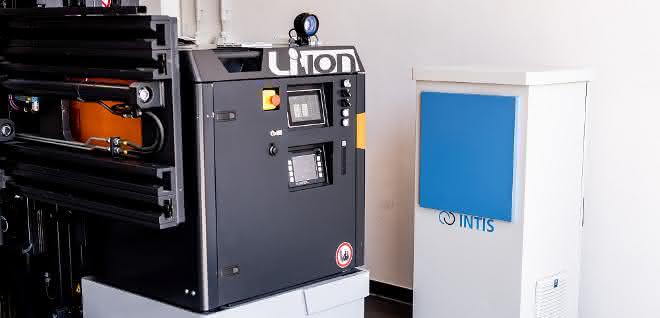
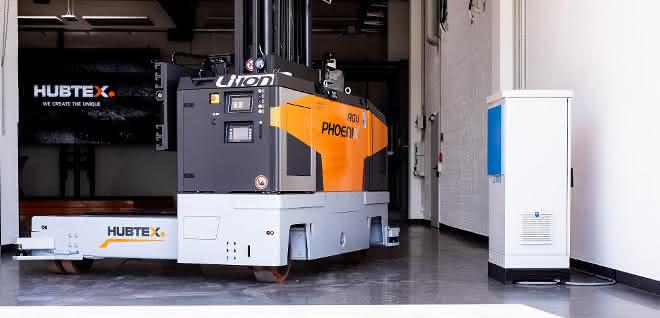
With the PhoeniX AGV, Hubtex has introduced the world's first fully automated electric multidirectional sideloader for handling long, heavy and bulky goods. With the inductive charging system from Intis, the vehicle can be charged with a 48V lithium-ion battery with a charging current of 400A without contact and without cables. The concept is transferable to all Hubtex vehicles with electric drive.
Energy management moves into focus
Due to the continuously growing requirements in intralogistics, energy management is becoming increasingly important in order to achieve time and cost savings. For a maximally economical AGV solution, it is important to determine the optimum charging system.
From Hubtex's perspective, stationary charging has disadvantages in terms of costs and space in the long term: manual charging is the most cost-effective solution, but is also dependent on the reliability of employees. With an exchangeable battery, users benefit from a shorter dwell time of the vehicles when changing the battery, but require a corresponding changing infrastructure and personnel. Although an automatic battery changing station can reduce the number of vehicles required in many cases, it must also be taken into account in the design.
Inductive charging system delivers maximum performance
For Hubtex, inductive battery charging for AGVs therefore makes the most sense: charging pads on the vehicle automatically interact with charging plates on the floor or on the walls as soon as the vehicle is positioned accordingly. "Together with Intis, as a specialist in inductive charging technology, we are focusing on a fully autonomous overall concept, which we believe works best with a combination of lithium-ion batteries and an inductive battery charging system," says Michael Röbig, energy management expert at Hubtex.
"In the past, maximum charging performance was mainly achieved with wired chargers," says Röbig. "What's new now are inductive fast charging systems, which ensure a fast charging time and therefore high device availability thanks to the high charging currents."
The compact charging station can be conveniently placed in the respective warehouse or production area; for example, production-related waiting times can be used for charging. The user can access data such as capacity, status and charging time at any time. Inductive charging is maintenance-free, resistant to vandalism and saves resources thanks to the smaller lithium-ion batteries. It also reduces the cost of supplying energy to the charging stations.


You might also be interested in
New low lift pallet truck with lithium-ion technology
Clark presents a completely newly developed electric pallet truck with lithium-ion technology (Li-Ion).
 read more...
material flow PRODUCT OF THE YEAR 2024
Category 3: Conductix-Wampfler - ContactCharger
The KontaktCharger is the solution for efficient and economical conductive charging of lithium-ion vehicle batteries in intralogistics.
read more...ReachStacker with hydrogen fuel cell
Hyster, a provider of container handling solutions, has delivered a reach stacker with a hydrogen fuel cell to the Port of Valencia in Spain. It is part of the H2Ports project. The aim of H2Ports is to introduce hydrogen-powered vehicles and...
read more...Material flow in pure culture
Electromobility is booming and the demand for batteries is greater than ever. In order to serve this market, more and more battery plants are currently being built in Europe. Mobile systems from SEW-Eurodrive are being used in the new plant of a...
read more...Winner material flow PRODUCTS OF THE YEAR 2023
Wagner Group: Fire protection solution for the storage of lithium-ion batteries at Kettler Alu-Rad
For the fully automated high-bay warehouse at the new production site, in which up to 50,000 e-bikes can be packed ready for dispatch and stored with installed batteries, Wagner implemented a customized fire protection solution that reduces the risk...
read more...Winner material flow PRODUCTS OF THE YEAR 2023
Conductix-Wampfler: ChargeLine 0865
Two-pole conductor rail segments for efficient opportunity charging of shuttles, suitable for thousands of cycles per day.
read more...Intelligent charging with solar energy
Charge industrial trucks with solar power and optimize your own consumption? This is now possible with a new function in the Charge & Connect portal from Fronius Perfect Charging.
read more...Paper manufacturer with innovative production logistics
Paper manufacturer Franz Veit has made its intralogistics operations much more efficient with the help of Linde Material Handling and Ernst Müller Fördertechnik.
read more...Battery logistics and more
Alfred Schuon presented its portfolio of transport and contract logistics services at Transport Logistic. The focus was also on the company's expertise in battery logistics.
read more...